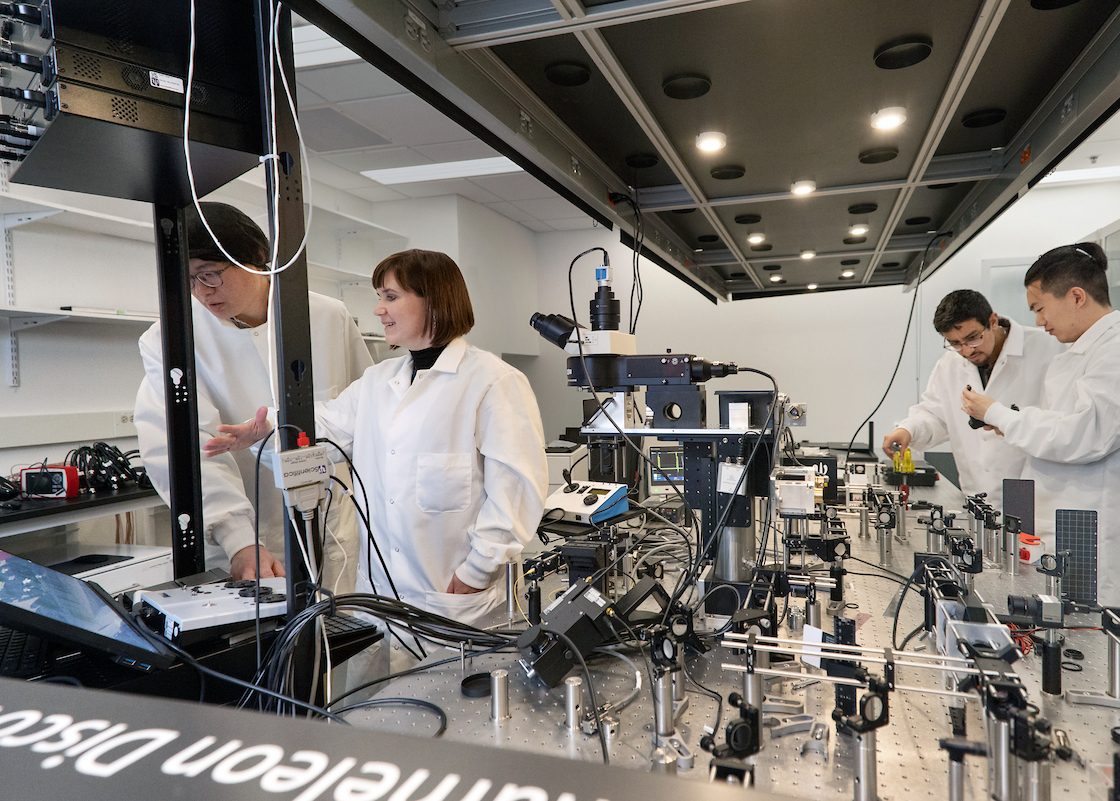
Researchers observe fruit fly larvae brains by recording neural activity as the larvae navigate their environment. Working with Assistant Professor Mirna Mihovilovic Skanata (second from left) are graduate students Seongjin Park (at left) Derick Ramos and Yiming Xu. (Photo by Jeremy Brinn)
4 Faculty Earn Prestigious NSF Early CAREER Awards
Four faculty members in the early stages of their research careers have earned recognition and funding from the National Science Foundation (NSF) this year through its Early CAREER award program.
The CAREER program is among the most prestigious awards NSF offers. It supports early-career faculty who show promise as both researchers and teachers and who weave education into their scientific work.
“CAREER awards are among the most competitive NSF offers, and they give a researcher’s work real momentum at a pivotal stage,” says Duncan Brown, vice president for research. “They tell the national scientific community that innovative work is happening here, and because the program values teaching as much as discovery, students can be confident they’re learning from faculty at the leading edge of their fields. Earning four awards in a single year speaks to the caliber of faculty joining, and at, Syracuse—and to what our students gain from learning alongside them.”
Receiving awards this year are:
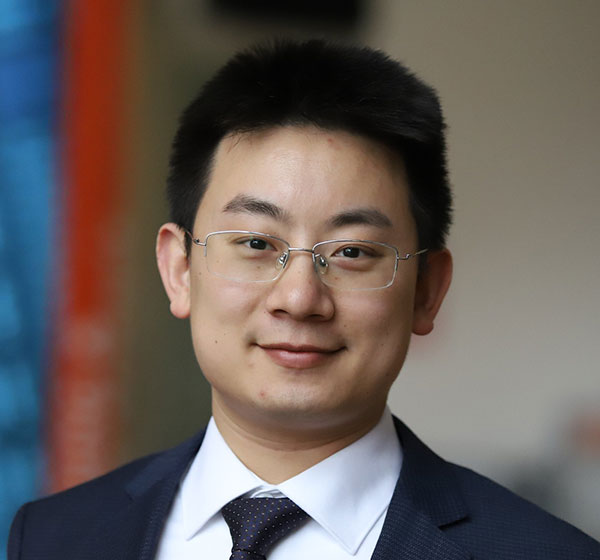
Zhenyu Gan, assistant professor of mechanical and aerospace engineering in the College of Engineering and Computer Science ($611,222)
Gan received the grant for his project “A Systematic Framework for Morphological Adaptation and Control of Transformable Legged Robots.” Most robots have a fixed shape; Gan is building one that doesn’t. His legged robot can change its own body—adjusting leg length, posture or shape—to walk, jump, crawl or carry a load. His work develops the math and controls that let a machine reshape itself as the task changes, with possible uses in search and rescue, disaster response and space exploration.
The award also builds a robotics pipeline for students at every stage: middle schoolers will program small four-legged robots, high schoolers will take on a self-driving racecar challenge, and Syracuse undergraduates will help teach them and carry the research into the classroom.
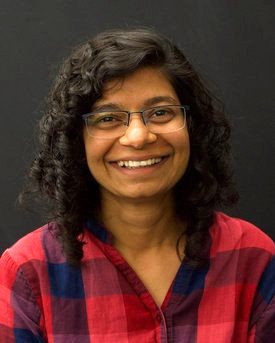
Nidhi Pashine, assistant professor of physics in the College of Arts and Sciences (A&S) ($770,516).
Pashine received funding for “Adaptability of Soft Deformable Granular Materials.” She studies granular materials—think sand or a bag of beads—but with a twist: her particles can bend, grip and change their size, shape and stiffness. Using custom-built robotic particles, she traces how the behavior of single grains adds up to how the whole material acts—whether it flows or holds firm. The goal is “programmable” matter that can be tuned to respond in specific ways.
Her project also brings physics to a wider audience. With a Syracuse colleague in mathematics and education, she is designing an algebra-based “meaningful physics” course for non-majors that ties the material to students’ everyday lives.
Undergraduate researchers will build interactive demonstrations in her lab that then travel to K-12 classrooms, creating a chain of hands-on science engagement.
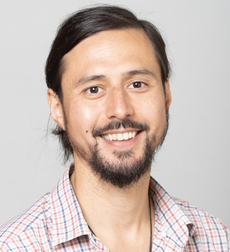
Josh Pollitz, assistant professor of mathematics in A&S ($400,000)
Pollitz received the funds for his project “Applications of Koszul Duality to Local Algebra.” He works in areas of mathematics that study number-like systems called rings and the patterns in how their parts fit together. He focuses on rings with “singularities”—points where the structure turns irregular and is hard to pin down.
His main tool is Koszul duality, which recasts a hard problem in a friendlier setting to tame calculations that would otherwise run on forever. Teaching sits at the center of the award: Pollitz will run week-long masterclasses and immersive summer schools—modeled on European programs—that bring students and researchers together for intensive, hands-on work and build a wider community around the field.
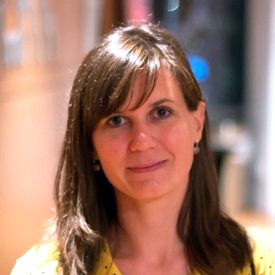
Mirna Mihovilovic Skanata, assistant professor of physics in A&S ($1,007,943).
Mihovilovic Skanata’s award advances her research on how a brain turns what it senses into what an animal does. Her model is the fruit fly larva, simple enough to study almost neuron by neuron. Her five-year project, Lessons From a Simple Brain, asks how neural circuits weigh competing signals and settle on a response.
Her interdisciplinary lab spans physics, neuroscience, engineering and computer science. The team builds its own instruments—including a microscope that follows a larva and records its brain activity as it moves freely—to watch the brain at work in real time.
The award also opens the lab to students. It funds an intensive “NeuroBootCamp,” a six-week summer research program for high schoolers run with the Syracuse City School District, and public science events such as “Ask a Scientist” at the Museum of Science & Technology.