Visualize a computer screen. A small circle drifts toward an image. It gets close, does some analysis, then pulls back. A moment later, it approaches again from another direction, then again backs off.
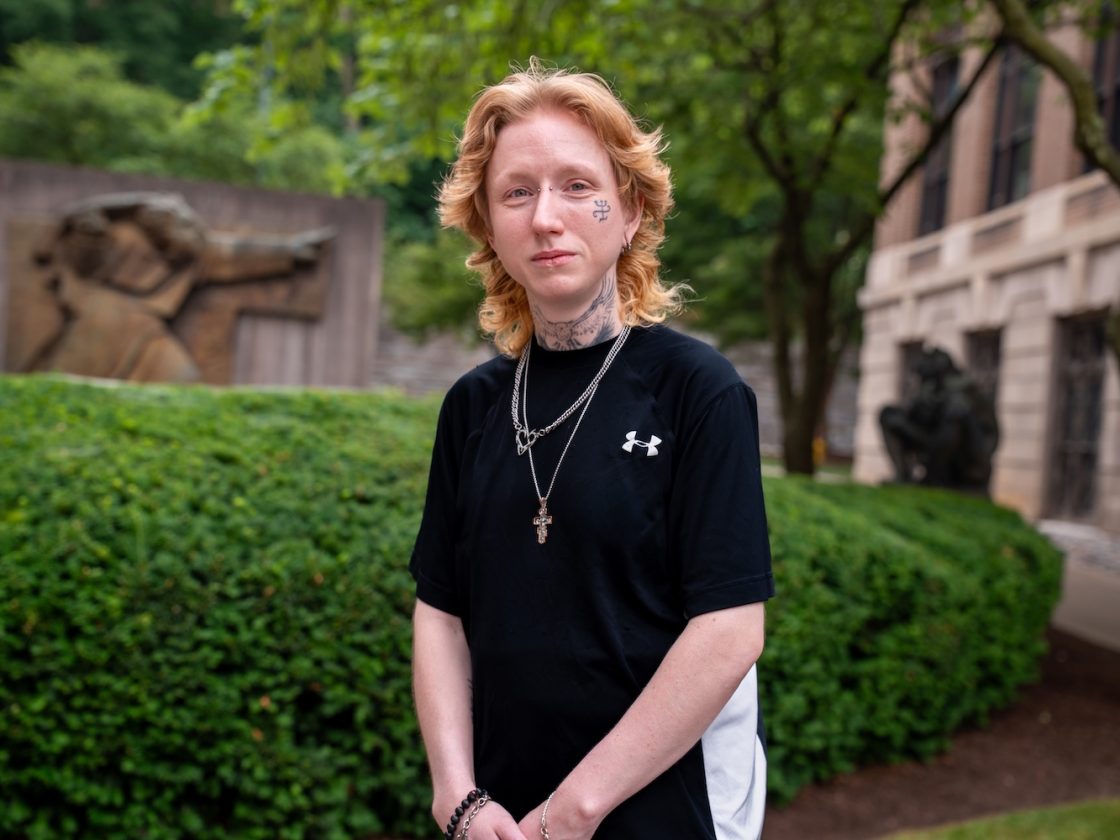
The circle is what Dio Brown ’28 calls the “emergent” or heart of Kairos, the artificial intelligence system the junior in the College of Engineering and Computer Science (ECS) has been developing.
Instead of feeding AI millions of images for it to recognize what, say, a cat is, Brown is testing whether the system, which she calls “a coherence-based framework for developmental perception,” can build understanding the way a child does: by exploring the world one small piece at a time to comprehend what is around them.
Brown is pursuing the work through support from the Patricia A. Wood, M.D., Ph.D., Spinoza Award, which funds undergraduate research exploring philosophical aspects of issues in the sciences or other professional disciplines. Offered through the Office of Undergraduate Research and Creative Engagement (The SOURCE), the award was established in collaboration with alumnus William Hrushesky ’69 and Samuel Gorovitz, professor emeritus of philosophy.
Recipients are selected from SOURCE’s Bridge and Fellowship applicant pool and complete an additional reflection essay exploring the philosophical questions raised by their work.
The Spinoza Award supported the first of what Brown imagines will be a three-phased project, and she presented what she’s found so far with Kairos at the SOURCE Symposium in August.
Teaching AI to Understand, Not Just Know

Today’s AI tools learn by analyzing enormous amounts of data. An AI trained on millions of cat photos can describe a cat in great detail, but Brown’s research rests on the argument that it doesn’t truly understand what a cat is. Computer scientists call this the symbol grounding problem: the gap between knowing facts about something and understanding it.
Brown believes this gap lies behind many of AI’s biggest flaws, including hallucinations, when a system confidently makes things up.
“We don’t typically hallucinate facts about things because we have an understanding of them,” Brown says. “Because we’ve developed an experiential understanding through time, which allows us great flexibility in our thinking.”
Kairos aims to tackle the problem by learning to see and grounding its understanding in what it observes, rather than being trained.
For the first phase, Brown placed the Emergent in a two-dimensional world she calls an Umwelt, where it can sense and act on its own. If an object is too complex to make sense of, the circle retreats and finds somewhere else where the rate of learning is higher. It never takes the whole picture in at once; instead, it moves on from a spot only when there’s nothing left there to learn.
Brown describes this active learning process as “nibbling at reality.” Over time, the system sorts what it sees into patterns and eventually into the understanding of an object with features.
Brown says the early results are encouraging. Kairos could learn things about a picture but struggled to grasp it was looking at a real object, which is hard to see in a flat image. That is why Brown plans to move next to a three-dimensional world, where the system can move around an object and view it from many angles.
“I had to supply a depth signal to Kairos in the 2D world,” Brown says. “As soon as I showed it where things started and ended, the recognition of sameness in complex objects became possible. This may seem like a cheat code in 2D, but in reality this helpful information is fundamental to how a human perceives the 3D world. Combining many 3D views to encourage the formation of rich, accurate objects is the next horizon for Kairos, and I look forward to seeing how my system learns to approach it.”
From Community College to the AI Frontier
Brown, 37, has been fascinated by artificial intelligence since childhood, when she devoured the works of Isaac Asimov and other science fiction. But life took her in a different direction for a time. In 2020, she says, she experienced homelessness and struggled with addiction. After her best friend died in 2022, she got sober, rebuilding her life around school and research aspirations. She enrolled at Onondaga Community College, earning an electromechanical technology degree. She applied for the Jack Kent Cooke Foundation scholarship, hoping to carry her ideas for Kairos with her to a four-year university.
“It feels like when you do the next right thing, that things just come to you that you need,” she says. “I know it’s not always like that, but it was for me. I can give that optimism to people for sure.”
Brown transferred to Syracuse last year and this semester enrolled in the new AI Science degree in ECS.
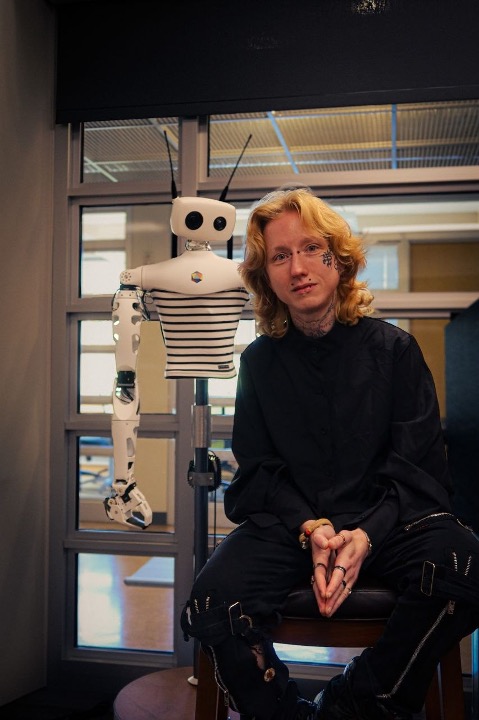
To close out the first phase of her project, Brown is making sure Kairos’s core learning engine is robust enough to leave its controlled 2D world. In later phases, she hopes Kairos will gain “hands” that let it interact with objects, gathering for itself the experience it needs to understand them.
“That’s my big lofty goal—to be able to teach an AI language without ever training it on language data,” Brown says.
If it works, Brown says it could reduce the field’s reliance on massive data centers for what she calls “brute forcing” the mass analysis of data for AI to learn.
Thinking Across Multiple Facets
Jaime Banks, Katchmar-Wilhelm Professor in the School of Information Studies, is Brown’s faculty mentor for the Spinoza Award. Brown met Banks during her first semester at the University, took her machine interaction course and now works as a research assistant in her lab.
Banks says Brown’s research to understand how consciousness may emerge in machines comes at a time when headlines are reporting AI doing unexpected things.
“We probably need to be understanding how and why they do such things,” she says. “Dio’s work informs that kind of understanding.”
Banks says she’s excited to see how Brown’s work progresses from a “tidy, 2D” environment to one that is complex, like “our everyday contexts.”
“What struck me most about Dio is her ability to think deeply across the theoretical, technical and scientific facets of the questions she is trying to answer,” Banks says.
Brown says she was initially surprised that tackling her own research during undergraduate studies was an option.
After meeting Banks, Brown joined the student group United AI and later served on its executive board. Her advice to other students is to seek out clubs related to their interests.
She also encourages other students interested in AI to look beyond the approaches that dominate the field.
“What can I do that people haven’t thought of yet that might make this safer or make this cheaper?” Brown says.