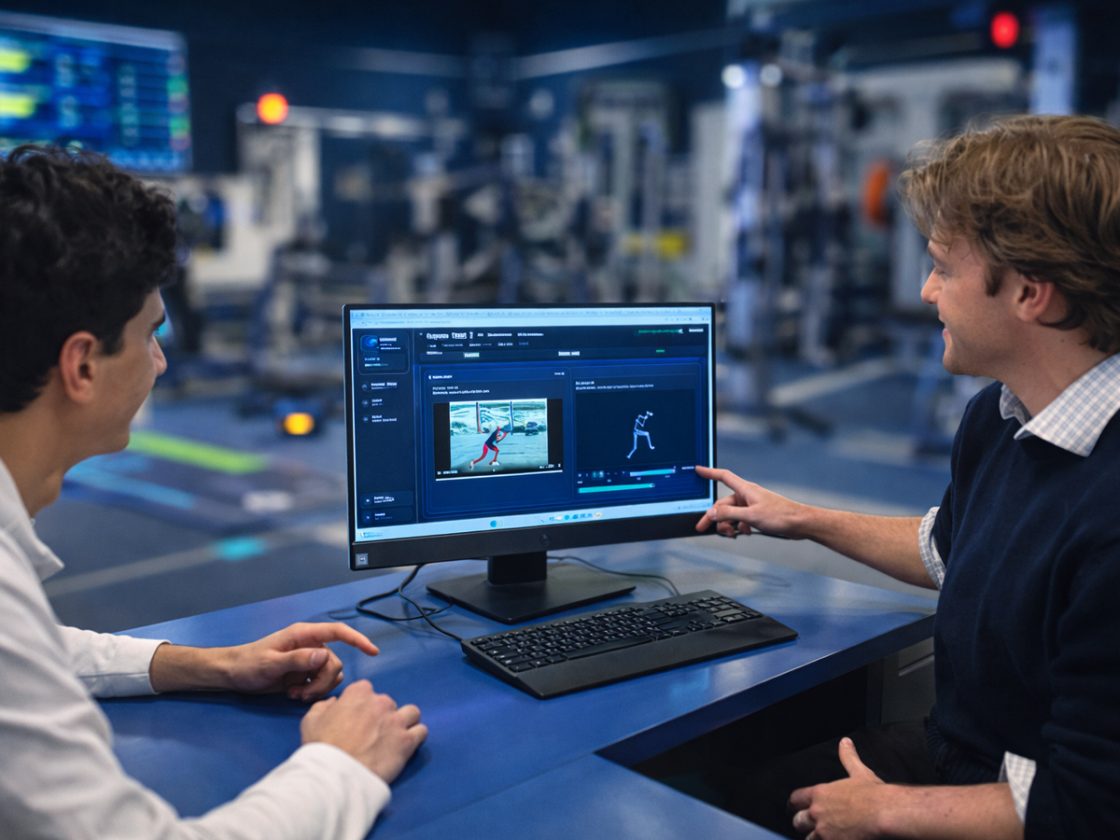
Brandon Parikh (left) and Dan Griffiths review a Guyanese athlete's outputs using Rebound Motion Intelligence, a biomechanics platform that creates professional motion analysis from a single camera.
Platform Finds Hidden Flaws in Athletes’ Form
For the first two laps, the student-athlete on the Syracuse University cross country team ran with flawless form. Then, down the stretch, their times began to slip as fatigue set in.
That’s when Dan Griffiths ’26 stepped in with an idea. He recorded the athlete during a competitive run and noticed that their entire left side, from knee to hip to ankle, “seemed to shut down” compared to their right side. The cause traced back to a hip injury from six years earlier that the athlete believed had fully healed.
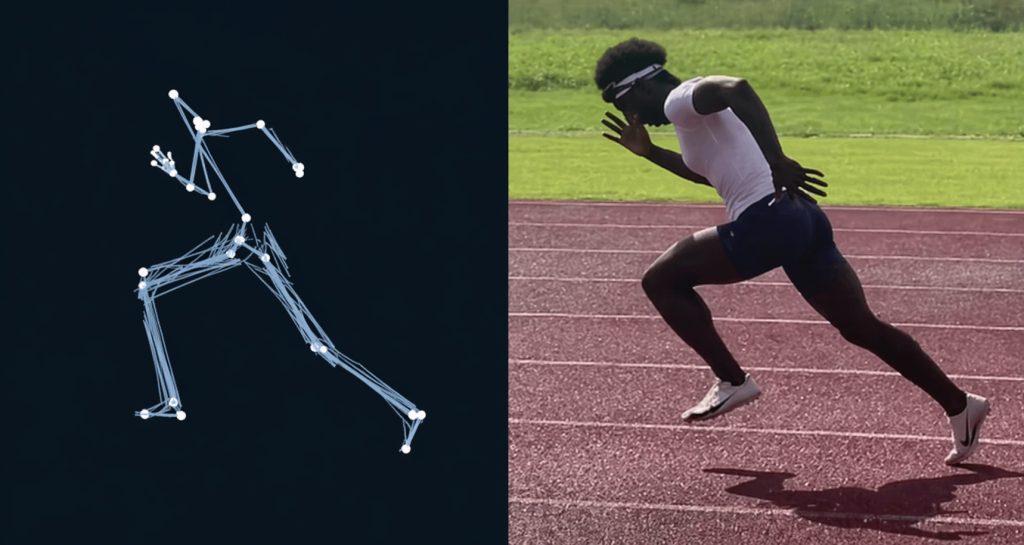
Griffiths, who studied sport analytics in the David B. Falk College of Sport, uncovered the problem with video and software he built himself. That software became Rebound Motion Intelligence, a biomechanics platform that creates professional motion analysis from a single camera.

“I have this exciting tool where I can democratize biomechanics without needing a $500,000 biomechanics lab to analyze an athlete’s motion. All you need is video, and you can apply this to any athletic motion,” says Griffiths, a quantitative analyst of computer vision for the Philadelphia Phillies.
Using AI and machine learning, Rebound turns recorded video into data once limited to high-end labs, including the forces moving through an athlete’s body, which can help predict injury risk, improve performance and shape individualized training plans across sports.
A built-in coach bot powered by a large language model then translates those results into plain language, explaining the reasoning behind each recommendation and laying out a plan of action.
Griffiths says Rebound also built one of the world’s only computer models designed specifically for the female body, so women athletes get feedback aimed at improving performance and preventing injury, instead of an adjusted male model.
“I’ve worked with basketball and baseball players and golfers, and there’s limitless possibilities for what you could do,” Griffiths says. “There’s a huge market now for this. We’re building out the infrastructure for the pipelines used in modeling and international scouting.”
In his work with the Phillies, Griffiths relies on many of the core skills behind Rebound. He applies computer vision and sports analytics methods to gauge player performance and on-field decision-making, then uses those insights to recommend ways to improve player development, scouting and performance optimization.
Finding the ‘Perfect Place’ to Hone His Skills
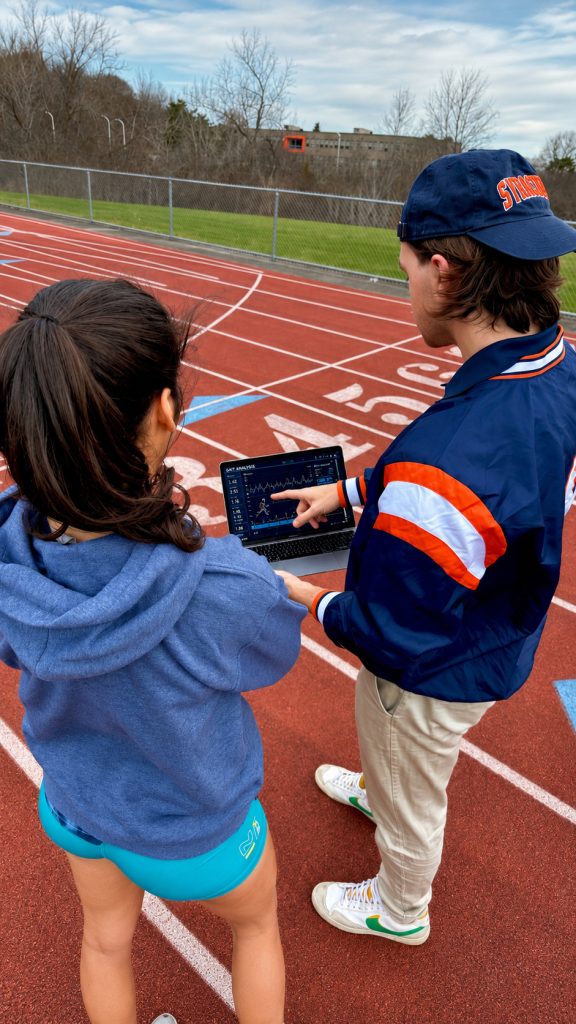
His freshman year, he worked as a data analyst for men’s soccer head coach Ian McIntyre as the Orange went on to claim the first national championship in program history. His sophomore year, he reached out to Brien Bell, the head cross country and track and field coach, with a plan to analyze the runners’ performances, create opportunities to make bigger gains in their races and attempt to predict and prevent injuries.
Griffiths started off capturing individual heart rate and workout data from 14 runners through an app he built.
To better analyze performance he needed to track more than just heart rate data and number of miles run; he needed to collect more biomechanical data, such as knee, ankle and shoulder positions.
“These athletes were training every day, so I needed a non-invasive way to capture this data,” Griffiths says. “Luckily, that’s around the time when computer vision started popping up. Initially, it was just 2-D poses, but as I kept going, I knew I was missing all of the forces going through the bodies of these athletes, which can be captured with a 3-D pose estimation.”
For that still-recovering cross country runner, Griffiths came up with a plan to build up the athlete’s resistance training on the left side through single-leg squats, single-leg bounds and other activities meant to improve the left side’s resistance to fatigue.
“The athlete thought they were fully recovered, but that’s something that can linger on,” Griffiths says.
Inspiring Training Changes
Following a successful internship with the USA Track & Field team, Griffiths was back on campus when Rodney Paul, chair of the sport analytics department, approached him with an idea.
The parent of a first-year Falk student was looking to launch an elite track and field program in Guyana and wondered whether any of Falk’s students were conducting research into ways to help track and field athletes improve.
Paul introduced Griffiths to the parent, and before long, they were working together on a way to incorporate video analysis into the athletes’ training regimen. One unintended benefit of the long-distance learning sessions? The Guyanese coaches are learning the basics of data analytics, data science and predictive modeling.
“Because they’re learning as I’m delivering the information, they’re a lot more receptive to using the insights and incorporating the technology in their practices,” Griffiths says. “We have conversations on Zoom to help the coaches explain the findings to their athletes and share their thoughts on how runners can improve.”
How Syracuse Developed Him
From his sophomore year through graduation in May, Griffiths worked on building out these pipelines, tools and code that served as the foundation for Rebound. He presented the research behind his findings at sport analytics conferences around the country, including the prestigious MIT Sloan Research Paper Competition.
Griffiths credits his data analysis skills with landing his current job with the Phillies, and he credits Syracuse University for equipping him with the confidence to present his findings.
“Initially I was hesitant to share my research, but the encouragement from other students and from professors doing their own research convinced me to step out of my comfort zone,” Griffiths says. “The culture and supportive environment in Falk has been the biggest driver of my success.”