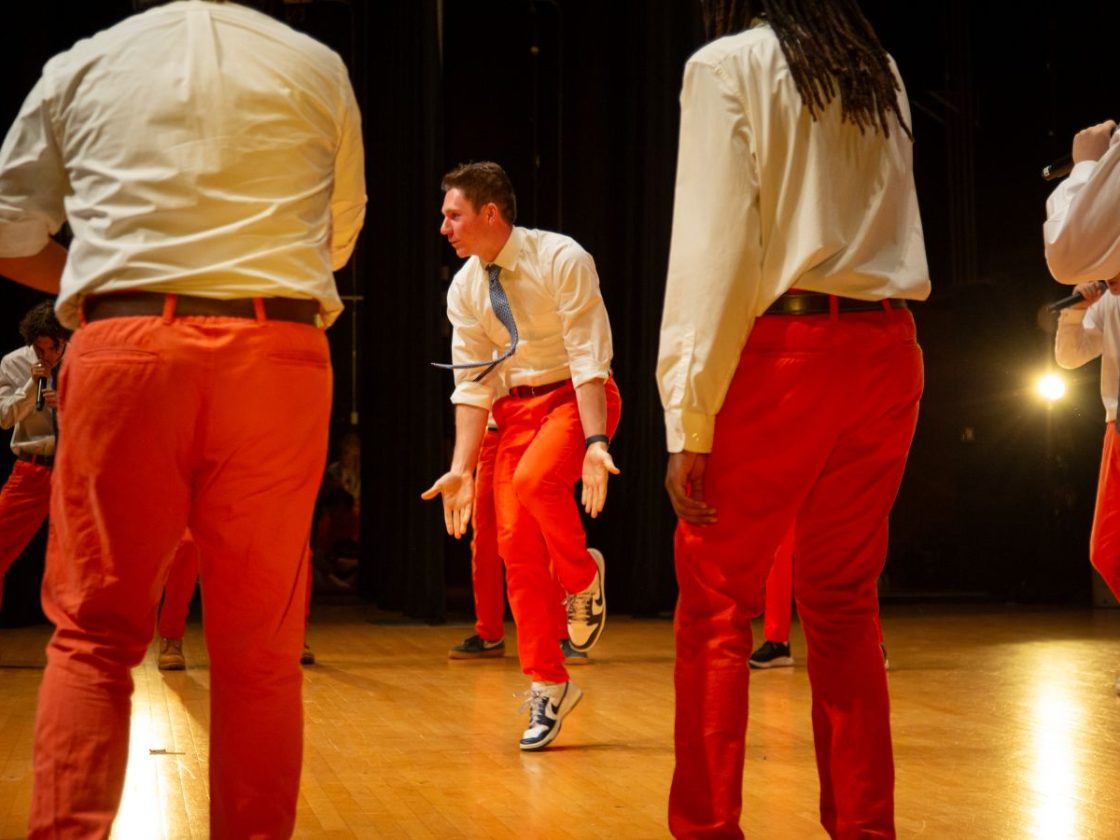
Grant LaMartina, a finance major, performs with the Otto Tunes a cappella group. (Photo by Reed Granger)
Non-Music Majors Thrive in University Ensembles
Senior Jay Helberg is pursuing a career in the social sciences, but it’s his extracurricular involvement in the Setnor School of Music that might give him a competitive edge after graduation.
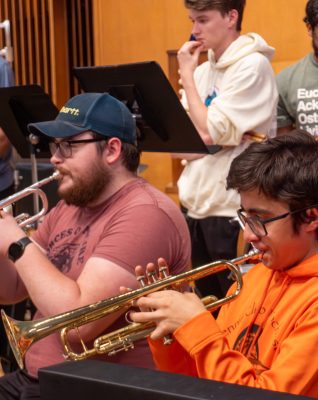
“Music develops skills like organization, problem solving and time management,” says the versatile trumpeter and composer, who performs with the Syracuse University Wind Ensemble, Morton Schiff Jazz Ensemble and Syracuse University Symphony Orchestra. “I’m also a good team player.”
Helberg ’27 is part of a new wave of undergraduates blending the liberal arts, professional studies and the creative and performing arts.
The result is a holistic educational experience that’s steeped in critical thinking, creative problem solving, adaptability and communication—durable assets in any job market.
“One of my favorite professors is John Raschella [principal trumpet of The Syracuse Orchestra], who communicates with great economy and technical dialect,” says Helberg, a law, society and policy and political science double major in the Maxwell School of Citizenship and Public Affairs. “They’re rare, invaluable traits to have in a teacher, and I’m learning a lot from him.”
Finding Their People
John Warren, professor and director of the Setnor School in the College of Visual and Performing Arts (VPA), suggests that non-music major participation is tied to the University’s inclusive recruitment practices.
“Our ensembles, by their very nature, are collaborative communities,” he says, citing an array of private lessons, academic courses, and choral and instrumental ensembles available to non-music majors. “Musicians often find their ‘people’ in band, orchestra or chorus.”
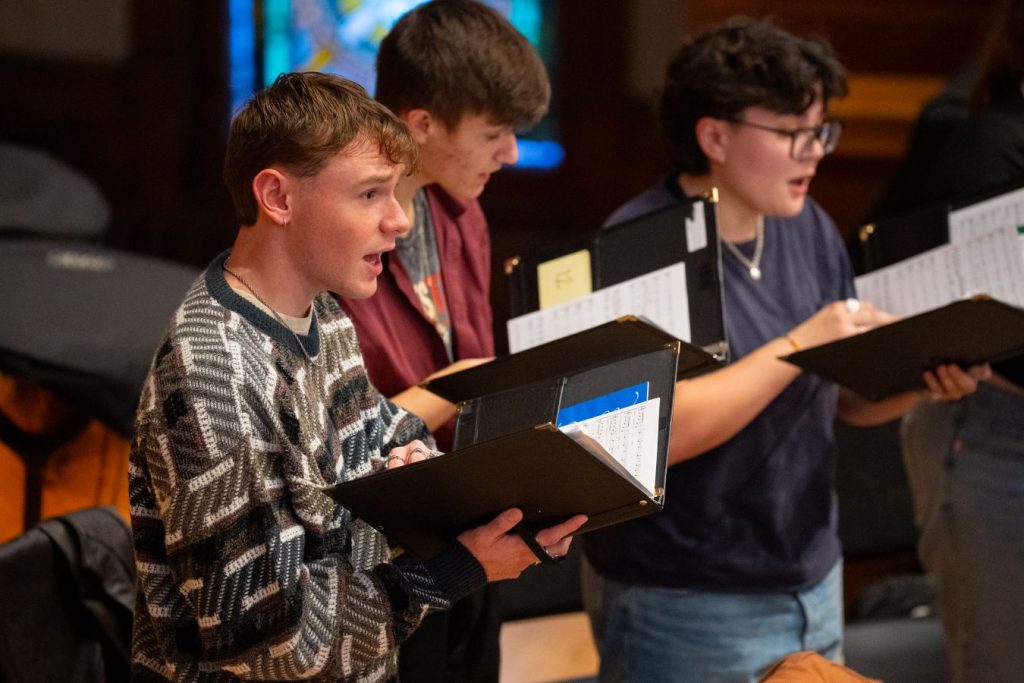
Owen Wilson ’27, a mechanical engineering (ME) major in the College of Engineering and Computer Science, recently toured South Africa with the Hendricks Chapel Choir. The experience not only reinforced his personal love for singing but also fostered social connections and institutional pride.
“The tour was an incredibly formative and important experience,” says the budding entrepreneur, who also performs with the Syracuse University Concert Choir, the Orange Appeal a cappella group and First Year Players. “I grew musically and personally.”
For him, rehearsing an advanced choral piece is not unlike solving a complex math or physics problem. Each experience causes his brain to adapt and grow—an ability known as neuroplasticity.
“As a result, I’m more well-rounded and multifaceted,” Wilson says.
Grant LaMartina ’29, a Whitman School finance major minoring in theater (VPA), echoes these sentiments, noting that breaking up an accounting midterm and a supply chain presentation to take a vocal lesson is not something he “takes for granted.”
“Making music makes me feel like I’m part of something bigger than myself,” says LaMartina, a member of the student-run Black Box Players and Otto Tunes a cappella group. “And being part of a community makes me feel supported in my academic journey.”
The relationship between music and the brain is well documented. Studies show that music engages a diverse network of brain circuits that, in turn, enhances social bonding, cognitive abilities and language processing.
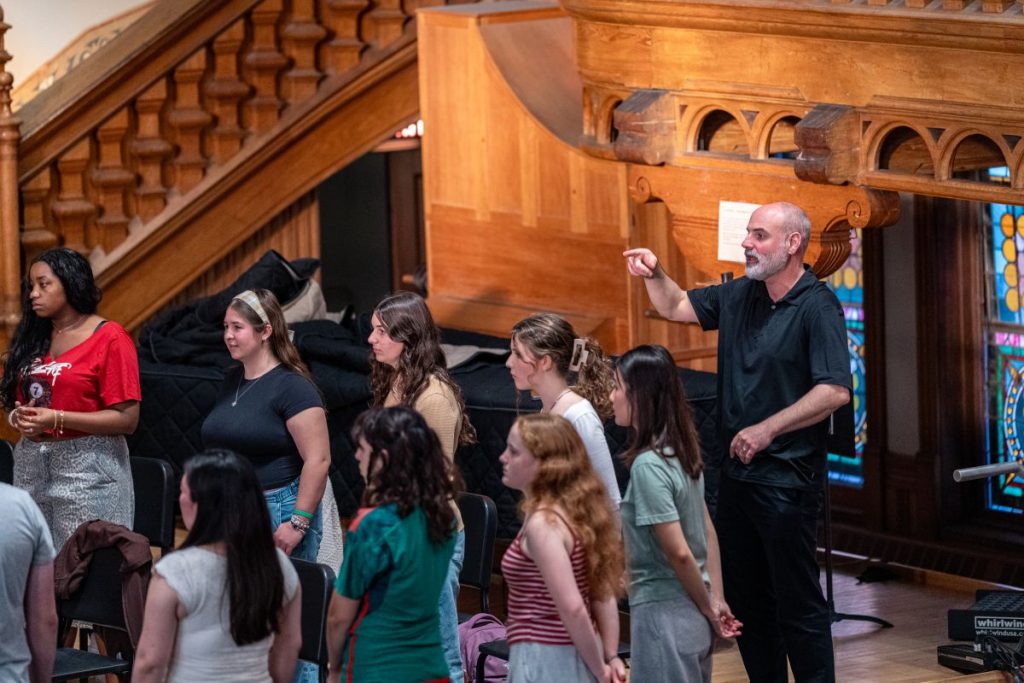
For this reason, José “Peppie” Calvar, who directs the chapel choir and oversees choral activities in the Setnor School, encourages musicians of all majors to explore the University’s 25-plus musical ensembles.
“Non-music majors bring a critical interpersonal and artistic dimension to our campus’ cultural life,” he says. “They also build pathways for collaboration and success at Syracuse University and beyond.”
A Full-Brain Workout
Abbey Noll ’27, an ME major minoring in mathematics in the College of Arts and Sciences, is not lost on the “structural, creative and cognitive” similarities between playing an instrument and designing a mechanical system.
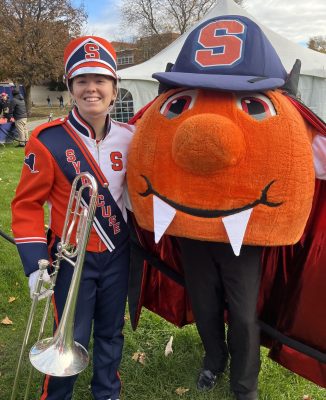
“Music and engineering blend hard and soft skills,” says the trombone section leader of the 125-year-old Syracuse University Marching Band, who also is president of the Sour Sitrus Society pep band. “Both require self-discipline.”
And with self-discipline comes camaraderie—a deep sense of friendship, trust and mutual respect—that’s unique among musicians, regardless of age and academic or career path.
Clarinetist Ella Roerden ’27 understands this phenomenon. An aspiring museum curator, she has twice conducted ethnographic studies of the Sour Sitrus Society.
“It’s interesting to see how my role in the group, along with my understanding and interpretation of it, has evolved,” says the anthropology and international relations double major in the Maxwell School, who also participates in marching band. “I’ve learned a lot about myself.”
So has fellow clarinetist Grace Hannah ’29, a B.Arch. major in the School of Architecture. She marvels at how music making affects parts of the brain related to memory, emotion and socialization.
“Playing in marching band leads to profound feelings of connection and unity,” says the aspiring architect. “It’s made me a better student and a better person.”