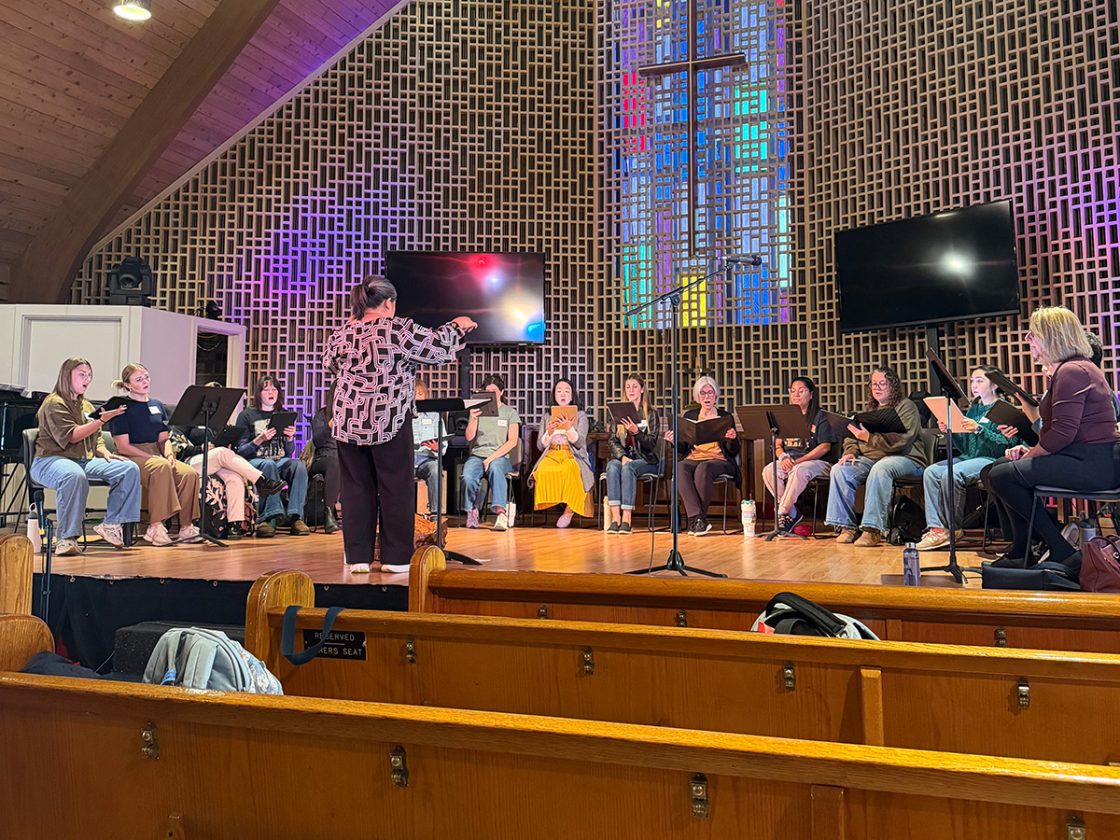
Members of the Ensemble Sonora rehearse pieces for the We Hold These Truths concert.
2 Setnor Composers Mark the Nation’s 250th With New Choral Works
When commissioned to write a piece for the upcoming We Hold These Truths concert Sunday, commemorating the nation’s 250th anniversary, Loren Loiacono immediately looked close to home for inspiration.
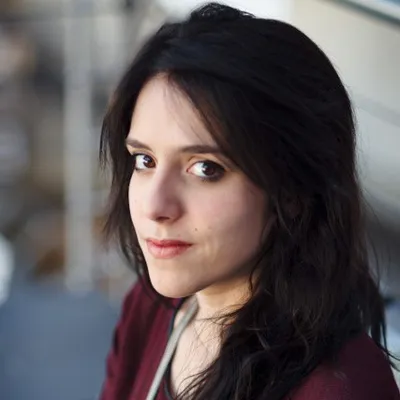
For “Campaign Song,” Loiacono drew on Upstate New York’s deep ties to the women’s suffrage movement, creating a work that celebrates resilience and the enduring pursuit of democratic ideals.
“We’re right down the road from Seneca Falls,” says Loiacono, assistant professor in the Setnor School of Music, College of Visual and Performing Arts. “That angle seemed like a natural fit not only for the concert’s theme, but for the place and for the people who’d be performing.”
Loiacono and Natalie Draper, associate professor in the Setnor School, were both asked to write pieces for the concert Sunday, Nov. 15, at 4 p.m. at Hendricks Chapel. Their work will be performed by Ensemble Sonora, a Central New York treble ensemble.
The commissioning was made possible by the New York State Council on the Arts with the support of the Office of the Governor and the New York State Legislature. The event is co-sponsored by Syracuse University Humanities Center’s Symposium on “Dreams” and the Malmgren Concert Series.
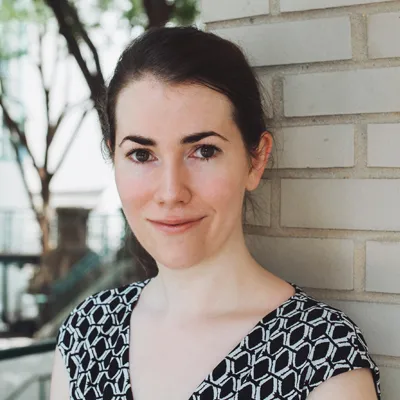
In her composition, “American Dream,” Draper drew inspiration from patriotic songs, turning familiar patriotic texts into questions.
“The concept behind American Dream is that of the dreamscape, with lyrics that combine snippets from a variety of patriotic songs and texts—all reframed as questions in order to challenge us to think about who we want to be and whether or not we are actually living up to the values that we sing about, that we pledge ourselves to that the fabric of our country was built on,” says Draper in a post on Ensemble Sonora.
Loiacono explains how her composition came to life in this Q&A with SU Today.
I was both honored and excited! I’ve known Dr. Wendy Moy [associate professor in the Setnor School of Music], who commissioned the piece and will conduct the premiere, for a long time. She’s not only my colleague at the Setnor School of Music, but she was also one of the vocalists who performed my first-ever choral piece, back when I was still a student.
Wendy’s vision for this concert was compelling, too. She wanted to present a program that would not only celebrate the nation’s 250th anniversary, but also reflect on its founding values, and how they’ve resonated throughout our history. There are so many thought-provoking ways to respond to that prompt—I immediately said yes!
My piece is called “Campaign Song (Or, Why We Oppose Votes For Men),” which, as you might guess, is meant to be a bit tongue-in-cheek. For my text, I used satirical poems by the suffragette author Alice Duer Miller. The poems are all very witty and pointed; she takes different arguments against women’s suffrage and exaggerates them, carrying them to a ridiculous conclusion and pointing out the hypocrisy of that rhetoric.
I decided to follow Duer Miller’s lead and write “Campaign Song” in a way that sounds like what you might hear at a 1910’s political rally but pushed to its extreme.
When Wendy first explained her idea to me, my mind immediately went to the women’s suffrage movement. Upstate New York, and our area in particular, has such a deep connection to women’s fight for equality.
From there, I spent a lot of time digging through historical speeches, articles, and poems, trying to find something that felt singable. I wasn’t expecting to use a humorous text, but once I read Alice Duer Miller’s poetry, I couldn’t get it out of my head. Her writing is so funny and incisive, and surprisingly resonant even today. From there, the music just came naturally.
I’d say resilience, as well as gratitude. The suffrage story is one of a long, hard-won battle for equality. While my piece leans into the irony in Duer Miller’s writing, her humor comes from a place of absolute conviction that those ideals—freedom, belonging, equality—are worth fighting for.
A huge part of my role as a faculty member is mentoring and teaching student composers. When I’m helping them work through a problem in one of their own pieces, I draw on how I’ve navigated similar challenges in my own artistic practice.
One thing I love about this piece is that it let me interact with Alice Duer Miller’s writing and bring a 2026 perspective to it. I always remind my students that art is a conversation. Nothing we create exists in a vacuum, so it’s important to find the music, art, literature, etc. that speaks to you, and say something back.
I hope listeners are reminded not to take their freedoms for granted and that someone had to fight for them; I hope they reflect on the ways our democracy is, and has always been, an ongoing project.
I also wouldn’t mind if someone finds themselves whistling the tunes afterward!