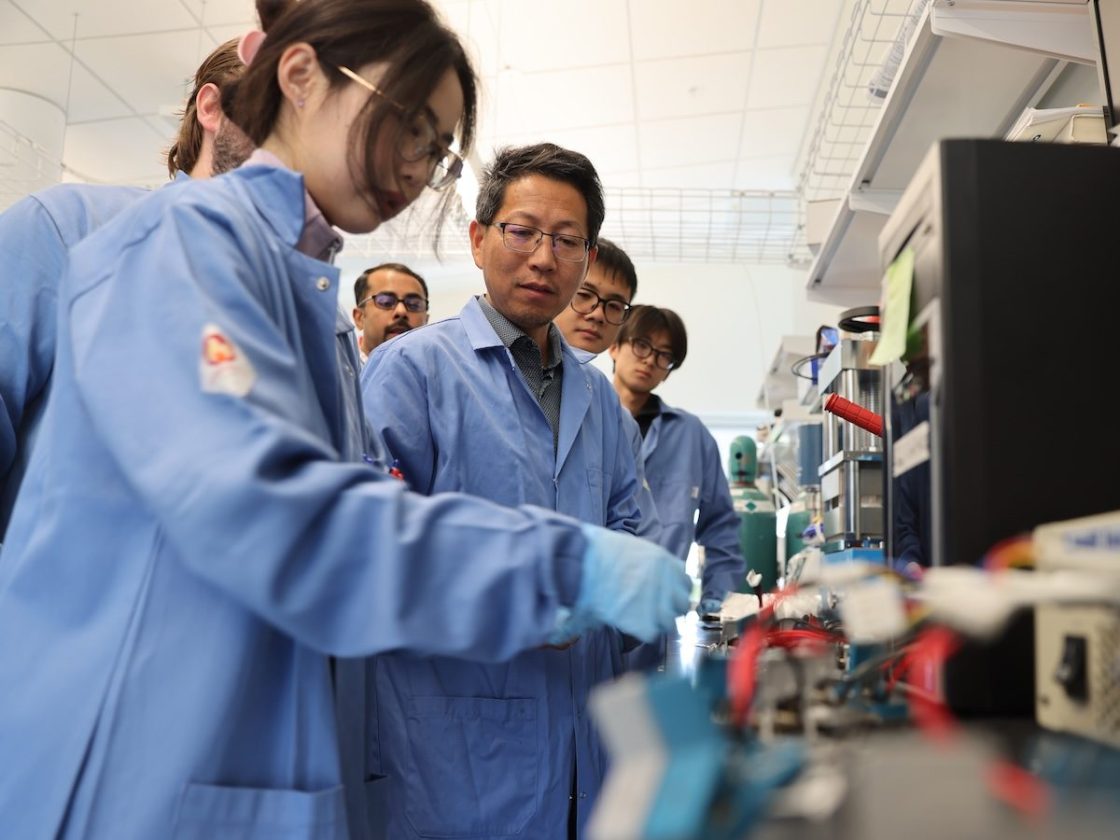
The Syracuse company TTM Technologies Inc., a first-round voucher recipient, is collaborating with the College of Engineering and Computer Science research group led by Quinn Qiao, second from left, William T. Frantz Endowed Chair in Mechanical and Aerospace Engineering.
$3M in New C3 Vouchers Fuels 21 Business-University Tech Partnerships
Twenty-one new business-university research projects are underway across Upstate New York, backed by $3 million in innovation vouchers from the NY SMART I-Corridor Commercialization and Collaboration Center (C3).
That is a big step up from February’s first round of funding, which delivered $350,000 to five companies. C3 has since built a pipeline of 60 engagements with regional tech firms, says Duncan Brown, vice president for research and principal investigator for C3.
C3 is the “front door” for companies across the Syracuse-Rochester-Buffalo corridor that need university expertise and equipment to develop and commercialize semiconductor technologies. Syracuse University leads C3 and administers its voucher program on behalf of partners including the University at Buffalo, Rochester Institute of Technology, Cornell University, University of Rochester and Alfred University. C3 is part of the $40 million NY SMART I-Corridor award from the U.S. Economic Development Administration’s Regional Technology and Innovation Hubs program.
Companies in Syracuse Labs
Syracuse faculty are research partners on seven of the 26 C3 projects funded so far.
“These partnerships put real industry problems inside Syracuse labs, and that opens doors for our students. They can work on technology companies are taking to market and graduate with the experience and the connections that employers across this region are hiring for. That is what research should mean for a Syracuse education,” Brown says.
Faculty Partnerships
Four new projects pair companies with College of Engineering and Computer Science (ECS) faculty:
- Flox Intelligence works with Distinguished Professor Qinru Qiu and Professor M. Cenk Gursoy, both of the Department of Electrical Engineering and Computer Science. The company combines AI, bioacoustics and behavioral science to decode how wildlife communicates.
- BQP partners with Rodrick Kuate Defo, assistant professor of electrical engineering and computer science, to test BQPhy QuantumNOW, software that uses AI to speed up and improve chip manufacturing.
- Conamix and Changmin Shi, assistant professor of mechanical and aerospace engineering, are testing whether a ceramic component from Shi’s lab can help Conamix’s lithium-sulfur batteries last longer.
- TAF Carbon provides plant-based raw materials to Lihong Lao, assistant professor of mechanical and aerospace engineering, whose lab is turning them into filters that clean wastewater from chip production.
Three first-round partnerships with ECS faculty continue:
- TunaBotics LLC, a soft-shell robotic gripper startup co-founded by Wanliang Shan, associate professor of mechanical and aerospace engineering; the company tests prototypes of tunable soft robotic grippers for advanced electronics manufacturing.
- TTM Technologies, a global manufacturer of mission systems, radio frequency components and microwave/microelectronic assemblies, partners with Quinn Qiao, William T. Frantz Endowed Chair in Mechanical and Aerospace Engineering. TTM is a manufacturer of technology products, including mission systems, radio frequency components, RF microwave/microelectronic assemblies and technologically advanced interconnect products.
- Saab Inc., the U.S. arm of the global defense and security company, is working with Distinguished Professors Qiu and Pramod Varshney and Professors Chilukuri Mohan and Gursoy on low-power, high-speed chips that combine memory and processing.
The Micron Effect
Many of the companies seeking C3 funding are positioning for the wave of chip-industry demand they expect from Micron Technology’s $100 billion megafab, now under construction in Clay, just north of Syracuse, Brown says. Micron says the site will be the most advanced memory manufacturing facility in the world, built to meet AI-driven demand.
“Micron’s investment is bringing new companies and new federal funding into the region. Our job is to make sure Syracuse researchers and students are part of that work, whether we are administering the program or partnering on the research,” he says.
The NY SMART I-Corridor is a federally designated Tech Hub of more than 100 businesses and higher education, economic development and community-based organizations positioning Upstate New York as a global leader in semiconductor manufacturing, innovation and workforce development.
The U.S. Economic Development Administration Tech Hubs program was established by the CHIPS and Science Act and provides funding for regional technology development with matching support from the Empire State Development Division of Science, Technology and Innovation.