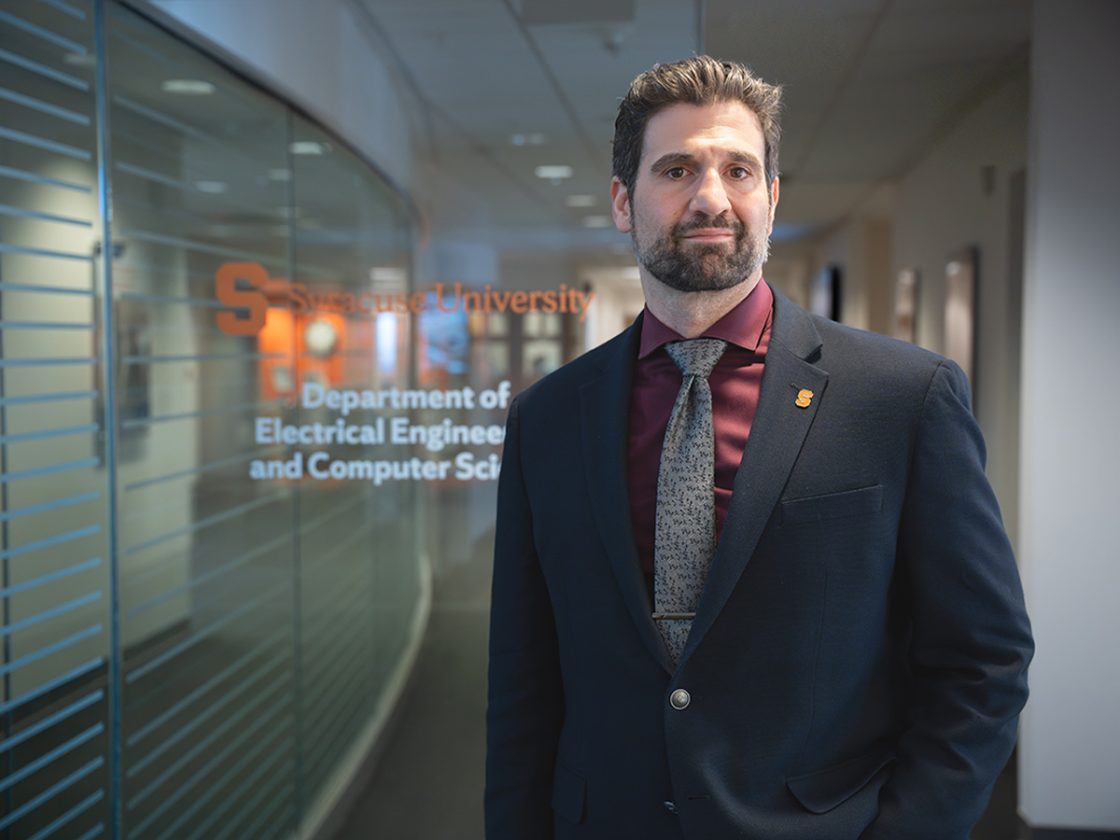
Paulo Shakarian, the KG Tan Endowed Professor of Artificial Intelligence in the College of Engineering and Computer Science, is director of the Institute for Artificial Intelligence.
Syracuse University Launches Institute for Artificial Intelligence
Syracuse University today announced the launch of the Institute for Artificial Intelligence, which brings together world-class researchers from across campus whose unique expertise in AI will help advance research, teaching and practice in the rapidly expanding field.
“Artificial intelligence is one of the defining research challenges of this decade, and Syracuse is making a serious commitment to it,” says Duncan Brown, vice president for research. “The Institute for Artificial Intelligence brings our faculty together to pursue AI research at a scale no single lab or department could take on alone, to build lasting partnerships with industry and government, and to translate that work into real-world impact.”
Led by Paulo Shakarian, the KG Tan Endowed Professor of Artificial Intelligence in the College of Engineering and Computer Science (ECS), the institute brings together faculty from four schools and colleges with expertise spanning engineering, information science, public policy and communications.
“This institute reflects Syracuse University’s commitment to advancing artificial intelligence research that is both rigorous and responsible,” says Shakarian, who serves as director and executive committee chair. “We’re building a research community that is equipped to tackle AI’s hardest technical problems alongside its societal implications. We envision a future of resilient AI systems that lead to high impact applications.”
Johannes Himmelreich, associate professor of public administration and international affairs in the Maxwell School of Citizenship and Public Affairs, is associate director and executive committee vice chair.
Four Research Areas
Research at the institute is organized around four areas of focus:
- AI and Security: Research spanning AI for cybersecurity, security of AI systems, formal verification and vulnerability discovery.
- Multidomain Intelligence: Sensing and perception research, including signal and image analysis and energy-efficient AI systems.
- AI in Socio-Cognitive Dynamics: How AI systems interact with human cognition, communication and social networks.
- AI for Governance and Policy: Trustworthy AI, AI safety and the policy frameworks needed to guide AI’s global development and deployment.
Federal research agencies and industry partners will also support the institute’s research agenda through collaboration and funding agreements.
Public Events, AI Community-Building
Planned public events, including lectures, workshops and symposia, will help the institute share knowledge, foster collaboration and engage the broader AI community. Events this fall include:
- Workshop on Contested and Distributed Multi-Domain Decision Making (Oct. 12-13, Washington, D.C.): Sponsored by the Army Research Office, this invitation-only workshop will examine AI use for decision making across the domains of electronic warfare, radar, aerial and space.
- METACOG-26: AAAI Symposium on Artificial Metacognition (Nov. 5-7, Arlington, Virginia): This symposium will feature traditional paper sessions with extended discussion, a poster session, three invited keynote speakers and a closing panel focused on artificial metacognition—AI’s ability to reflect on itself.
The Institute for Artificial Intelligence is part of Syracuse University’s comprehensive AI academic portfolio, which includes undergraduate and graduate degree programs in AI, a suite of AI-focused minors and the peer-led AI Bootcamp for students, reinforcing the University’s position as a growing center for AI research and education. The institute will also create research opportunities for students and supports United AI, a student community that brings together undergraduate and graduate students from across the University to learn, build and lead in AI.
The Institute for Artificial Intelligence is located on the second floor of Hinds Hall. For more information, visit instituteai.syracuse.edu.