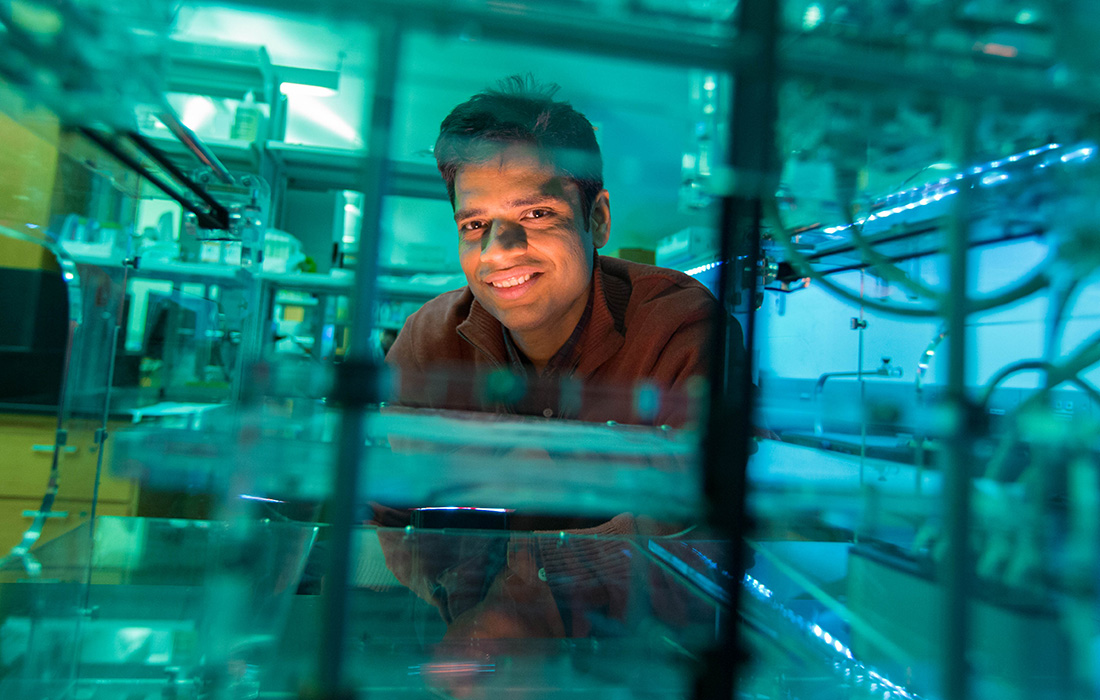
Pranav Soman, professor of biomedical and chemical engineering in the College of Engineering and Computer Science (ECS), has been named director of the University’s BioInspired Institute.
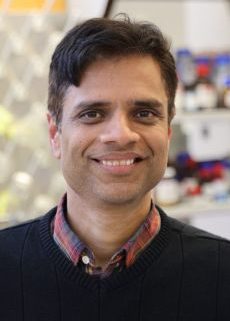
“My vision is to build a trust-based community where we elevate our research together. I am optimistic about securing center-scale and collaborative funding and championing new entrepreneurship and industry partnerships,” Soman says.
He also plans to help incubate a new generation of Syracuse University-based entrepreneurs in BioInspired’s core focus areas.
Soman succeeds James (Jay) Henderson, senior associate dean for faculty affairs in ECS, who has led the institute since 2023 and remains an active member.
Soman joined the Syracuse faculty in 2013 as a member of the Biomaterials Institute and later as a BioInspired affiliate. He also served as a program director for the National Science Foundation.
His lab builds light-based tools to grow lab models of organs, print living tissue at scale and study how biological systems process information. The work could transform how scientists model disease, build replacement tissue and understand the limits of biological intelligence.
Institute founding director M. Lisa Manning, William R. Kenan Jr. Professor of Physics in the College of Arts and Sciences, says Soman brings valuable perspective to the role.
“Pranav has a strong commitment to supporting both fundamental scientific advances and translating those advances into products that help people,” she says. “Those qualities make him an excellent choice to move the institute forward to build an entrepreneurial biotechnology and material science workforce and to champion researchers and trainees in a time of substantial research funding uncertainty.”
During his time as BioInspired director, Henderson has grown the institute on nearly every front. Nine new faculty joined its ranks, and co-located lab space expanded twice over to house five new affiliates in 2023 and five more in 2024. Equipment also kept pace with the acquisition of a new Zeiss Sigma 360 field emission scanning electron microscope, a first-of-its-kind addition to the Materials Research Core.
Henderson also pushed the institute into new intellectual territory: an NSF-funded emergent intelligence research training program, led by Manning as principal investigator, serves 115 graduate students over the program lifetime. A new focus group, Posthumanities: Arts and Sciences, bridges research across the arts, humanities and sciences. Intramural funding from the institute backed projects on polar fungi survival and shape memory polymers.
That momentum is clear at the institute’s annual research symposium, where student poster presentations grew from 79 in 2023 to 115 in 2025, and research distinction awards rose from student poster presentations to 11 in 2025.