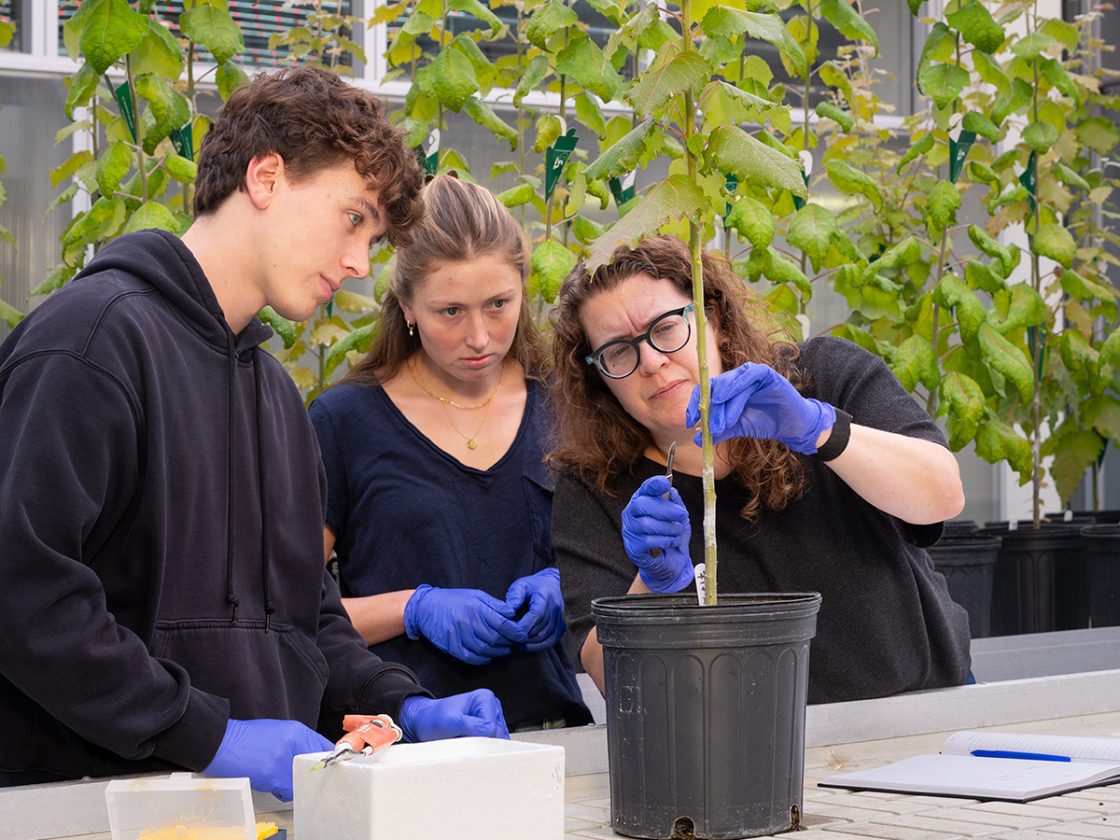
In her greenhouse lab, biology professor Heather Coleman cuts into a poplar’s vascular cambium as student researchers John O’Brien and Elle McLaughlin look on. (Photo by Marilyn Hesler)
A&S Scientist Seeks To Build a Better Tree With Biotechnology
In the greenhouse atop the Life Sciences Complex, Heather Coleman, an associate professor of biology in the College of Arts and Sciences at Syracuse University, is growing poplar trees. A floor below, in Coleman’s lab, is where these trees got their start. Coleman and her team of undergraduate and graduate researchers work with two hybrid species of poplar—from North America and Europe—and use biotechnology to modify their genomes, creating genetic lines with more desired traits like improved drought resistance.
“My true love is trees and nature—and this question of how trees can be these magnificent organisms that are so huge and beautiful,” she says. “Part of the reason for that is because they produce this very thick secondary cell wall. We want to understand both how and why they do that and how we can potentially manipulate it for our own purposes.”
Coleman, who holds a doctorate in forestry from the University of British Columbia, has studied poplars for decades, specializing in plant cell wall formation and structure. She describes poplar as a “workhorse” for understanding tree genetics. “It’s fast growing, has a wide habitat range and its genome is relatively small and multiple species and varieties of poplar have been sequenced,” she says. “We have a lot of genetic information about them, so it’s an ideal model species for anything to do with wood formation.”
Because of these characteristics, poplars are recognized as go-to trees for researchers exploring biofuels, carbon storage, paper production and high-value chemicals. Beginning in January, Coleman will lead a project to advance the biotechnology that drives the use of trees as a sustainable resource.
Expressing Genes in Targeted Cells
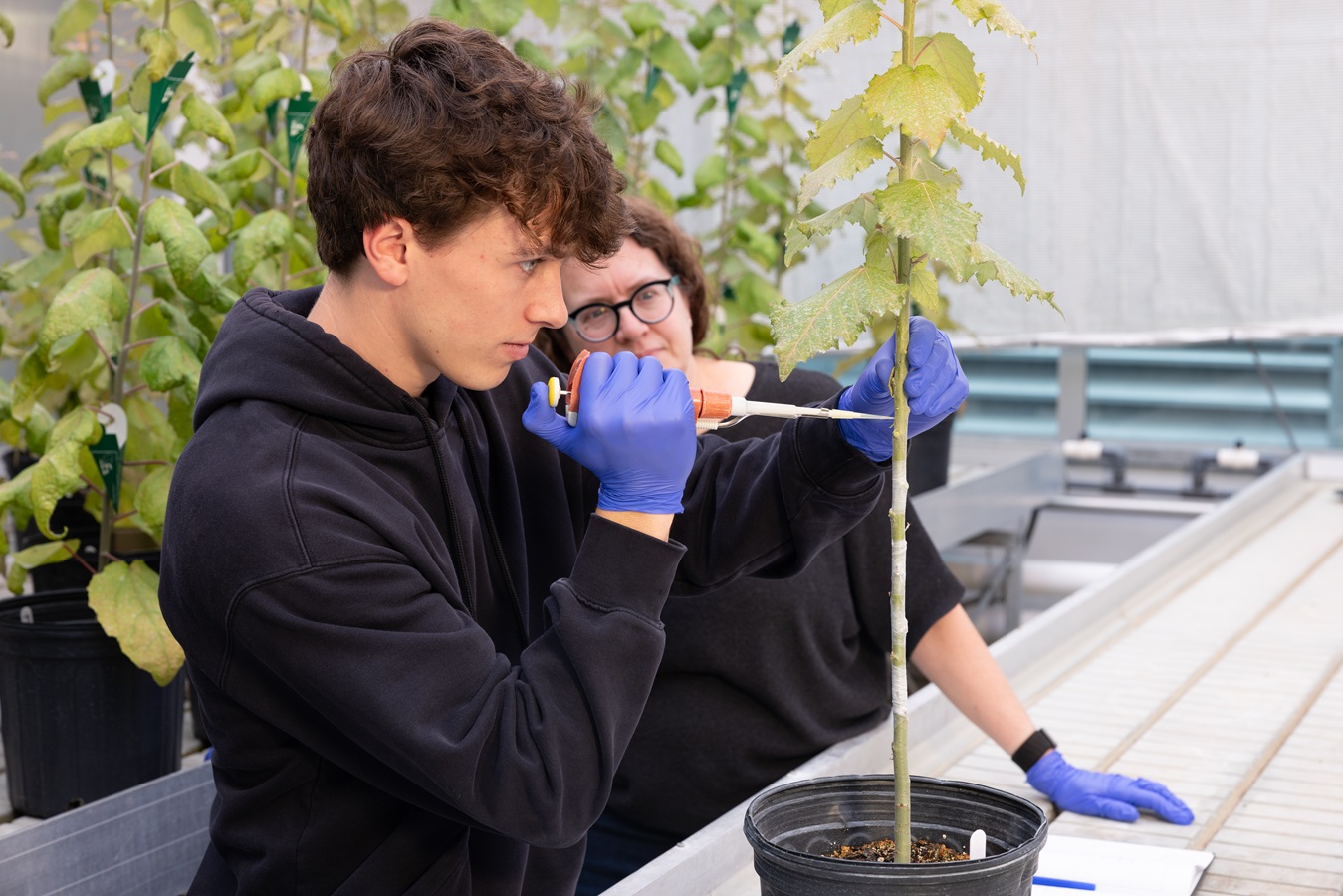
Awarded a three-year, $351,911 National Science Foundation grant, Coleman plans to create an accessible, public digital library for tree biology that will aid scientists seeking to turn on gene expression in targeted cell populations within the poplar’s wood-forming zone, or vascular cambium. This is the engine room where cells divide and produce different types of cells that make up wood, including ones responsible for water and mineral transport, structure and regulating responses to internal and environmental factors. At the heart of her research is identifying cell-type-specific promoters—which aid in gene transcription—and how they’re regulated. Promoters control the timing and location of gene expression—for example, turning on autumnal colors or reacting to drought, she explains.
“One of the things we can’t do very well right now is selectively modify specific cells—and that’s because we don’t have promoters to drive gene expression in each of the different types of cells,” says Coleman, who serves on the advisory board of the Department of Energy’s Center for Bioenergy Innovation at Oak Ridge National Laboratory.
To address this, Coleman will use existing single-nucleus RNA sequencing data, which reveals genetic data from individual cells with specific expression patterns in the xylem, the vascular tissue that transports water and nutrients and helps form wood. With this information, Coleman will identify and characterize promoters and the molecular switches that regulate transcription in these cells.
Coleman will draw on new and existing datasets—researchers have identified genes transcribed in specific cells—to identify candidate genes and then validate candidate promoters by introducing the altered genes into wood-forming tissues. She’ll pair this with reporter genes, including RUBY, a synthetic gene-reporting system that turns a visible red when expressed. Once she identifies promising candidates, she’ll confirm results in greenhouse-grown poplars, using computer modeling along the way to design synthetic promoters and test whether that cell-type specificity can be engineered.
“I expect we’ll find some promoters that have higher activity in a specific cell type but are still actually activated across the wood tissue,” she says. “Then if we can identify the regulatory elements that drive that expression in the specific cell type, we can create these synthetic promoters.”
Beyond that, Coleman says the approach could eventually transfer to other plant tissues, not just wood.
Creating Genetically Altered Poplar
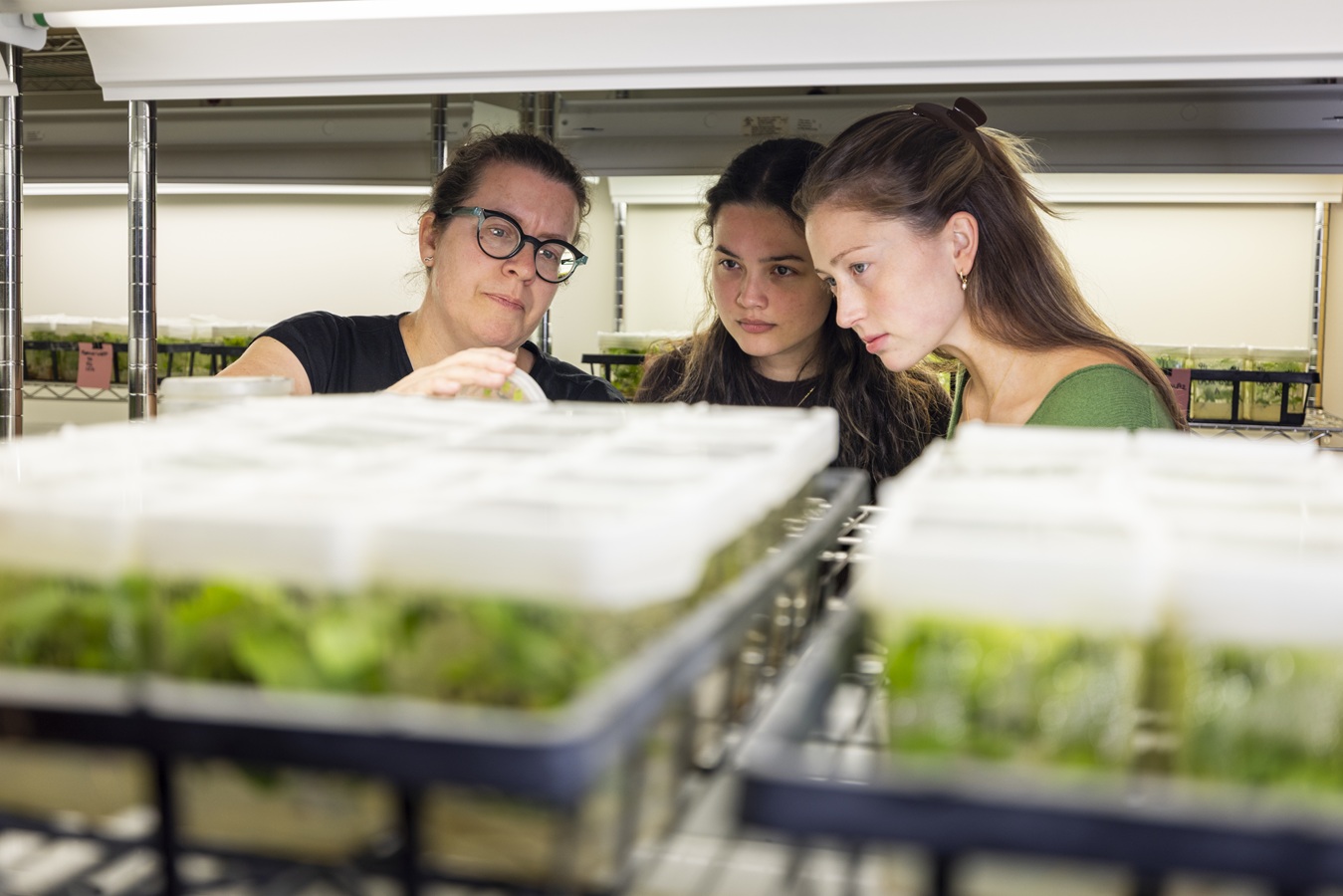
In her lab’s tissue culture room, Coleman holds up a petri dish containing a leaf tissue that’s been dosed with Agrobacterium harboring a gene construct encoding RUBY. In nature, Agrobacterium creates tumors, or galls, in trees. In the lab, biotechnologists use it to introduce desired genes. Her students inoculate the leaves using Agrobacterium and then use different hormone combinations to produce stem cell-like tissue called callus, which can then be induced to produce roots and shoots. A new genetic line of tree in the making. Shelves line the room, holding a variety of these specimens.
Coleman says she loves having undergraduates and graduate students in the lab. The NSF grant, she says, will let her advance biotechnology in tree genetics while keeping students active in their own experiments. “That’s one of the reasons why I’m most excited about getting the funding,” she says. “I can keep going along and doing what I like to do and will also be able to mentor students.”