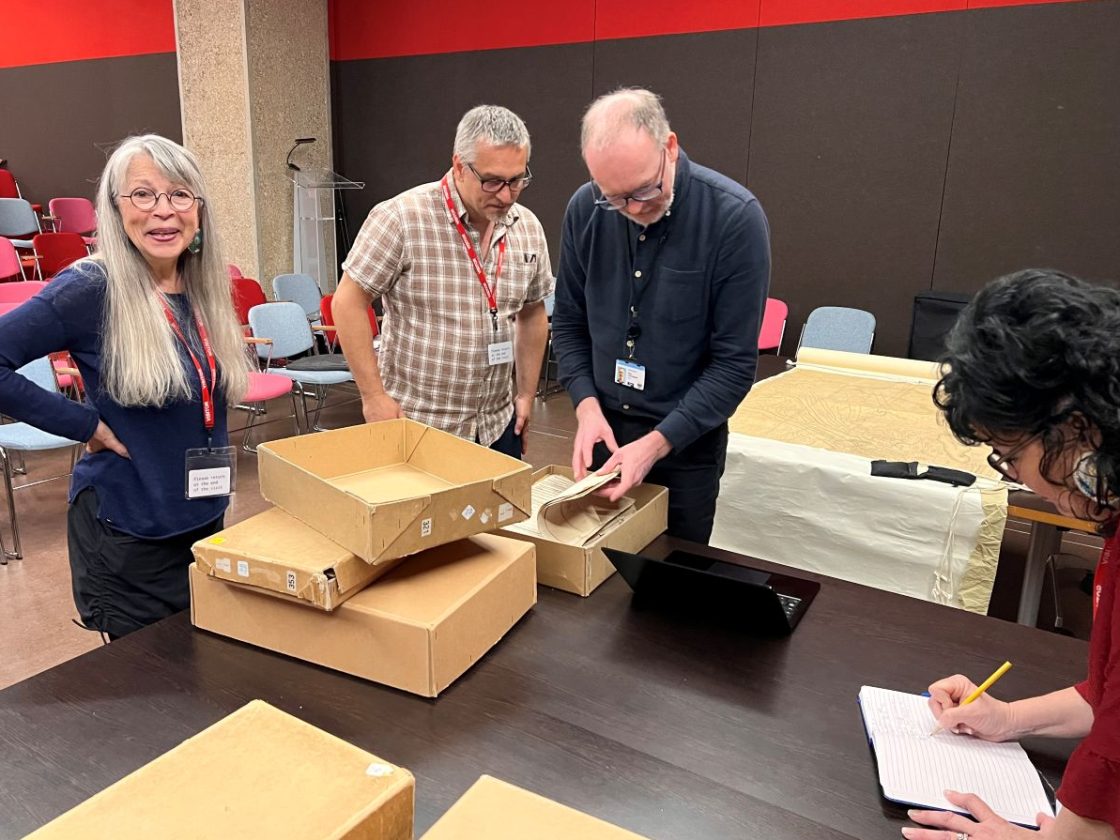
A trip to The National Archive in London in 2025 helped faculty members Sebastian Modrow and Philip P. Arnold form their National Endowment for the Humanities-funded project to digitize the Jeffrey Amherst Papers. Visiting the Archive are, from left, Sandra Bigtree (Akwesasne Mohawk), of the Indigenous Values Initiative, which has supported the research since 2023; Modrow; and Sean Cunningham, the Archives’ head of collections (Medieval, Early Modern, Legal). At right is Betty Hill (Lyons) (Onondaga) of the American Indian Law Alliance, which helped to sponsor the U.K. trip in 2025. (Photo by Philip P. Arnold)
NEH Grant-Funded Project Will Digitize Pre-Revolutionary War Papers
Two Syracuse University faculty members have received a National Endowment for the Humanities (NEH) grant to digitize portions of the Jeffrey Amherst Papers—a rare, 54-volume trove of 18th-century documents charting British, American colonial and Haudenosaunee (Iroquois) Confederacy relations in the years surrounding the American Revolution.
Sebastian Modrow, principal investigator and assistant professor in the School of Information Studies, and Philip P. Arnold, co-principal investigator and professor of religion in the College of Arts and Sciences, received nearly $350,000 for their two-year project, “E Pluribus Unum: The American Revolution at the Intersection of Ideas and Interests.” Their project is one of 81 humanities projects the NEH funded nationwide to mark the country’s 250th anniversary, including 33 grants awarded under NEH’s new Rediscovering Our Revolutionary Tradition funding opportunity.
Amherst commanded British forces in North America during the French and Indian/Seven Years’ War, helping secure Britain’s victory. Housed at the National Archives of the United Kingdom, the 54 volumes span the 1740s to 1790s and include military correspondence, orders and reports from the war, including Amherst’s letters to and from James Wolfe, Sir William Johnson and Frederick Haldimand.
Three-Way Relations
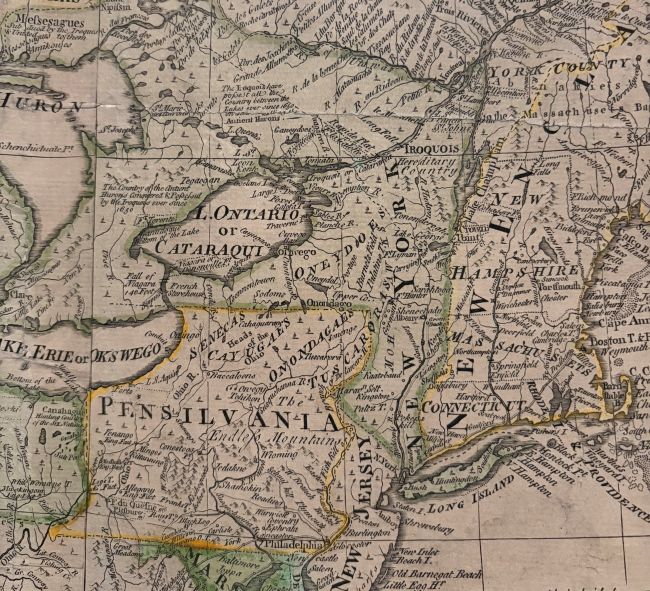
The collection captures the three-way relationship among British officials, colonial American leaders and the Haudenosaunee Confederacy in the years before the American Revolution. Their content illuminates how ideas of liberty, sovereignty and democracy developed amid diplomacy, conflict and negotiation in that era.
The archived materials have long been largely inaccessible to the public, somewhat because of their bulk and a lack of freely accessible digital surrogates of the materials, apart from some cumbersome digitized WWII-era microfilm, Modrow says.
This project aims to change that. In 2026, Modrow and Arnold will travel to London to photograph each document individually, producing high-resolution digital surrogates. They’ll then tag the images with metadata and use the AI-powered Transcribus app to make them full-text-searchable by name, date and subject. That will let researchers search tens of thousands of pages in seconds, rather than leafing through folders by hand.
Student Helpers
Once digitized, Modrow will recruit a project coordinator and iSchool and Arts and Sciences students to fact-check the AI-generated transcriptions, comparing the descriptions against the original 18th-century handwriting for accuracy.
After vetting, the collection will be uploaded to an Omeka-based, open-source platform hosted on the iSchool’s servers, Modrow says.
Window to Relations
Amherst’s papers offer an underused window into the alliances, rivalries and negotiations that shaped American independence, Arnold says. While British and colonial-patriot perspectives of this time are well documented, these papers can help remedy missing Haudenosaunee Confederacy viewpoints, material Arnold plans to bring into his classes and offer at public workshops to broaden understanding of the era’s varied perspectives, he says.
“Despite the confederacy’s influence on the era’s diplomacy, conflict and the development of Western democratic ideas, the Haudenosaunee viewpoint has remained comparatively obscure. This is a critically important collection. It is a continuation of many decades of work around the Doctrine of Discovery and how Haudenosaunee, British and American actions 250 years ago interacted to create the world we inhabit today.”
Modrow, Arnold and other members of the Doctrine of Discovery research group participated in a British National Archives exhibit about the entire War of Independence, “Revolution 250: America’s Independence Story 1763-1783,” while in London in 2025 to research the Amherst Papers.