Study Shows University’s Advising Model Boosts International Students
Ling LeBeau and Steve Schaffling spent five years building and refining a framework for supporting international students at Syracuse University, which culminated with the establishment of the International Student Success Model, launched by the Office of Academic and Career Advising/Office of Student Success in the College of Arts and Sciences (A&S) and the Maxwell School of Citizenship and Public Affairs.
A new peer-reviewed study shows that work produced consistent gains in retention, mentoring satisfaction and career readiness across four cohorts of incoming first-year international students.
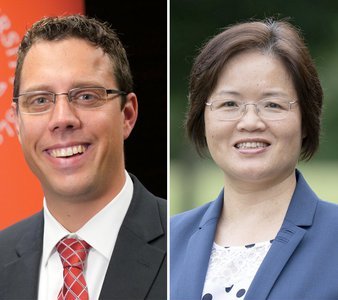
LeBeau, director of international student success, and Schaffling, assistant dean of student success in the College of Arts and Sciences (A&S) and the Maxwell School, co-authored “International Student Academic Success: A Practice-Based Model for Retention and Advising in Higher Education,” published in the Journal of College Student Retention: Research, Theory & Practice. The peer-reviewed article presents the first longitudinal, practice-based assessment of a structured international student success model published in the field.
The study draws on two sources of data: a 2022 global survey of 255 academic advisors conducted in partnership with NACADA, the global community for academic advising, and five years of program assessment data collected at Syracuse from 2020 to 2024. Together, they build the case for why international student success has been underserved—and what a structured response can look like.
The need, the survey data suggest, is significant. Fewer than four in 10 advisors surveyed believed their institution successfully supports new international students in their academic transition. Only 19% thought their institution adequately prepares international students for life after graduation. And 96% expressed a need for professional development on advising international students, a near-unanimous consensus that the field recognizes a gap and is ready for a new approach.
The article documents the development of Syracuse’s five-pillar model: prearrival academic coaching, peer mentoring, advisor training, academic intervention and communication. It tracks outcomes across four cohorts of incoming first-year international students and the results show consistent improvement across nearly every measured dimension.
Satisfaction with the peer mentoring program rose sharply, from 38% of students reporting the highest level of satisfaction in fall 2021 to 87% in fall 2024. No students reported dissatisfaction in any of the four cohort years. Students who engaged actively with their peer mentors maintained average GPAs between 3.34 and 3.48, outperforming their less engaged peers by as much as half a grade point in some years.
The Academic Success Compass, a structured advising resource developed as part of the model’s academic intervention pillar, produced gains across a range of skills and behaviors. Students who could identify degree requirements increased from 72% to 100%. Awareness of tutoring and writing center resources increased from 74% to 100%. Career readiness metrics also improved: LinkedIn profile creation rose from 48% to 79%, resume creation or updating from 55% to 79% and engagement in searching for internship or employment opportunities increased from 35% to 68%.
The article situates these outcomes within established theory, such as Tinto’s interactionalist theory of student departure and Berger and Braxton’s organizational attributes model. It also acknowledges the limits of retention as a success metric. Departmental records indicate that most international students who left during the study period did so with GPAs of 3.5 or above, indicating voluntary departure rather than academic failure.
“If a well-implemented success model prepares international students to become competitive for opportunities at other institutions, standard retention metrics may systematically undervalue the program’s actual contribution to student success,” they write.
The article calls for future research employing multi-institutional comparative designs and more nuanced approaches to measuring student outcomes, such as tracking students beyond their initial institution and disaggregating voluntary transfers from those who leave due to financial or academic hardship.
LeBeau and Schaffling note that as of 2025, no other published, data-informed framework for international student academic success exists in the literature. Their model, they argue, is designed to be adaptable across institutional types and offers a replicable starting point for colleges and universities working to move beyond transactional services, such as visa paperwork, English-language support or social programming, toward sustained academic and career investment in international students.
“Institutions must move beyond welcome orientation to provide ongoing academic support, meaningful campus connections and clear career pathways for international students throughout their entire academic journey,” they write in the study.