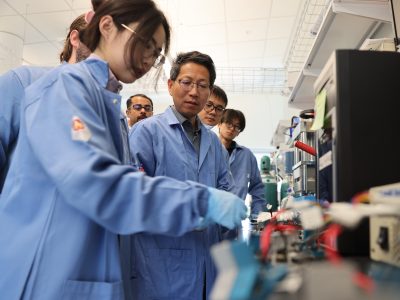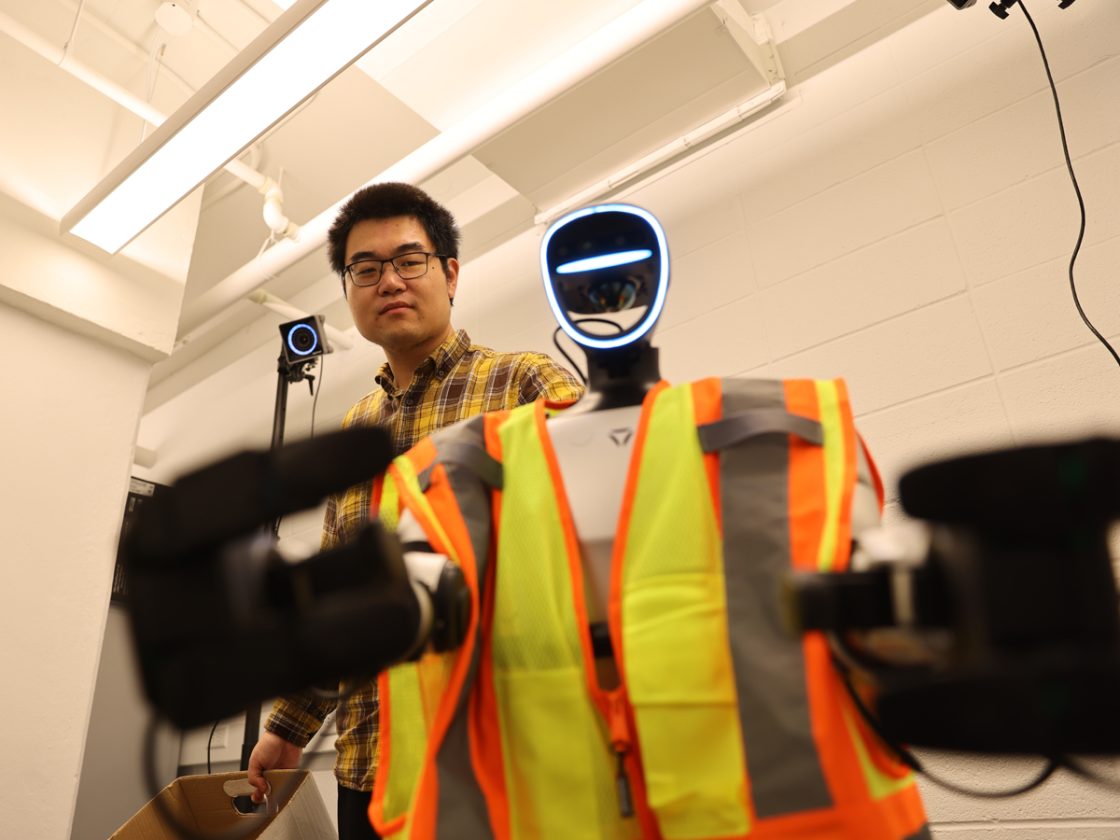
Civil and Environmental Engineering Professor Yizhi Liu has developed a first-of-its-kind breakthrough in the construction field.
Developing Humanoid Robot That Learns Construction Skills From Human Workers
Civil and Environmental Engineering Professor Yizhi Liu and his Ph.D. student Yanxi Liu have developed a system that allows a humanoid robot to observe construction workers and replicate their physical techniques, a breakthrough Liu believes is among the first of its kind in the construction field.
They published their findings in Computer-Aided Civil and Infrastructure Engineering, one of the leading peer-reviewed journals covering construction automation and robotics.
In the study, Yizhi Liu’s team built what they call a vision-based “perception-and-action” system, which enables a humanoid robot to watch, process and reproduce the motions of skilled construction workers. Using the system, the robot successfully learned and executed 30 distinct construction skills and tasks demonstrated directly by human workers on-site.
The research comes as the U.S. construction industry faces a projected shortfall of nearly 350,000 additional workers in 2026, according to estimates from Associated Builders and Contractors. Construction accidents, meanwhile, account for roughly 30% of all work-related deaths worldwide, according to the International Labour Organization.
Yanxi Liu, the study’s first author, says humanoid robots—machines built to approximate the human form—are particularly well-suited for construction work because job sites are designed around the human body. Unlike industrial robots confined to controlled factory floors, humanoid robots can navigate scaffolding, ladders and irregular terrain that more conventional machines cannot.
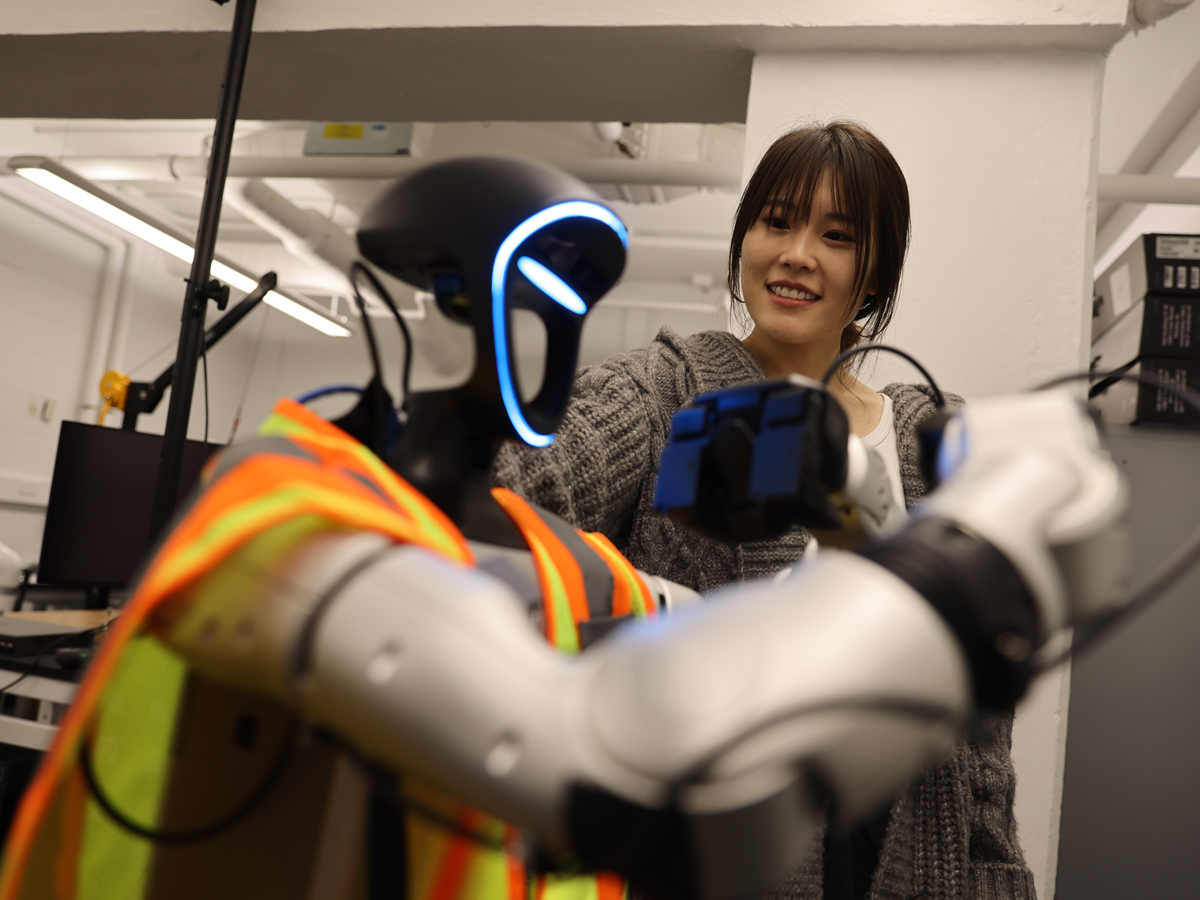
The system goes beyond remote control or pre-programmed routines. Instead, the robot uses the perception-and-action framework to interpret a worker’s body movements in three dimensions, translate those motions to fit its own physical proportions, and then carry out the task.
Yizhi Liu joined the College of Engineering and Computer Science in 2024 after earning a doctorate in architectural engineering from Pennsylvania State University. He also holds master’s degrees in electrical engineering, robotics and civil engineering.
His A-STAR lab focuses on robotics, artificial intelligence and human-robot interaction in construction settings. Prior research from the group has explored brain-computer interfaces for hands-free robot control and AI-driven systems for detecting fall hazards on job sites. Liu is also part of Syracuse University’s Center for Advanced Semiconductor Manufacturing.