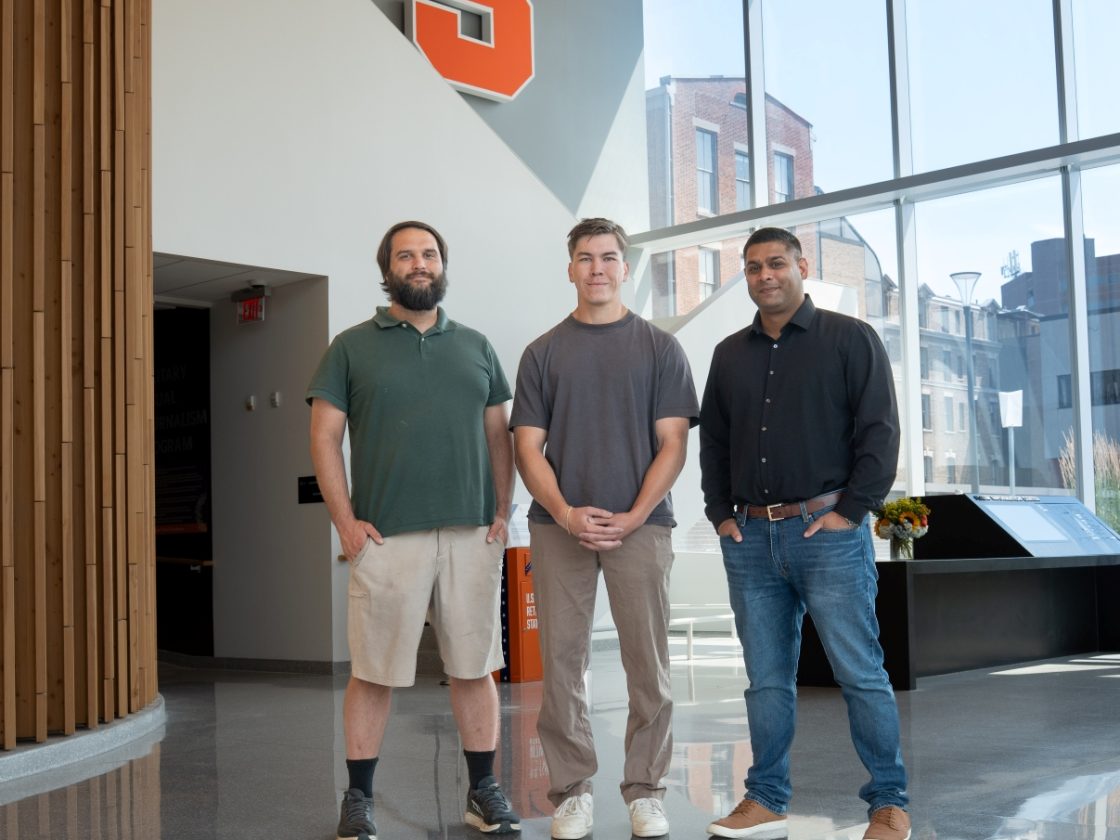
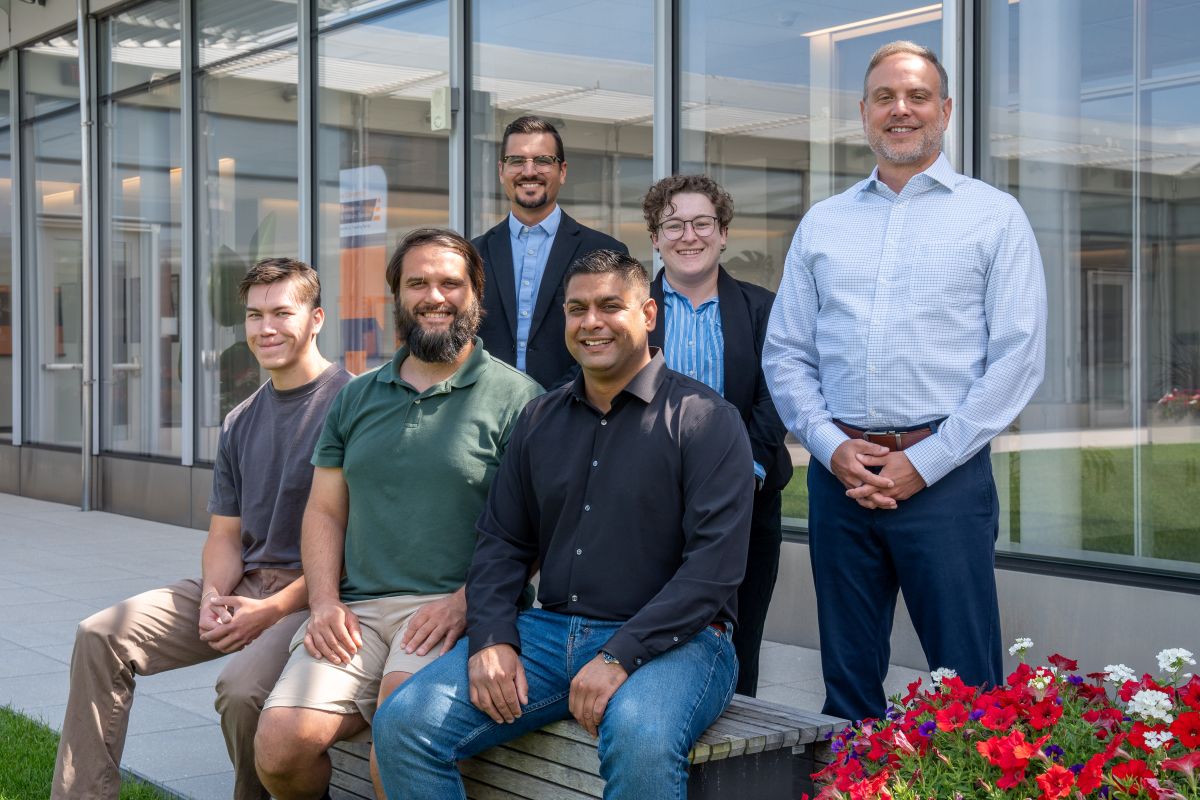
The inaugural cohort of the CHB summer research program included (from left): student veterans Matthew Soukup (Navy), Hunter Pyke (Marines) and Varun Varun Gollapudi (Army/Army Reserves). (Photo by Amy Manley)
Serving Twice: How 3 Student Veterans Became Researchers
Hunter Pyke ’27 spent four years as a U.S. Marine Corps anti-tank missileman before enrolling at Syracuse University. Matthew Soukup ’27 served 11 years in the Navy as an aviation electronics technician. Varun Gollapudi ’27 was a U.S. Army flight paramedic and now serves as a detachment sergeant for Forward Resuscitative Surgical Detachment in the Army Reserves. This summer, all three spent eight weeks in research settings studying issues related to the mental health and well-being of veterans just like them.
It’s the kind of opportunity that reflects why Syracuse University has become the best place for veteran and military-connected students—not just supporting them but putting them at the center of research that could shape care for the broader veteran community.
The three rising seniors made up the inaugural cohort of the Veteran and Military Learning Scholars Summer Program, which paired them with faculty mentors from Syracuse’s Center for Health Behavior Research and Innovation (CHB), a collaborative initiative of the College of Arts and Sciences, the Office of Research, and the D’Aniello Institute for Veterans and Military Families (IVMF).
. Over 20-hour weeks, the students dug into cutting-edge research, mental health care, and community programming for veterans and military service members. They conducted a meta-analysis of student veteran mental health. They also helped with a study aimed at encouraging healthier alcohol-related behavior among veterans in VA integrated primary care settings. Their research also stretched into issues of post-traumatic stress disorder, chronic pain, moral injury and suicide prevention.
New Skills, New Direction
For Pyke, a psychology and neuroscience major in the College of Arts and Sciences (A&S), the experience sharpened how he thinks. The work, he says, “furthered my academic development and gave me a new perspective on how to approach problems, evaluate possible solutions and consider the needs of the individuals involved.”
Soukup, also a psychology major, says the program, which comes with a $2,500 stipend, let him focus fully on the work without financial stress. It also opened his eyes to what comes next. “Our visits to community groups doing real work in the field has provided newfound insight into what potential future careers could look like,” he says.
Gollapudi, a biology/pre-med major who spent his career as an operational medic, found particular meaning in learning directly from faculty experts. “Working with [these professionals] is an amazing opportunity to learn and fine tune my skills,” he says. Field trips and conversations with fellow veterans, he adds, gave him a deeper understanding of behavioral health issues.
Program coordinator and CHB/D’Aniello Institute for Veterans and Military Families (IVMF) postdoctoral scholar Emily Rabinowitz says visits to the Syracuse VA Medical Center, Clear Path for Veterans, Veterans Treatment Court and Altamont Syracuse Veterans Residential Program, along with training on suicide prevention and other wellness topics, “allowed the students to translate academic literature to on-the-ground applications. They are learning from people who are doing the work and seeing the outcomes of those efforts.”
The Program Behind the Experience
An extension of the University’s longstanding commitment to veterans and military-connected families, the CHB-sponsored program grew out of the Veteran and Military Behavioral Health Collaborative, a partnership between CHB, the IVMF and the Office of Veteran and Military Affairs (OVMA).
“Our goal was to extend that experiential learning model to create an accessible, high-impact pathway connecting student development with active scholarship and mentorship and with veteran-serving organizations while helping strengthen the University’s veteran and military academic ecosystem,” says Joseph Ditre, CHB director and professor of psychology in A&S.
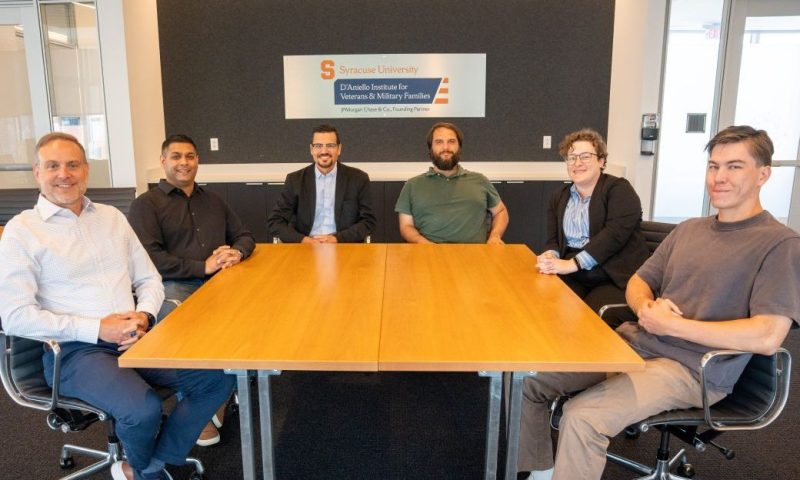
Ditre co-leads the program with Kenneth Marfilius ’07, CHB associate director of education and training and an associate teaching professor of social work in the School of Education, and Rabinowitz. The program was supported by Marfilius’ Meredith Professor Teaching Award, with additional funding from CHB.
Ditre says the students have been highly engaged, taking full advantage of these new research, training and professional development opportunities. “The students are building new skills, clarifying their career interests and forming connections across Syracuse University and the broader veteran-serving community,” Marfilius adds.
The program strengthens cross-unit collaboration between CHB, IVMF and OVMA and builds a longer-term pipeline into research, graduate training and health-profession careers. Moving forward, organizers hope to expand the number of scholars, mentors and research opportunities while preserving the close mentorship that defines the program.