Researchers Examine the Invisible Hearing Struggle of Student Veterans
Hearing loss and tinnitus are the two most common service-related disabilities among U.S. veterans, affecting more than three million people nationwide.
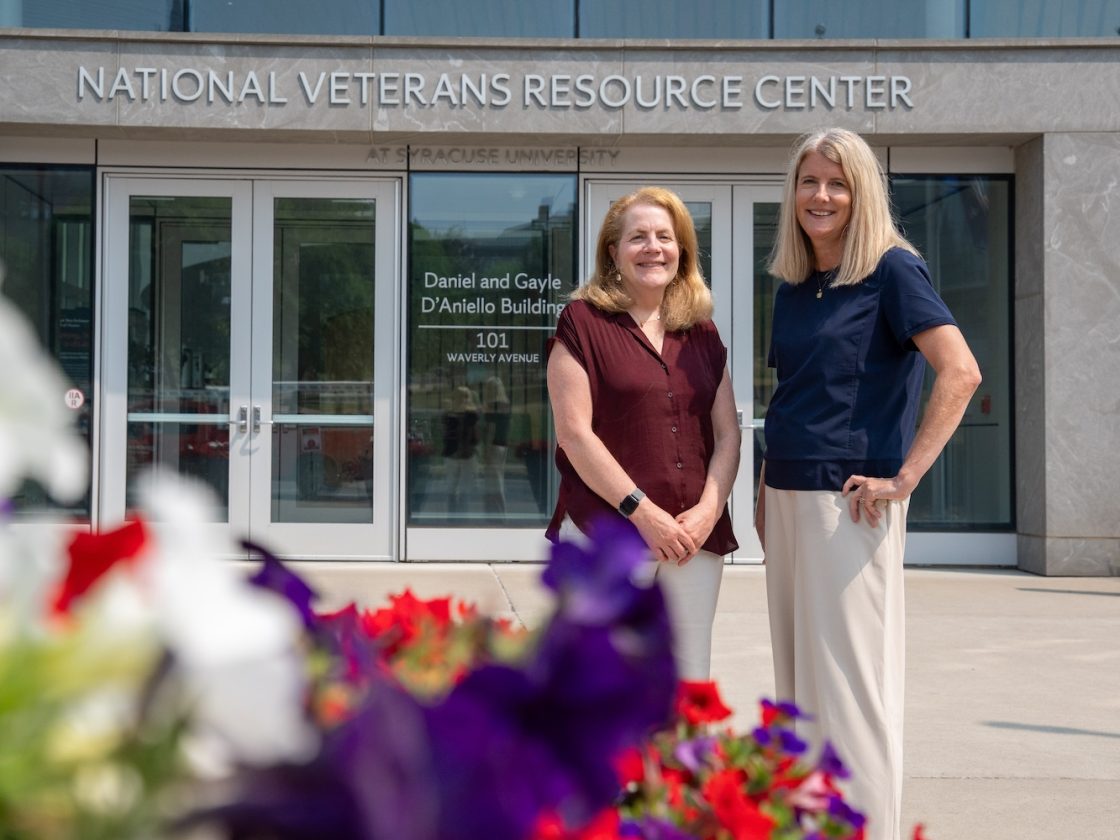
Knowing military service members are routinely exposed to noise that can cause lasting auditory damage, which can make school harder for active duty and student veterans, Karen Doherty, senior associate dean for faculty affairs and professor in the Department of Communication Sciences and Disorders in the College of Arts and Sciences, and Tammy Kordas, associate teaching professor also in CSD, set out to learn how tinnitus may be impacting veteran students on campus.
When the two certified audiologists initially went looking for existing research on the prevalence of tinnitus—a ringing or other noise in the ears that isn’t caused by external sound—among veterans on college campuses, they found almost nothing.
So they, along with two of their doctoral students, Marissa Merrifield and Joshua Deus, surveyed service members and veterans currently enrolled at Syracuse University to explore the relationship between self-perceived hearing difficulty and listening fatigue and self-perceived hearing difficulty and tinnitus severity.
The two faculty members have collaborated on research in the past, though this is their first project focused on veterans. Together, they bring complementary expertise to the project. Doherty contributes a research perspective, while Kordas brings a clinical perspective and specialized training in tinnitus management through her work with patients at the Gebbie Clinic.
Doherty says the sparse literature on student veterans and tinnitus wasn’t entirely surprising. Most tinnitus research focuses on older veterans, the demographic that arrives at VA medical centers in their 60s and 70s, ready for hearing aids for diagnosed hearing loss.
Student veterans, meanwhile, appeared to occupy a different and largely unexamined space.
“You might have ‘normal’ hearing yet have a lot of difficulty hearing in background noise as well as challenges in trying to deal with the secondary effects of tinnitus,” Doherty says.
To get a sense of how much tinnitus impacts student veterans, they sent out the survey with the help of retired U.S. Army Colonel Ron Novack, executive director of the Office of Veteran and Military Affairs.
Determining the Prevalence—and Impact—of Tinnitus
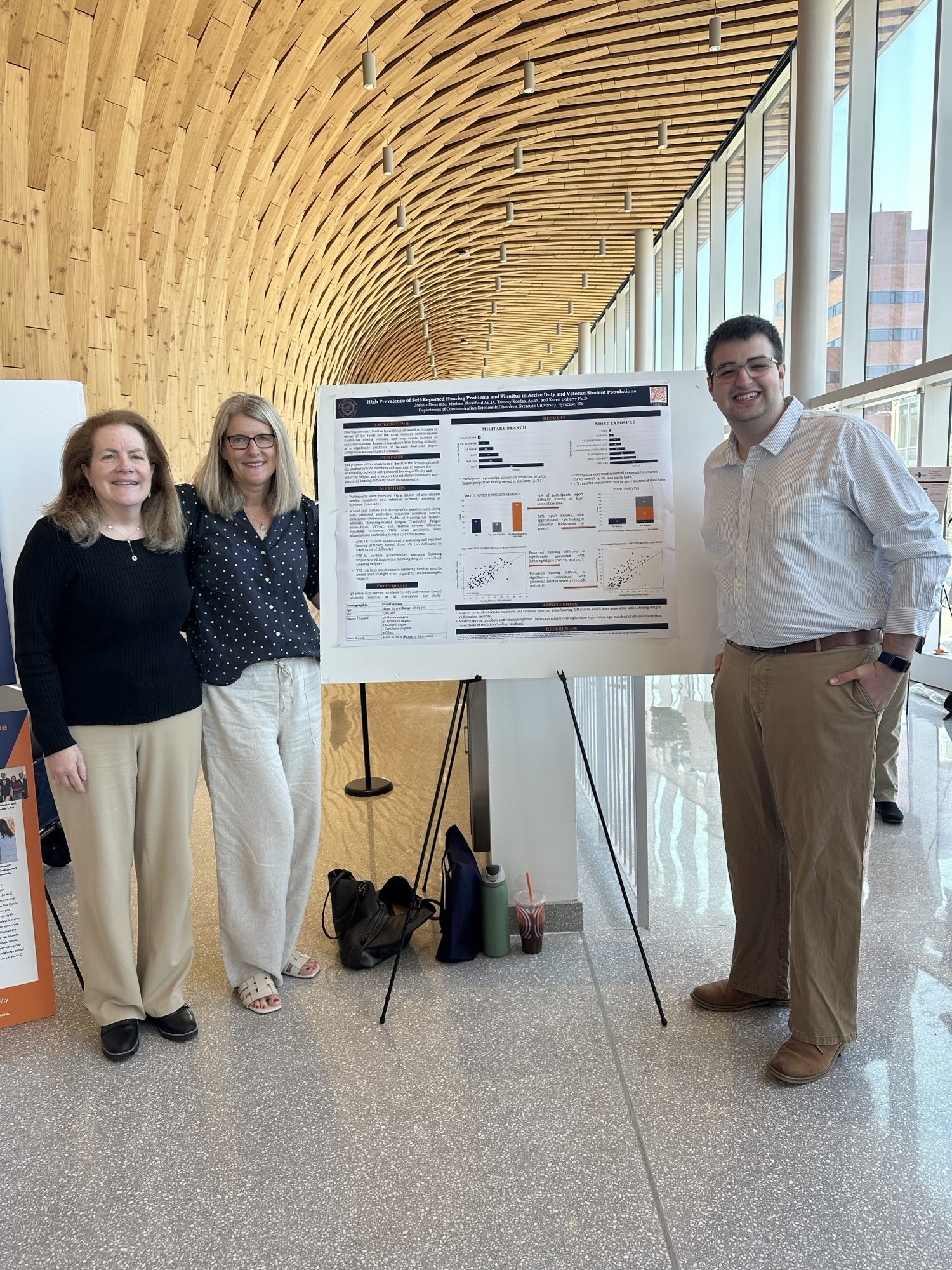
The research team developed a survey combining standardized outcome measures for determining self-perceived listening difficulties and the severity of a person’s tinnitus. Original questions about the students’ past noise exposures, such as firearms, explosions or piloted aircraft, were included.
“Tinnitus is one of the most common service-connected injuries affecting members as they transition out of military service,” Novack says. “It affects your quality of sleep, your concentration. It affects stress levels for you, either up or down, depending on the acoustics in the environment in which you’re operating. It affects your ability, or a student’s ability, to fully engage in learning environments.”
For student veterans, experiencing tinnitus could mean difficulty focusing during lectures or increased fatigue, with background noise in a classroom forcing them to work twice as hard to hear the lesson.
“The tinnitus itself wears on anyone,” Novack says. “It can increase anxiety in what we would like to see and experience as a quiet learning environment. And veterans may not come right out and tell someone they have this problem. They’re going to go into a classroom, and they’re going to find a way to navigate that invisible disability potentially without an accommodation, because they don’t think it’s a big deal. So they might be recording the whole entire lecture and then come back and take notes at their own pace and cadence.”
The research team sent the survey to 270 student veterans in the fall and 97 responded. Of those students, 82% reported experiencing tinnitus.
Students who reported experiencing tinnitus went on to complete a standardized test measuring the severity. Forty percent reported bothersome tinnitus, which indicates it is affecting quality of life. Only about 10% of the general population in the same age range experiences bothersome tinnitus.
“We went into this with certain hypotheses, one of them being that exposure to loud noise during military service would be associated with higher rates of tinnitus,” Doherty says. “But we didn’t know it was going to be more than twice those of traditional college students. We were really surprised.”
A Starting Point
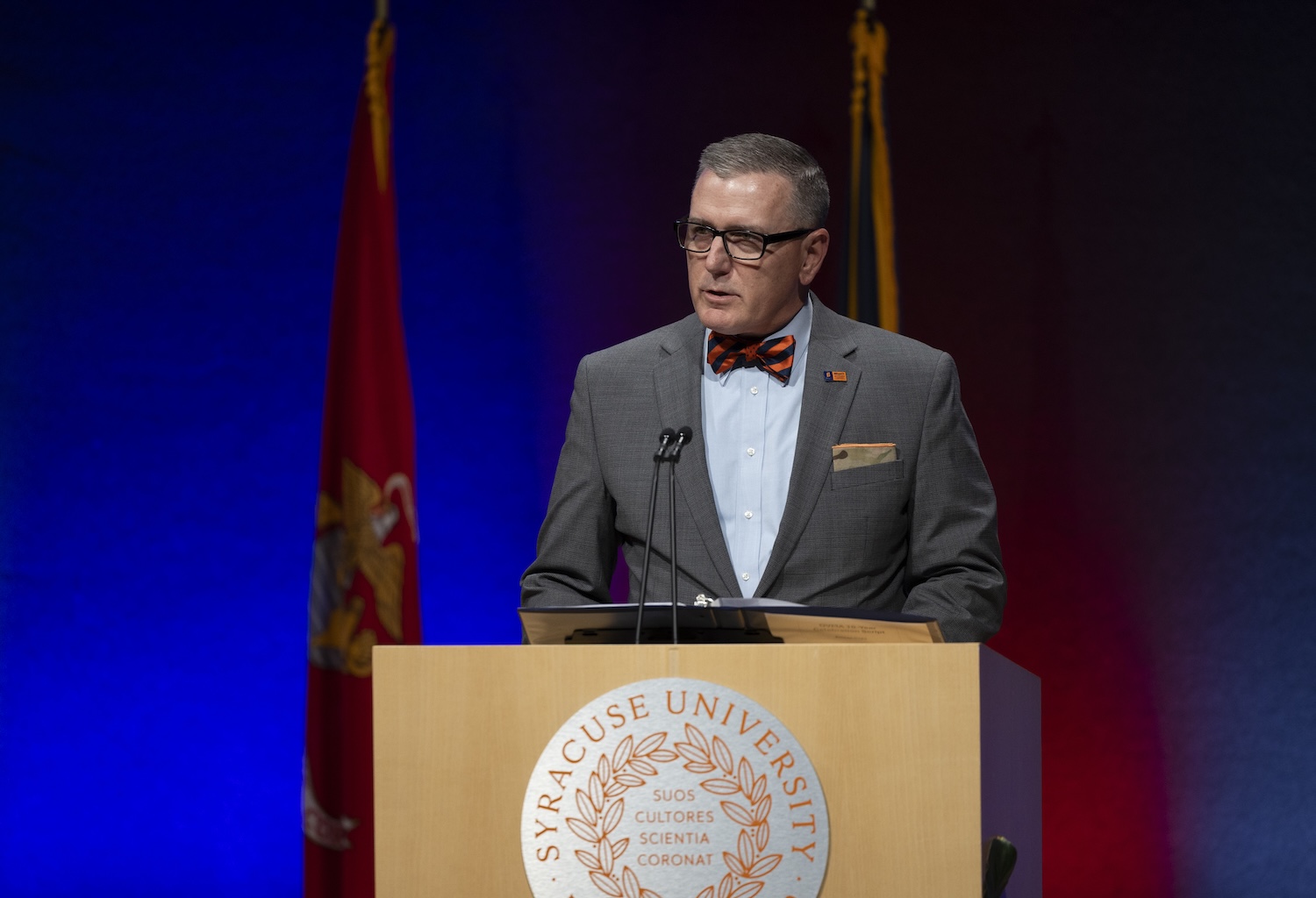
Kordas, Doherty and Novack all agree that identifying the scope of the problem is only the first step toward developing meaningful support and solutions.
“It gives us more of an opportunity to move from an anecdotal awareness on campus, toward a more data-informed understanding of how this issue really affects student veterans at the University,” Novack says.
Doherty and Kordas aim to implement interventions for student veterans with listening difficulties and tinnitus, including using hearing assistive technologies in the classroom that improve signal-to-noise ratios in lecture settings. This would potentially reduce fatigue and listening effort.
The researchers also hope to bring student veterans into a clinic setting to assess whether their tinnitus is accompanied by measurable hearing loss.
“You can manage and treat tinnitus, so knowledge is power,” Kordas says. “I think providing them with informational counseling about this condition would be beneficial as well.”
Many student veterans may already be eligible for treatment or other interventions for their hearing difficulties through the VA medical center.
“‘I need assistance,’ that’s what our veterans need to say,” Novack says. “Once they do that, we have the Center for Disability Resources here on campus and we have the VITAL program where we can help knock down barriers and facilitate care for our veterans who might need accommodations, need to have this tinnitus addressed and put in a care plan to assist them.”
First for Veterans
The University’s infrastructure for veterans made this research possible in a way few universities could replicate, Doherty says.
“We couldn’t do this without the veteran center being the way it is, and Ron’s support of the project was an integral part of its success,” she says.
Novack says the OVMA is always eager to partner and support “responsible research that helps better inform and understand the lived experience of our veterans.”
“It’s small things like this that move the needle each and every day,” he says. “And our longstanding institutional commitment is what brings transitioning service members to Syracuse, because they know when they come here, they’re going to get taken care of, that this institution has a national reputation for taking care of those who have worn the nation’s cloth.”
What the research team learned and implements as a result of their recent study could serve as a model for other academic institutions with smaller veteran programs and less organized support systems, Doherty says.
“There are a lot of people who have tinnitus and there are ways to treat it,” Kordas says. “It may not go away completely, but the goal is to manage it and reduce how much it affects daily life.”