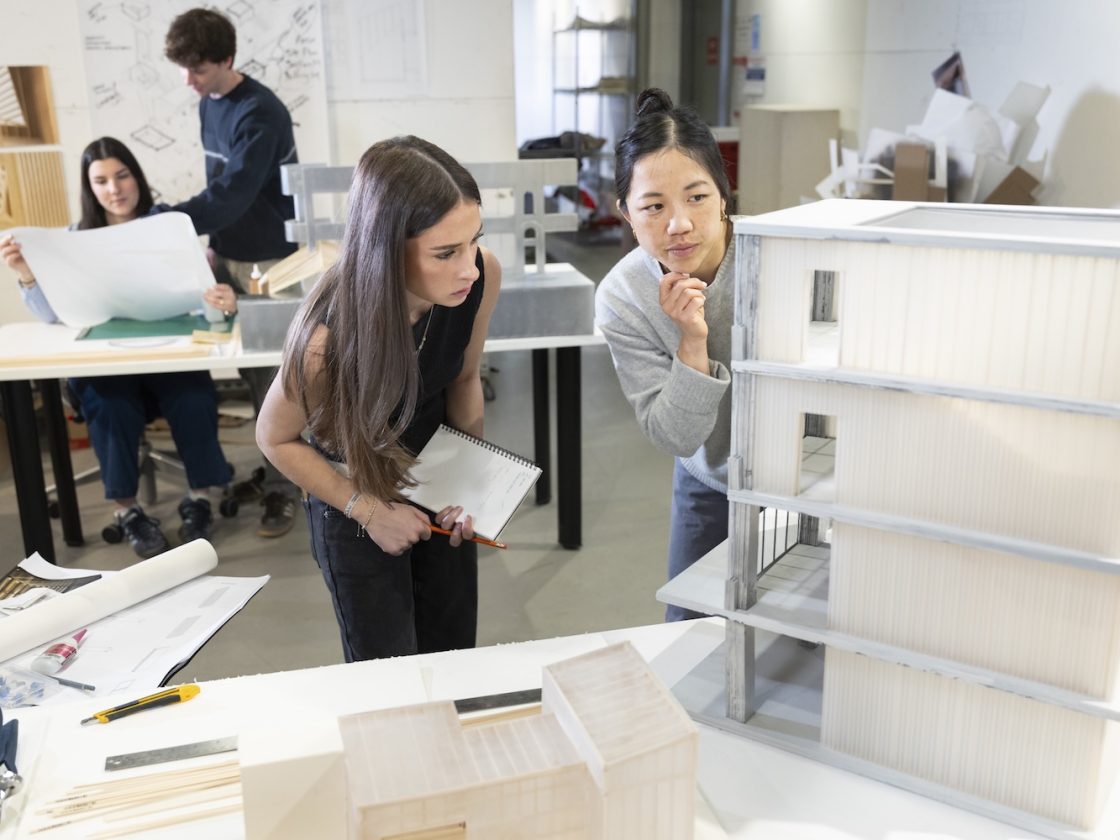
Tiffany Xu (right) with students in her studio during her Boghosian Fellowship
Fellows Reflect as Boghosian Fellowship Enters Its Second Decade
Buildings are often taught and drawn as finished objects, but they behave differently once people occupy them. They wear, they’re repaired, they’re inhabited in ways the designers might not have anticipated, says Dennis Sola, the School of Architecture’s 2026–27 Harry der Boghosian Fellow.
That relationship between buildings and time is the subject of his fellowship year.
“The aim of this research is not to predict the effects of time on matter, but to understand how to operate under the premise of uncertainty and what possibilities open up when we relinquish the idea of permanence, or immunity,” he says.
It’s a different question from the one Erin Cuevas pursued as the 2024–25 Boghosian fellow, when she explored the intersection of performance art, interactive digital media and architectural installation through immersive experiences that blurred the lines between audience and performer. Tiffany Xu, the 2025–26 fellow, took a third path, studying how wood is grown, milled and framed.
But all three are the kind of inquiry the fellowship was created to support.
Established in 2015 by Paula der Boghosian ’64 in memory of her brother, Harry der Boghosian ’54, the residency is entering its second decade with Sola as its 11th fellow. The yearlong residency gives emerging independent creatives the opportunity to develop a body of design research while teaching at the School of Architecture.
Designing for Uncertainty
Sola says his practice has always been closely tied to understanding territory, climate and landscape.
“These concerns inevitably led me to ask, progressively, about the material permanence of our work, and about how a building traces a trajectory through time, from the moment it is conceived to its eventual disappearance,” he says.
He hopes students will practice what he calls attention, an idea he draws from French philosopher Simone Weil: observing the ordinary and the deteriorated, and letting a building reveal its current condition before imposing ideas on it. Design opportunities, he says, follow from that openness.
That approach shapes his fall seminar, in which students observe maintenance, construction deficiencies and habits of use in Slocum and Smith halls. Their findings will become full-scale “interventions” that are installed temporarily and then withdrawn, leaving no permanent trace.
The seminar does not try to anticipate or solve deterioration, Sola says.
“In my proposal, deterioration is not something to be foreseen but something to be worked with, channeled rather than predicted,” he says. “That cycle of installing and withdrawing is the built form of the question that interests me, how to operate once permanence is relinquished.”
He expects students to push back.
“When several people observe the same building, readings of deterioration, maintenance and use emerge that I wouldn’t arrive at on my own,” he says.
A successful year, Sola says, would let him build at least one prototype “out in the weather,” exposed to climate and the passage of time. He also hopes to collaborate with the SUNY College of Environmental Science and Forestry on landscape and climate and with civil engineering on construction systems that allow for change.
His fellowship will culminate in an exhibition at Slocum Hall.
Architecture for Performance
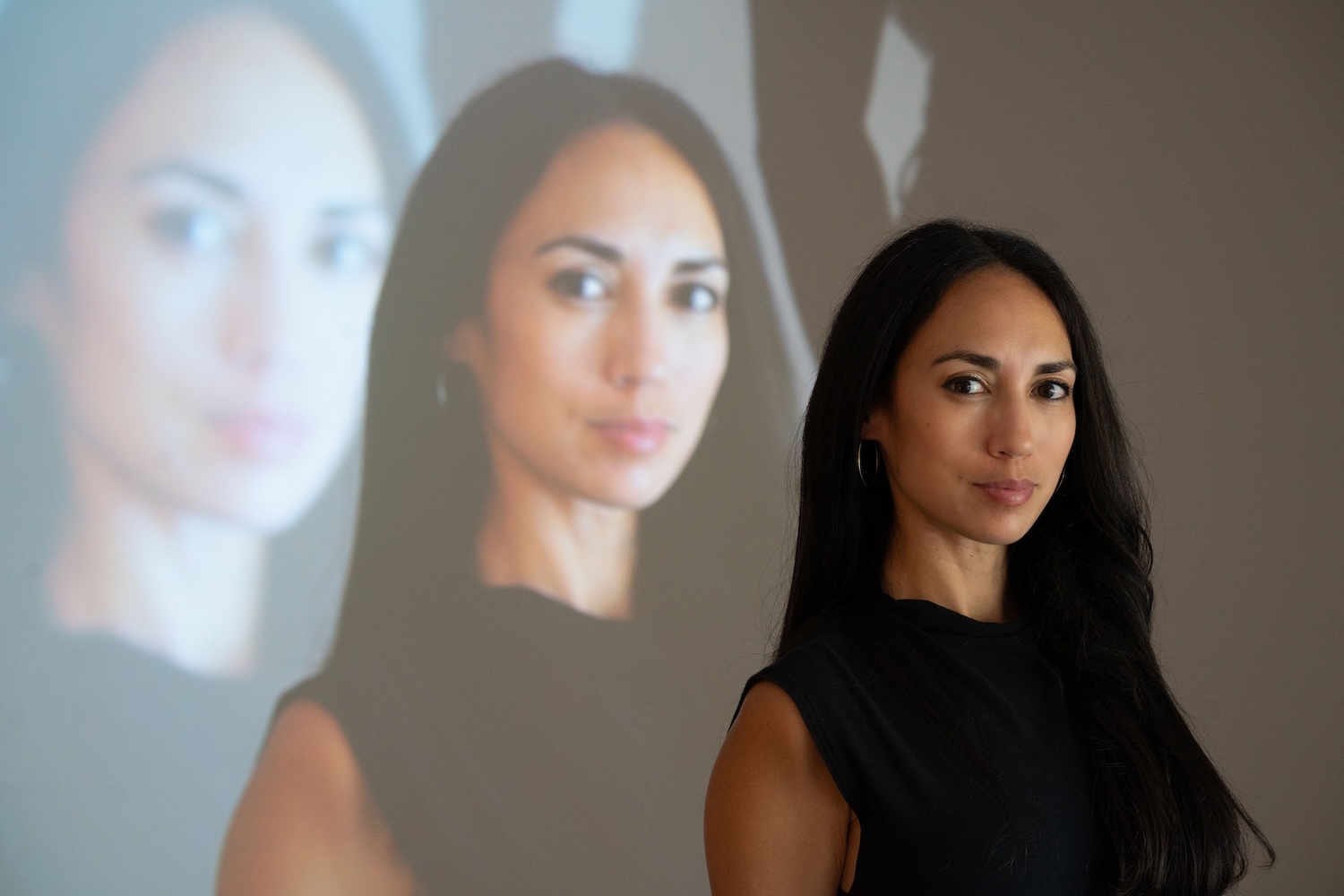
Cuevas, the 2024–25 fellow, arrived from a full-time job in a large corporate setting after a couple of years away from teaching.
“It was a pivotal moment in my career, the first opportunity I had to pick up my life, move across the country and fully dedicate myself towards my own work within a rigorous academic setting,” she says. “The fellowship gave me the permission to take the leap.”
As the ninth Boghosian fellow, her research culminated in Ouroboros, a seven-chapter immersive performance staged on a grid of 36 poles in the Everson Museum of Art’s ceramics gallery.
“It was important to me that the academic research could be accessible and translatable to storytelling for the broader public, which the Everson platform afforded,” she says.
In her elective, students each chose a performance type, from ballet to tennis to circus, and examined how architecture shapes perception, power and control. Her studio was the first to collaborate with the fashion design program, pairing architecture and fashion students.
Building With Wood
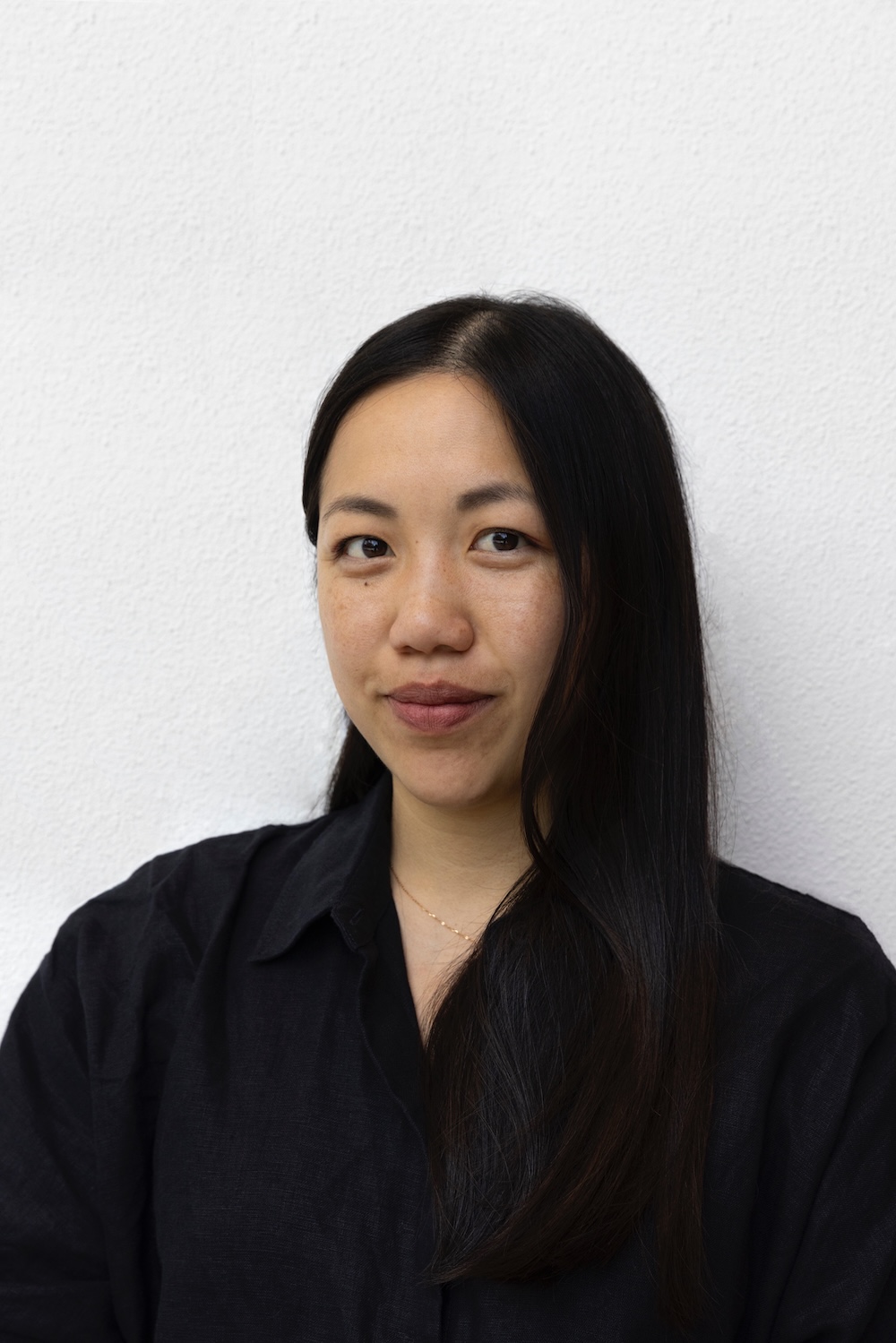
Xu, the 10th Boghosian fellow, spent her year examining light timber framing and how its construction shapes architecture. She came to Syracuse from the University at Buffalo, where she was the 2024–25 Peter Reyner Banham Fellow.
Her option studio began with making models of volumes and planes built to the rules of stud framing. Students then used contemporary fiction as prompts for reworking light timber precedents, eventually building a full-scale model. The class traveled to Northern California to visit in-progress framed houses by small experimental practices in the Bay Area and at Sea Ranch.
“It was insightful to see students absorb and interpret the prompt in unanticipated ways and develop novel tectonics and material arrangements,” Xu says.
Her fellowship installation paired a half-scale framing model of Robert Venturi and Denise Scott Brown’s Trubek and Wislocki houses with a lightbox of documents used to build the details and harvest softwood from managed forests.
“It calls attention to the areas that require high craft—time and attention–from adjacent disciplines, such as shims that are cut to site-specific conditions by the builder and ecological permits from licensed foresters,” she says. “It asks viewers to think more critically at what might appear arbitrary and standard practice in this discipline.”
Freedom to Push Forward Practice
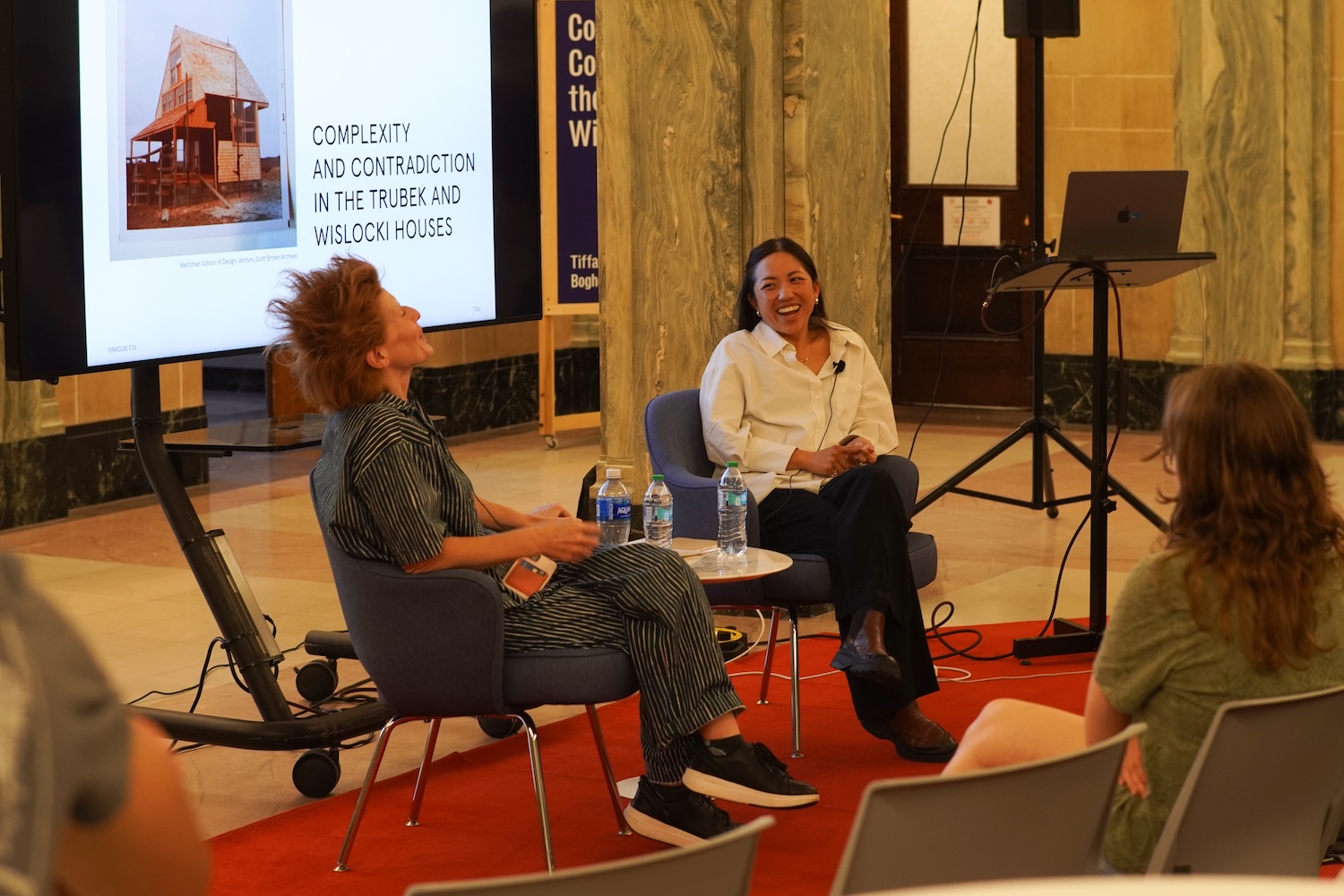
Though their subjects differ all three fellows describe the fellowship as a rare and impactful chance to test ideas against students, collaborators and the world beyond the studio.
“The Boghosian Fellowship is absolutely transformative for anyone in the early stages of an experimental practice or research and teaching career,” Xu says.
She says the balance of teaching and production timelines, coupled with colleagues who are “extremely smart and critical” and students who are engaged, makes the fellowship stand out.
Cuevas says the diversity of research across fellows is one of the program’s greatest strengths.
“The faculty at Syracuse are extraordinarily talented and generous,” she says. “There is a real culture of collaboration, curiosity and possibility that makes the School of Architecture a particularly fertile environment for experimentation and exchange.”
The fellowship helped her reconnect with her own practice—teaching, pursuing commissioned design work and developing her research together, she says. It became the most fruitful year of business since she started her studio in 2016.
With the opportunity the fellowship offers comes a “significant responsibility,” Sola says. He hopes the work he produces “can be carried further in the years that follow at the school.”
For future applicants, Cuevas offers this advice: “Be fearless in embracing freedom of exploration, expand the boundaries of your own work and think big.”