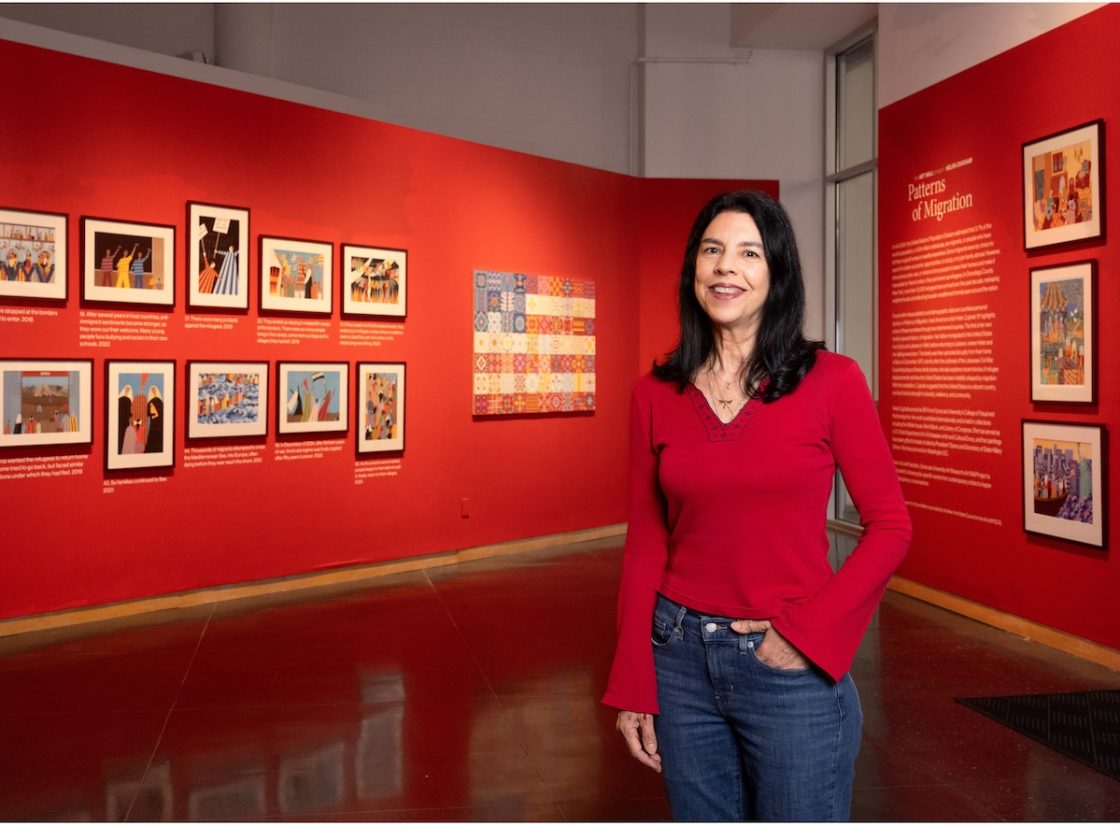
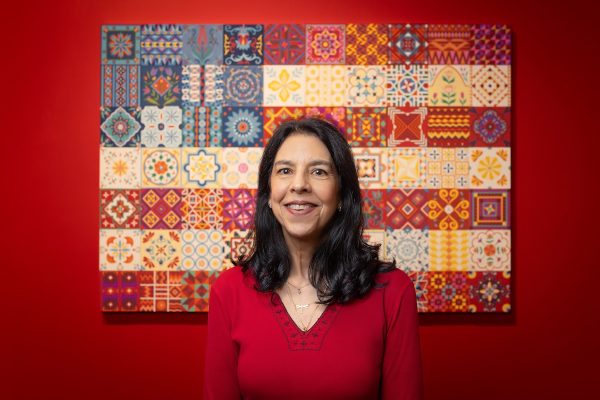
Alumna artist Helen Zughaib stands with her artwork being exhibited at the Syracuse University Art Museum. (Photo by Marilyn Hesler)
Acclaimed Alumna Artist Shares Stories of Family and Migration
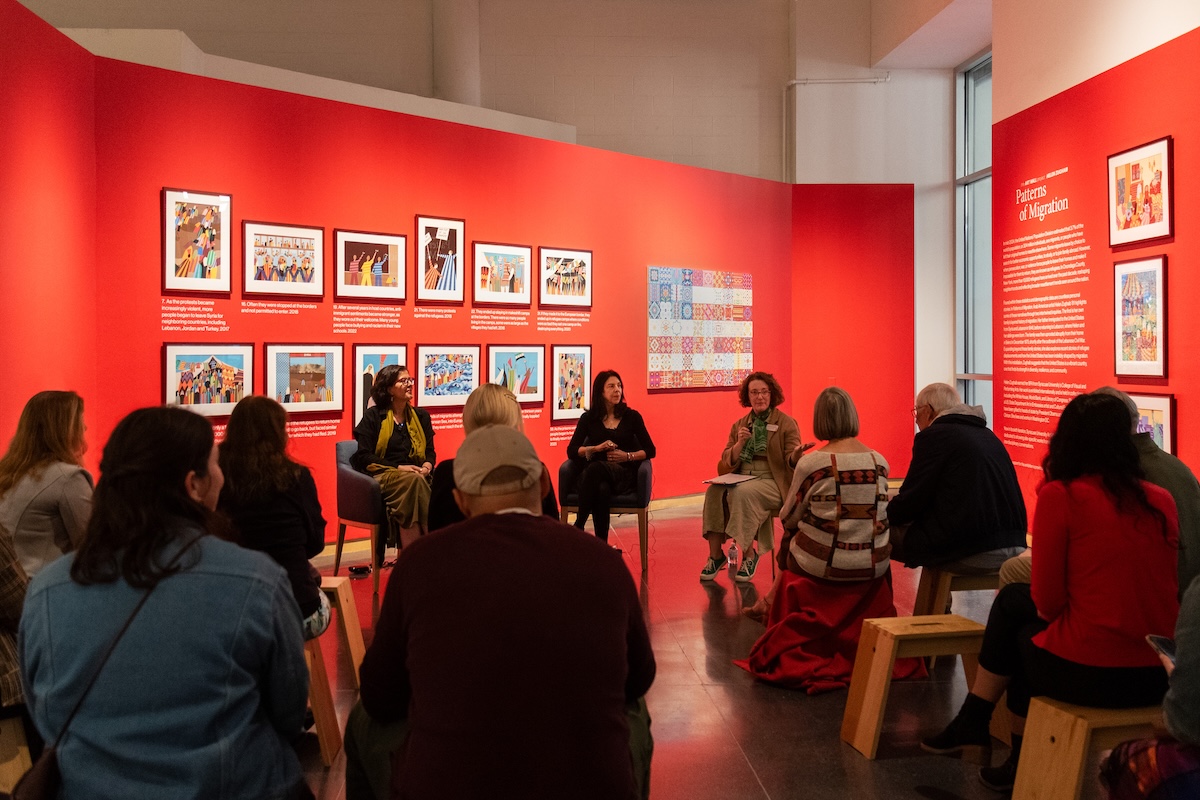
Sitting in the Syracuse University Art Museum, internationally renowned artist Helen Zughaib ’81 reflects on her work featured in “Patterns of Migration,” the latest rendition of the museum’s Art Wall Project. She shares stories of her family and how they fled Lebanon when civil war broke out in 1975. She talks about visiting refugee camps and heartbreaking conversations she’s had with people displaced by war. And she talks about her art, its influences and the impact she hopes it has.
“The majority of my work is trying to have a connection or put something in a different light,” she says. “Art can just be beautiful, but I do try and say something with my art.”
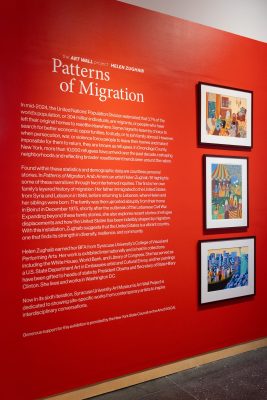
In the exhibition, Curator Melissa Yuen brings together themes of family history, refugee displacement and migration’s influence on America in Zughaib’s art:
- Three pieces from “Stories My Father Told Me,” a book and art project she collaborated on with her late father, Elias Zughaib ’51, G’52, G’57, who was known as a storyteller in the Arabic oral tradition and created a deep connection to Syracuse University for their family;
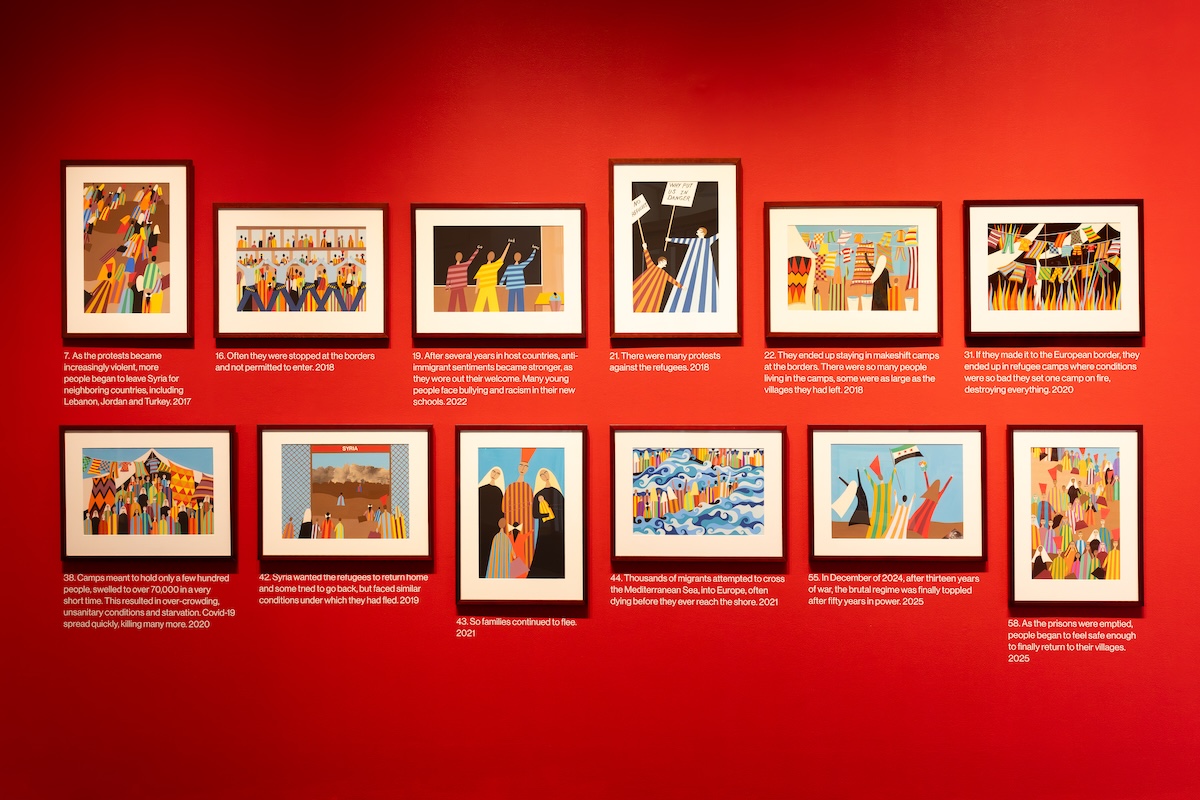
- 12 gouache paintings from “Migrations”: Inspired by artist Jacob Lawrence’s 60-part “The Migration Series” depicting African Americans’ movement from the rural South to the urban North, Zughaib created a 58-panel series documenting the Syrian migration—from the Arab Spring to the civil war to the 2024 fall of the Assad regime; and
- “American Mosaic: Wall of Resilience,” a colorful, patterned tile version of the American flag that she created for the exhibition.
“It’s intentional that all the tiles are butted up to one another, reflecting the solidarity of people in this country standing together and a wall of resilience,” she says.
Zughaib’s artwork has been exhibited around the world and featured in numerous collections, including the White House, Library of Congress and World Bank. She has also served as artist and cultural envoy for the U.S. State Department’s Art in Embassies initiative.
Connecting With Syracuse
Zughaib’s father was born in Damascus, migrated to the U.S. as a teenager and earned three degrees from Syracuse University, including a Ph.D. in international relations from the Maxwell School of Citizenship and Public Affairs. A U.S. Foreign Service diplomat, he was working at the U.S. Embassy in Beirut when fighting erupted in Lebanon, and he guided his family to safety.
“We left everything,” says Zughaib, who was 16 at the time.
They were evacuated to Athens, Greece, and eventually settled in Paris, where her interest in art flourished and she set her sights on the College of Visual and Performing Arts.
“I had grown up with my parents talking about Syracuse, and my dad loved the football,” she says. “All I knew was the Orange and Syracuse—nice memories that we grew up with.”
For her portfolio review, she met with a faculty member at the Louvre Museum and showed her art on a bench.
“I didn’t think about it at that time. It was sort of matter of fact,” she says. “I knew what I wanted when I came to Syracuse, so I went right into the art.”
Zughaib’s mother, Georgia ’55, G’59, and three siblings—Edward L’85, Nancy G’89 and Karen L’91—all earned Syracuse degrees as well. She majored in surface pattern design and discovered her affinity for gouache.
“I’m so thankful for that,” she says. “It suits me. You can see the patterning and the simplification that I use and the intensity of the colors.”
Identifying With Personal Stories
At the core of her art is a commitment to creating understanding among different cultures and promoting a sense of shared humanity. For Zughaib, 9/11 represented a turning point in her life as an artist. As an Arab American, she wanted to counter the negative stereotypes and misconceptions about Arabs and Arab Americans.
“9/11 refocused my concept of what I should do as an artist and what my responsibility as an artist is to do,” she says.
In “Migrations,” Zughaib subversively pairs colorful imagery with captions that reflect the reality of the Syrian refugee experience. She believes strongly in the power of refugees’ personal stories, knowing they can move people, invite dialogue and create understanding and empathy. And that’s the message she shares through her art.
“Whether or not I’m successful,” she says, “I’m not really sure, but that is what I would like to happen.”