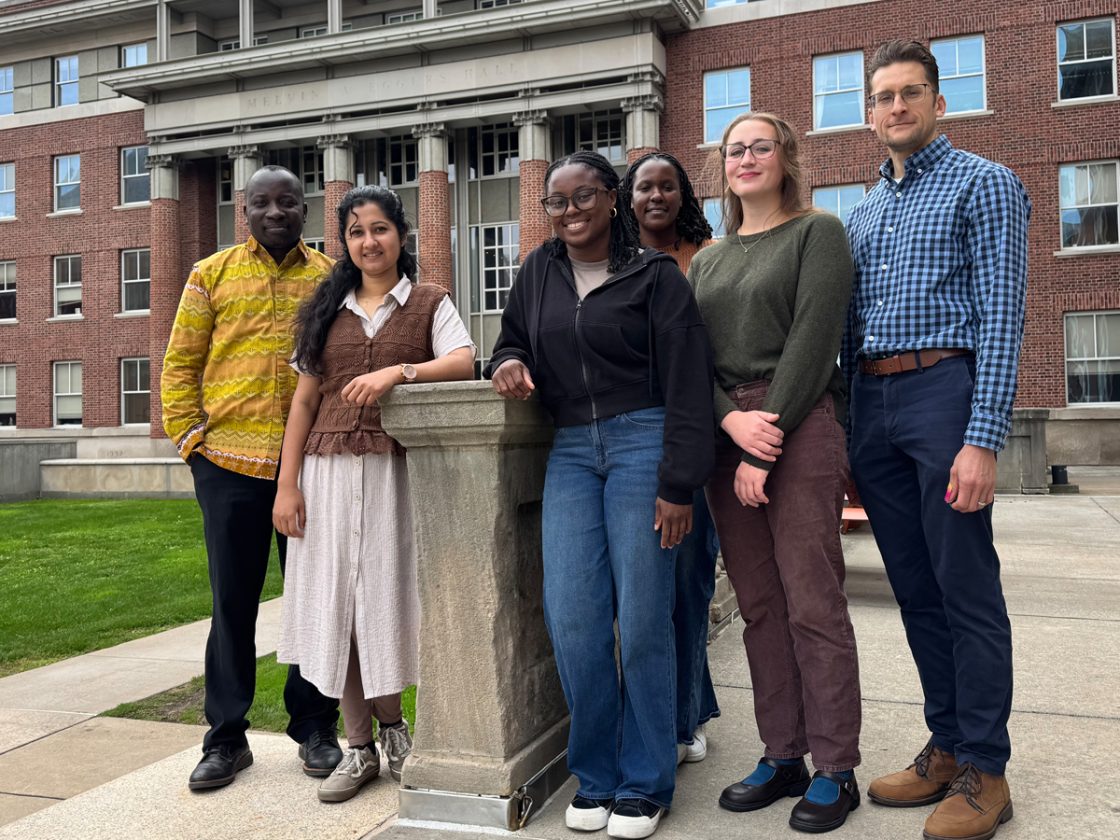
From left: Bernard Appiah, Jannat Ara Disha, Fikayomi Okunzua, Jane Apiyo Abok, Eulena Banzer and Bryce Hruska.
Public Health Students Take Their Research to a National Stage
Five projects by students in the Maxwell School’s public health department have been accepted for presentation at the American Public Health Association’s (APHA) 2026 Annual Meeting and Expo in San Antonio, Texas, Nov. 1-4.
The projects were developed under the mentorship of public health faculty members Bernard Appiah, Brooks B. Gump, David Larsen and Bryce Hruska, along with several research collaborators. Together, the projects range from a first exploration of a public health topic in an undergraduate course to graduate-level studies built on years of ongoing faculty research.
Organized this year around the theme “Together We Thrive: Health Across the Lifespan,” the conference is expected to draw about 11,000 public health professionals, researchers, educators and students from around the world. APHA calls it the largest public health gathering of the year.
Postpartum Depression Coverage
One project grew out of Global Health Communication and Advocacy, a course taught by Appiah that asks students to analyze real advocacy and communication problems.
Public health undergraduates Fikayomi Okunzua, Hannah Fuchsberg and Aneesa Haque—along with Max Loccisano of the State University of New York College of Environmental Science and Forestry—turned a class assignment into a research paper, “Postpartum Depression in US Southern States Newspapers: A Content Analysis of News Coverage of Burden, Diagnosis, Treatment and Race, 2016-2025.”
Their abstract was accepted for a roundtable. At the conference, Okunzua, Fuchsberg, Haque and Loccisano will field questions and walk through their findings conversationally with a rotating audience of public health professionals, researchers and students.
The students analyzed a decade of newspaper coverage of postpartum depression in Southern states, looking at how it addressed the condition’s burden, diagnosis and treatment, and its effects by race. Research has shown that postpartum depression disproportionately affects women from lower socioeconomic backgrounds and women of color, particularly Black women.
“Our project was basically a summary of how no one has been educating or spreading information about postpartum depression,” Fuchsberg says. “It shows a huge gap in what is needed. In my career, I hope to create the content that doesn’t currently exist.”
“I’m really just excited to kind of bring more attention to postpartum depression and the care that we can bring to people who are facing it,” Okunzua says.
Comparing End-of-Life Policy
A second project, also accepted as a roundtable, began in a course taught by Hruska, an associate professor. Graduate student Eulena Banzer adapted a class project into “Medical Assistance in Dying as an Emergent Public Health Issue: A Comparison of Policy Landscapes and Ethical Frameworks in Canada and Oregon.”
Banzer’s research compares how Oregon and Canada have approached medical assistance in dying (MAiD), a practice that allows eligible patients to end their lives with medical support. Oregon’s law, in effect since 1997, allows terminally ill adults to take prescribed medication themselves. Canada legalized the practice in 2016, allows clinicians to administer it and has since seen use rise sharply.
Using APHA’s Public Health Code of Ethics, Banzer examined both policies through a public health lens rather than the bioethical framework typically applied to end-of-life law. She found that a public health approach surfaces concerns—for both patients and the broader population—that bioethical analysis alone can miss.
“Much of the existing literature around the ethics of MAiD policy focuses on individual rights and safeguards,” Banzer says. The population-level approach of the APHA Public Health Code of Ethics makes it easier to judge whether a policy addresses concerns raised by disability rights advocates and other interest groups, she says.
The “tenets of public health ethics,” such as permissibility, respect, equity and transparency, “allow for analysis of existing MAiD policies to be put in direct conversation with major critiques of such policies,” Banzer says.
Pesticide Exposure in Children
A third project, accepted for an oral presentation, examines how exposure to pyrethroids, a class of insecticide widely used in homes and on farms, is linked to children’s health. Graduate students Jane Apiyo Abok and Jannat Ara Disha worked with Gump, the Falk Family Endowed Professor of Public Health, and Larsen, professor and chair of the department, as well as several other researchers, on “Pyrethroid Exposures in Childhood: Associations with IQ and Depressive Symptoms Are More Pronounced Among Children Facing Concurrent Adversity.”
The study draws on Syracuse’s long-running Environmental Exposures and Child Health Outcomes cohort and examines pyrethroid exposure in more than 240 children ages 9-11. The researchers found that higher exposure was associated with lower nonverbal IQ scores and greater depressive symptoms, and that some of these associations were more pronounced among children already facing higher levels of adversity.
“Exploring the connection between pyrethroid exposure and childhood adversity is a relatively new area of research,” Disha says. “Being part of this work has been a valuable learning experience for us, and the opportunity to present our findings at APHA makes this even more rewarding.”
“Working on this project with Dr. Gump made me realize how important it is to consider environmental exposures alongside the conditions people live in, especially for children who may be more vulnerable to both environmental and social stressors,” says Abok.
Hannah Peters contributed to this story