Professor Featured in MOST Scientist Showcase
Health is shaped by more than genetics. That’s why one question sits at the center of Catherine García’s research: how do the experiences and opportunities people have throughout their lives become “written” into their health as they age?

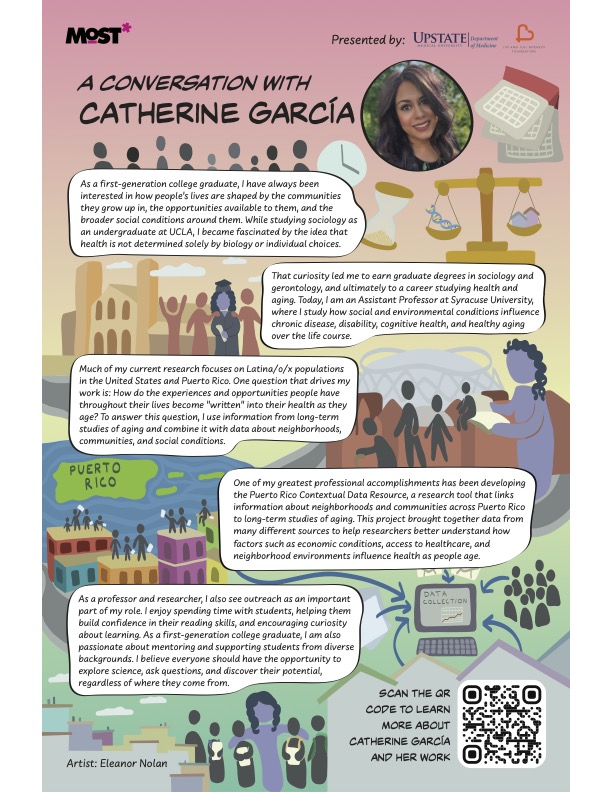
García, assistant professor of human development and family science in the College of Arts and Sciences (A&S), is featured in the Scientist Showcase at the Milton J. Rubenstein Museum of Science and Technology (MOST) in Syracuse. The Scientist Showcase Series highlights underrepresented scientists through biographical displays and hands-on activities. It is presented by the Jim & Juli Boeheim Foundation and Upstate Medical University.
García’s illustrated poster, created by artist Eleanor Nolan, tells her story in her own words. A first-generation college graduate, she says her interest in how communities and opportunities shape lives took hold while studying sociology at UCLA. She became fascinated by the idea that health is “not determined solely by biology or individual choices.”
That curiosity led to graduate degrees in sociology and gerontology and a career studying health and aging. García’s research focuses on Hispanic and Latino populations in the United States and Puerto Rico. She combines long-term studies of aging with data about neighborhoods, communities and social conditions.
García calls developing the Puerto Rico Contextual Data Resource, a research tool that links neighborhood and community information across Puerto Rico to long-term aging studies, one of her greatest professional accomplishments. The tool helps researchers understand how economic conditions, access to health care and neighborhood environments influence health as people age.
García also values outreach, from time with students to mentoring those from diverse backgrounds.
“I believe everyone should have the opportunity to explore science, ask questions and discover their potential, regardless of where they come from,” she says.