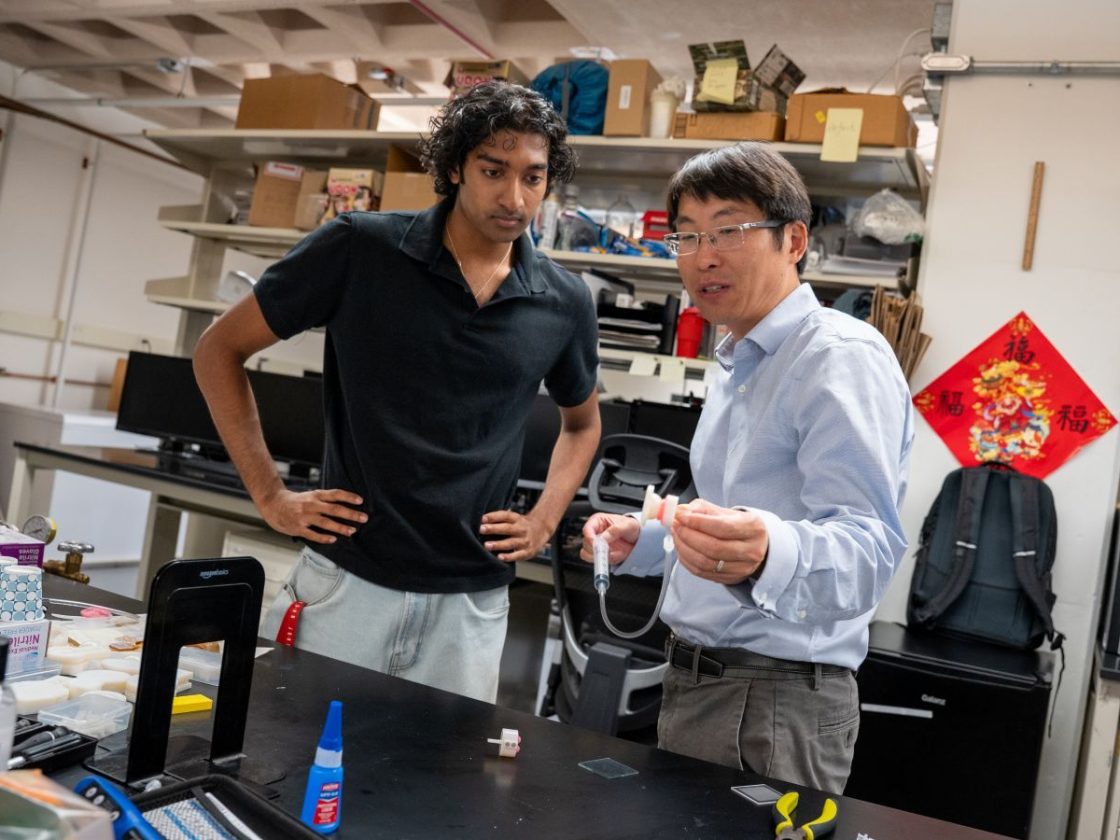
ECS senior Ruben John, left, works with Wanliang Shan, associate professor of mechanical and aerospace engineering, on robotic grippers. John joined Shan's lab after a trial summer research program. (Photo by Amy Manley)
Summer Robotics and AI Program Turns Student’s Curiosity into Career Pathway
As a fourth-year student in the College of Engineering and Computer Science (ECS), Ruben John thought learning state-of-the-art robotics and controls with faculty experts was too good an opportunity to pass up. So he applied to and was accepted into a new summer Research Experience for Undergraduates (REU) program that let him do just that. This fall, he built on that experience by becoming a research assistant in his faculty mentor’s robotics lab.
John was one of eight undergraduates who participated in the new Robotics and AI for Advanced Manufacturing REU program over the summer. The eight-week, hands-on research experience was developed by Wanliang Shan, associate professor of mechanical and aerospace engineering at ECS and co-founder of the robotics startup TunaBotics.
“I wanted to join Dr. Shan’s lab because I wanted to continue working with and learning from him,” John says. “I really admire his work ethic, the person he is and the way he mentors students. He would talk with us not only about our research, but also about life, business and how to think about our future. It felt like more than just a research experience.”
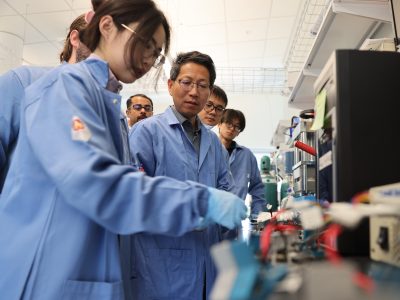
Students in the program were divided into eight teams composed of an undergraduate student, a Ph.D. scholar and a faculty mentor, each tackling different areas of cutting-edge robotics research. Shan designed the program so undergraduates could learn from and be mentored by Ph.D. students. Faculty members met with the undergraduates and Ph.D. students every week.
Team projects mirrored the University’s portfolio in AI, robotics and advanced manufacturing, Shan says. That includes the Center for Advanced Semiconductor Manufacturing, Dynamic Locomotion and Robotics Lab, A-STAR Lab, LINKLab and Autonomous Systems Policy Institute, plus the University’s lead role in the NY SMART I-Corridor Tech Hub and affiliation with Micron’s regional tech-jobs creation engines.
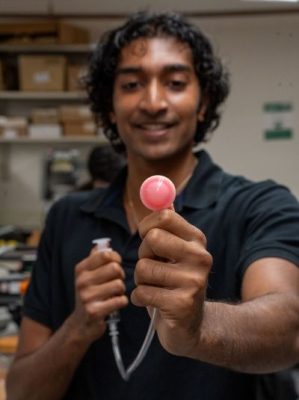
The teams designed algorithms for vision-guided robot arm control, developed robotic maneuvers for aerospace vehicles, translated spoken instructions into machine-interpretable programs for industrial robots and created soft grippers and stretchable sensors that enable robots handle delicate objects.
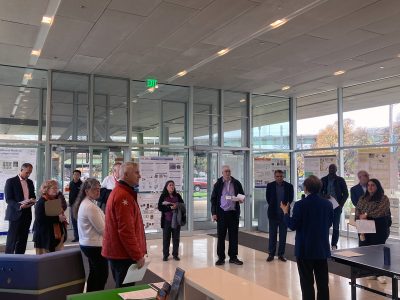
Though each team worked on separate projects, they came together once a week to share research insights, discuss project progress and attend workshops featuring experts in entrepreneurship. Along with conducting research, students participated in cohort-building and social activities, including touring the Museum of Science and Technology and a robotics firm.
The entrepreneurial focus was designed to give students a look at startup life as an alternative to the more traditional career routes in academia and industry, Shan says. For John, that orientation prompted him to pursue his next step in both research and entrepreneurship. In Shan’s lab, he continues to study gripper design and performance while also observing new steps in in product development underway at TunaBotics.
“My goal has always been to become the best possible version of myself, whether through engineering, entrepreneurship or a combination of both,” John says. “Meeting Dr. Shan and being in the program helped guide me toward that goal. It gave me a different outlook on what I want to do in the future and opened my mind to opportunities beyond the traditional engineering path.”