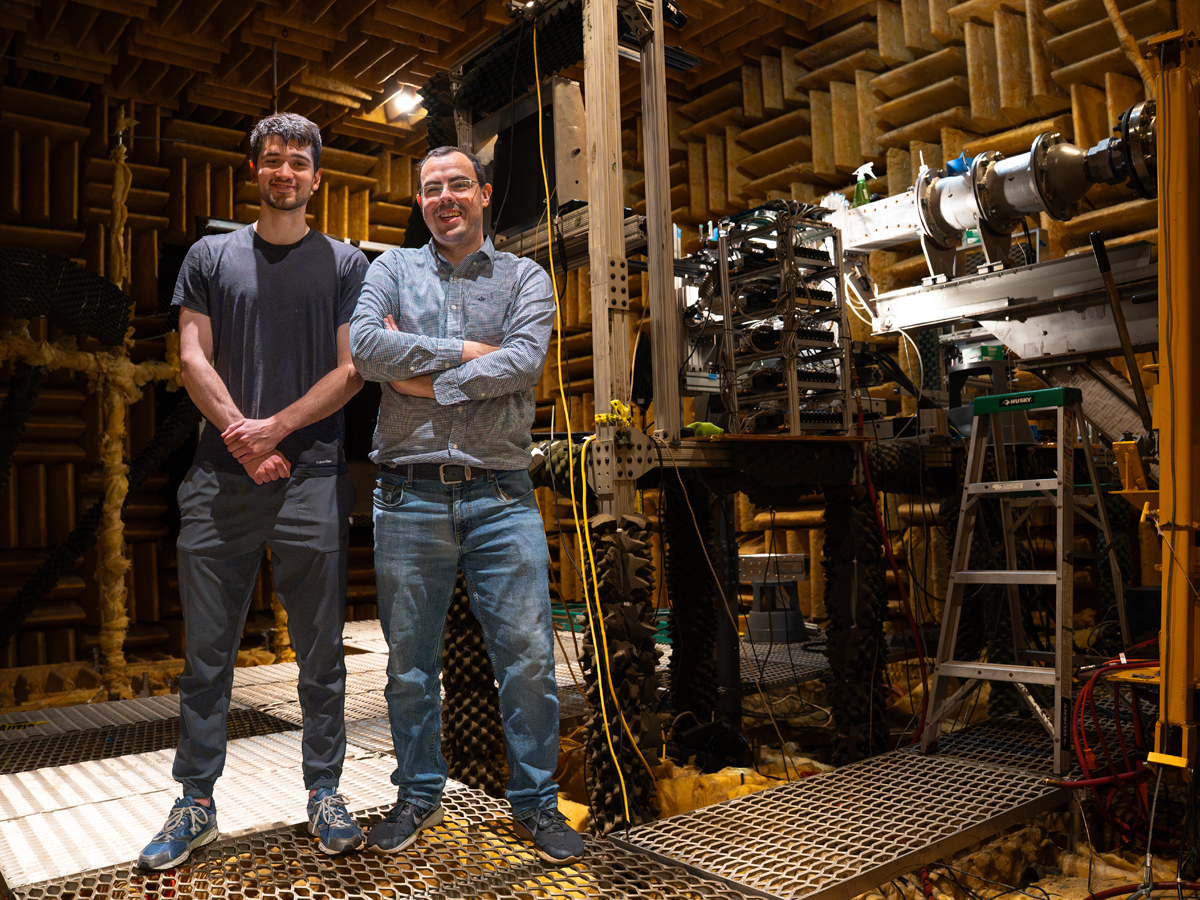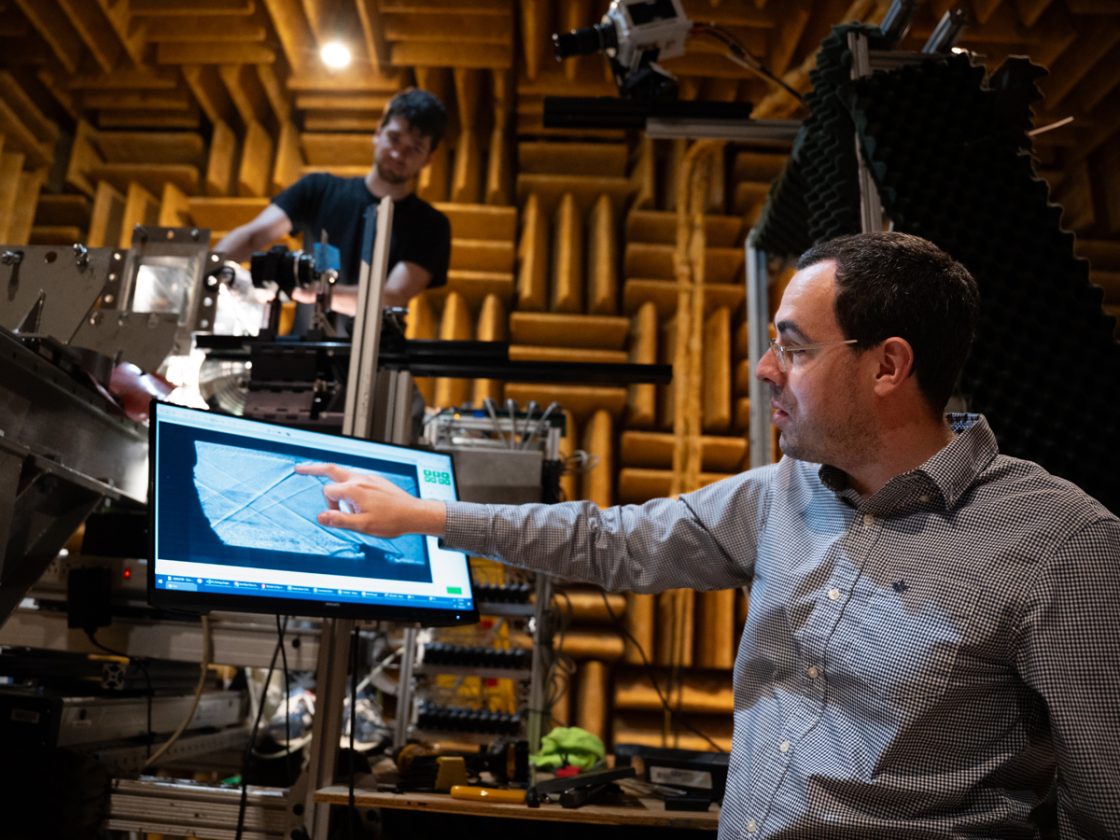
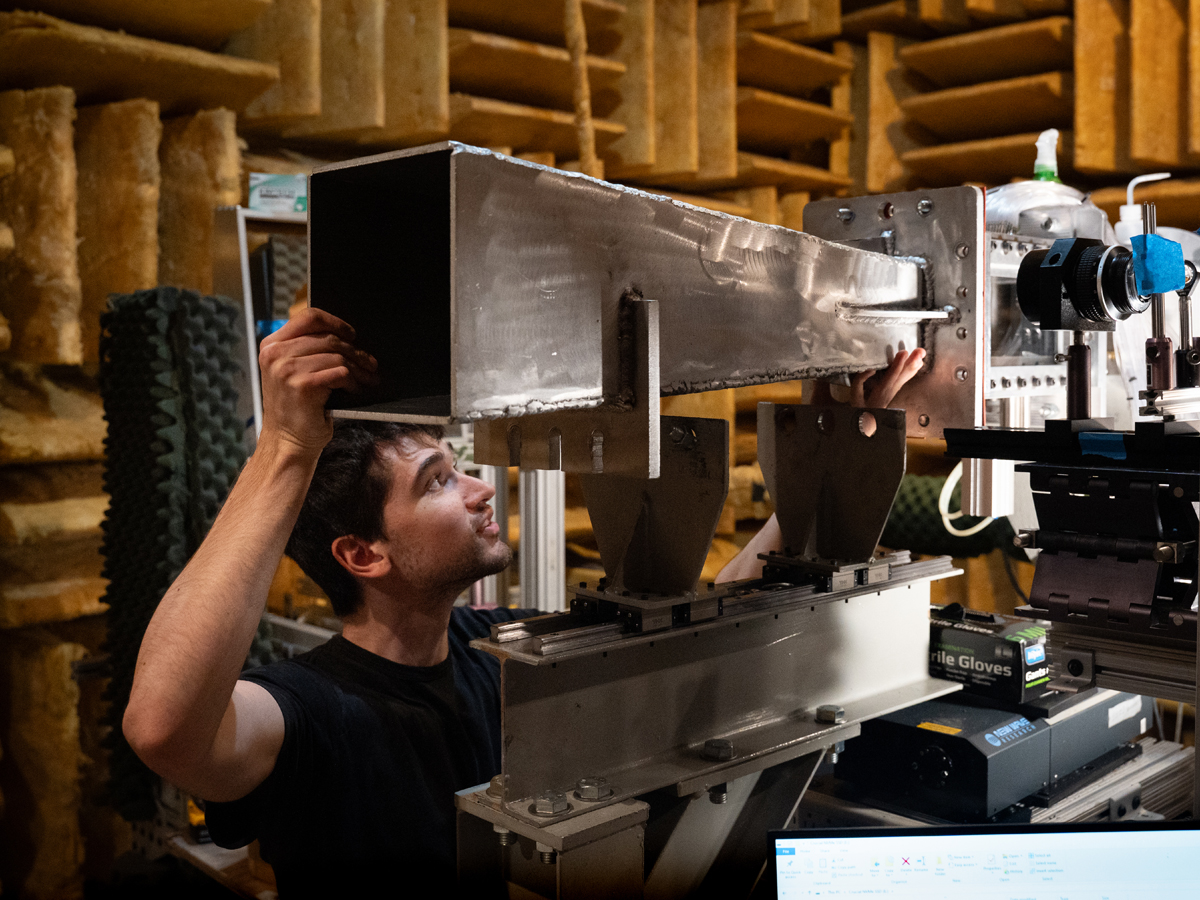
Fernando Zigunov and Ph.D. candidate Mark Namatsaliuk set up a test section of the wind tunnel that simulates the effects of supersonic flow and the resulting turbulence on a flying vehicle. (Photo by Amy Manley)
Professor Follows the Flow to Help Engineers Improve Future Aircraft
Imagine riding in a car with the windows rolled down and your arms extended out the window. As the car speeds up, your hand meets wind resistance that only intensifies at higher speeds.
Now imagine that car is a plane, flying at speeds faster than sound. The air pushing against your hand becomes a rush of air along the entire aircraft, creating turbulence that is difficult to predict.
But Fernando Zigunov, assistant professor in the Department of Mechanical and Aerospace Engineering in the College of Engineering and Computer Science, is working to change that by studying how turbulence behaves at those speeds.
The Air Force Office of Scientific Research recently awarded Zigunov’s team three years of funding to study what happens when shock waves strike curved surfaces, work that could help engineers design better aircraft and energy production systems.
With high-speed cameras and powerful lasers, Zigunov and his student researchers in the Skytop Turbulence Laboratory—which Zigunov estimates is one of only a dozen supersonic wind tunnels on a college campus—add particles to the flow to track its direction. At faster frame rates there is less time to capture each frame, which would normally produce a giant blur. The lasers help “freeze the flow,” letting the team capture accurate data.
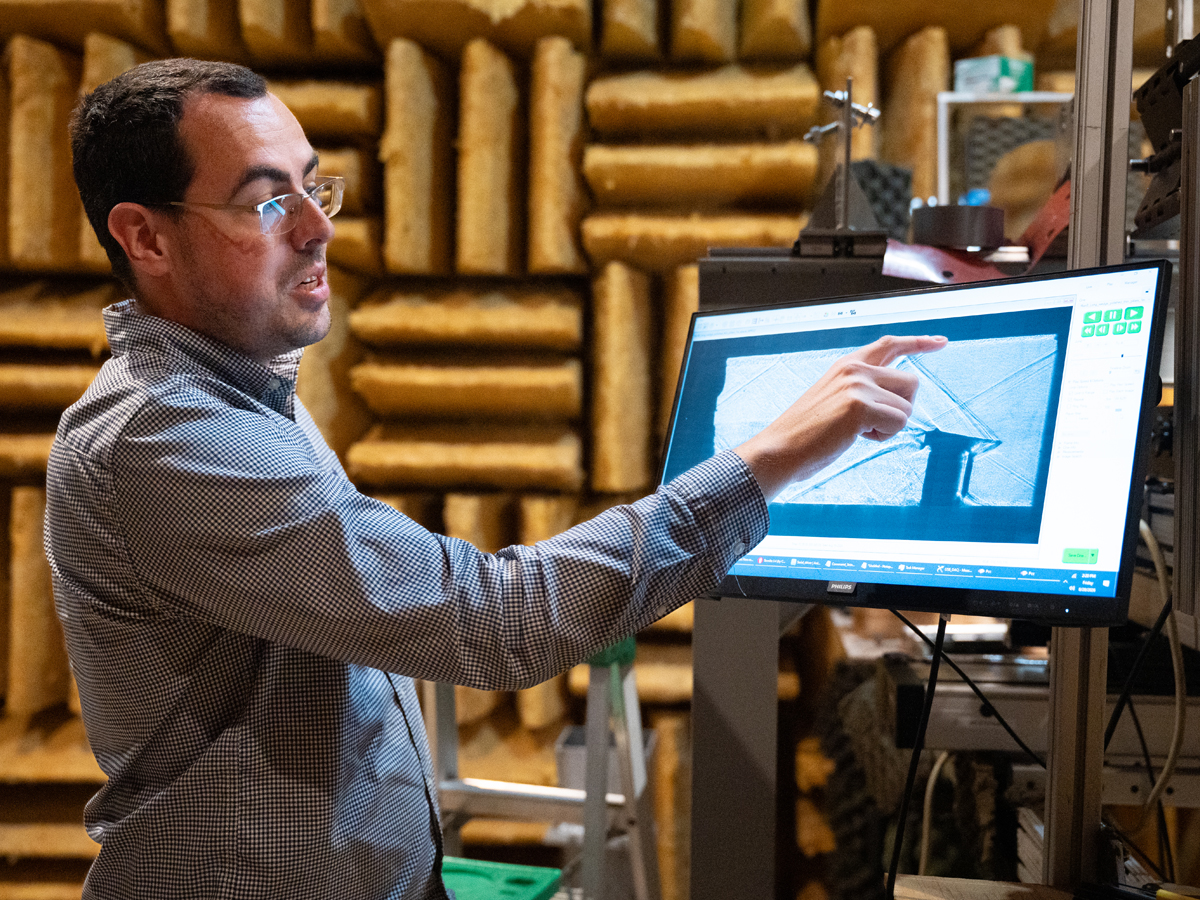
To study supersonic flows, the lab must recreate them, and Zigunov says they can reach as fast as twice the speed of sound, roughly 2,000 miles an hour. He turns to schlieren, an optical technique that makes invisible density changes in a flow visible.
Zigunov says developing and utilizing schlieren in his laboratory helps students create a validation data set that “quantitatively measures flow so we can provide a representation of what actually happened in the physical experiment that can be used to compare the findings with the computational models.”
Following the Flow
Zigunov is originally from Brazil, where he earned a bachelor’s degree in mechanical engineering from the University of Vale do Rio dos Sinos and spent about seven years working in the refrigeration industry. It taught him how engineering is done in the field and left him asking what was really happening behind the scenes in the fluid systems he worked on.
“I always had a dream, and I wanted to study a little more,” Zigunov says. That led him to Florida State, where he earned a Ph.D. in mechanical engineering and specialized in experimental high-speed aerodynamics, including shock waves and the noise of supersonic jets.
Zigunov then spent two years doing postdoctoral research at Los Alamos National Laboratory, developing three-dimensional imaging methods to study how shock waves affect turbulence in fusion research. In 2024, he joined the ECS faculty, seeing Syracuse as a way to integrate his research and expand it into new areas.
“Aerospace is such a cool topic and making supersonic flying machines is even cooler,” Zigunov says. “But we have a lot to learn about understanding the unsteady behavior in fluids. The forces that arise from these fluid-structure interactions are unforgiving.”
Setting Students Up for Success
At every step of his research, Zigunov relies on talented students to tackle the real-world challenges presented by high-speed aerodynamics and supersonic flows.
On a recent afternoon in the Skytop Turbulence Laboratory, Ph.D. candidate Mark Namatsaliuk ‘22, G’23 sets up a test section of the wind tunnel that simulates the effects of supersonic flow and the resulting turbulence on a flying vehicle so the lab’s high-speed cameras can capture images of the flow. The key features of the flow are captured for computer analysis, with the experiment run repeatedly, through thousands of combinations.
Namatsaliuk says the team first tried controlling the flow with plasma actuators, but “for the supersonic flows, it didn’t seem to work very well, so we moved on.” His thesis now tests whether blowing air through rows of small holes can change how the shock wave interaction behaves.
“We had to build the whole tunnel, and the design had to be done from the ground up,” says Namatsaliuk, who graduated with bachelor’s and master’s degrees in aerospace, aeronautical and astronautical engineering.
Zigunov says students take part in every stage, from mechanical design and manufacturing to electronics, laser optics and fluid flow analysis.
“This prepares these students for working in this type of wind tunnel testing, whether facilities at NASA or research labs with the Air Force and the Navy,” Zigunov says.
A Problem Worth Solving
The Air Force-funded project centers on a problem called fluid-structure interaction. To keep aircraft light, their panels must be extremely thin, which also makes them flexible. If airflow near the surface makes a panel vibrate too much, “the aircraft shakes itself apart mid-flight,” Zigunov says.
Today, engineers manage that risk by limiting how aircraft can operate. A more accurate picture of the forces would let them design panels that are thin but just strong enough to survive.
The team will focus on a scenario common in engine inlets, where a shock wave created by one part of an aircraft strikes a curved wall. The resulting interaction with the thin layer of air along the surface is hard to predict and can turn fast, harmless turbulence into a slower oscillation that is more likely to shake a panel.
Few researchers have examined the curved-wall version because it is so difficult to test, Zigunov says, but his lab now makes it possible. “I spent countless hours developing this lab and we can actually do this here at Syracuse,” he says.
Zigunov says the problem is much bigger than any one project, and he expects the team to learn as much about what it doesn’t yet understand as about what it does. “Good research always leads to new questions,” he says.