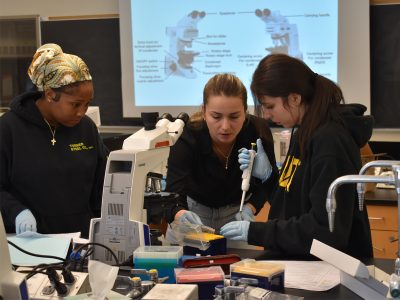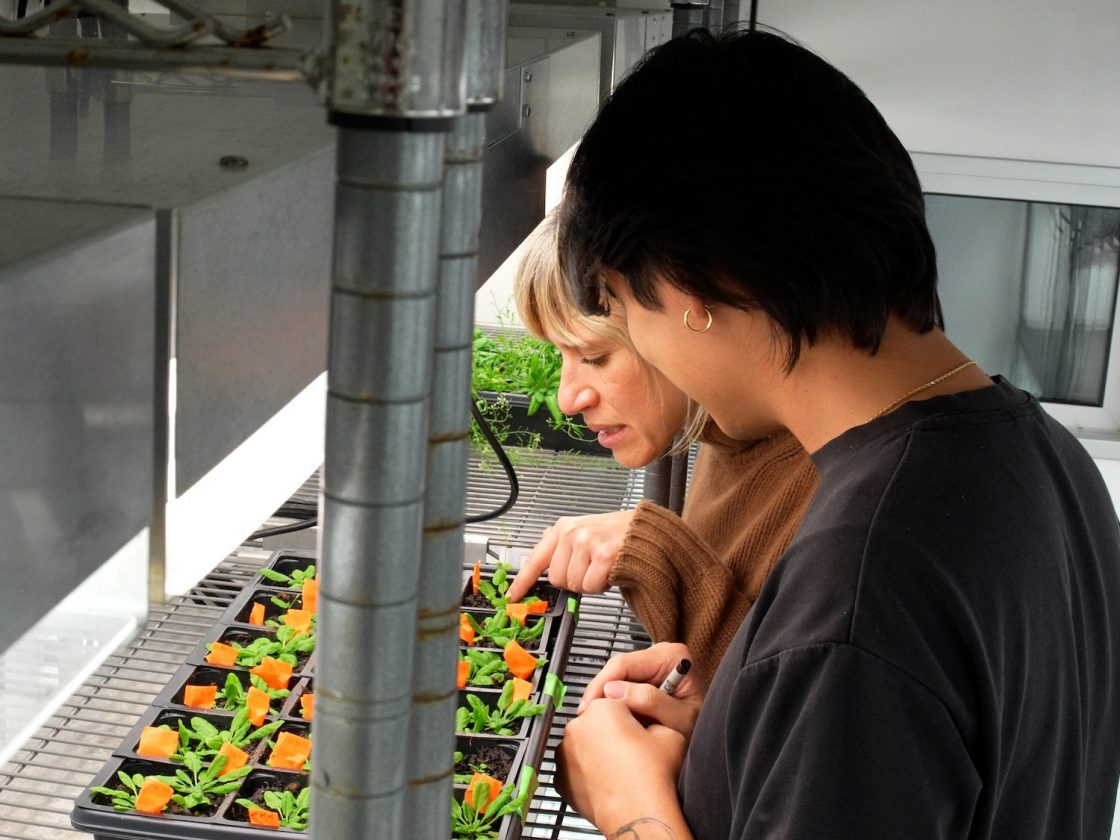
Heather Meyer, assistant professor of biology, works with a student in the lab.
Multidisciplinary Group of Faculty Examines Disease ‘From Cells to Society’
A growing cohort of University faculty members from diverse disciplines is engaged in complementary research that bridges molecular biology, cell biology, biophysics, neuroscience and aging and has implications for the treatment of Alzheimer’s and other neurodegenerative diseases.
Recently bolstered by new hires who are focused on neuroscience and disordered proteins, the group of researchers exemplifies a key strength of the higher education environment, where a diverse range of experts can come together in a holistic way to work on tackling society’s most pressing issues.
“This is what universities do,” says Duncan Brown, vice president for research. “Universities are the only places that have this kind of breadth and depth of expertise, where individuals can work to find causes, effects and cures for diseases that are affecting everyday Americans and their families.”
Conversations Across Disciplines
The University has long had a solid portfolio of aging-related research, as evidenced by the work of faculty affiliates at the Aging Studies Institute. There, scholars focus on population aging and health and functioning across the life course, among other areas.
“From the aging studies perspective, we’re interested in understanding aging ‘from cells to society,’ and I think we are known for being particularly been strong on the society side,” says Janet Wilmoth, director of the institute and a professor of sociology in the Maxwell School of Citizenship and Public Affairs.
Now, she says, the recent strategic hires position the University to further advance understanding of the molecular and cellular processes that might contribute to degenerative diseases, particularly Alzheimer’s and related dementias, that affect aging populations.
“This is really enabling us to build some synergies that will be helpful moving forward,” Wilmoth says. “We’re working to increase conversations across the disciplines so that the people in physical sciences and neurosciences and social sciences are talking to one another.”
Much of that molecular and cellular work is happening at the University’s BioInspired Institute, where some researchers are studying the role of disordered proteins—flexible cellular molecules that lack a fixed structure—in neurodegenerative disease. Among those researchers is Jennifer Ross, interim dean of the College of Engineering and Computer Science and professor of physics in the College of Arts and Sciences (A&S) (who was associate dean for creativity, scholarship and research in A&S at the time this interview was conducted). Like Wilmoth, she sees the potential for synergies across disciplines.
“At BioInspired, we have a lot of the molecular to cellular to tissue [expertise], but we don’t have as much on the human subject side,” Ross says. “There are some opportunities to make that bridge across.”
New Faculty Members
Three of the new faculty members are part of a research cohort led by Carlos Castañeda, associate professor of biology and chemistry, whose work focuses on proteins associated with neurodegenerative and neuromuscular diseases, particularly ALS. “[Hiring] this cohort was a grass-roots effort and would not have been possible without cross-University support,” Castañeda says. “We have a tremendous opportunity here to set the University and the broader Syracuse area as a national hub for new ways to study disordered proteins and their role in disease.”
Shahar Sukenik, an assistant professor of chemistry, studies how proteins interact with their surroundings, with a particular focus on disordered proteins. He aims to understand how these proteins work in different situations, both inside and outside the cell, and how they contribute to both health and disease.
Li-En Jao, an associate professor of biology, studies the development of centrosomes, which serve to organize cells and are key to cell division. Jao explores the process by which centrosomes are built, how they transport proteins within cells and how centrosome dysfunction contributes to human disease.
Heather Meyer, an assistant professor of biology, is a plant molecular and cell biologist who examines how plants sense and respond to their environment, especially through the behavior of disordered proteins. Because plants are similar to humans at the cellular and protein level, her work contributes to an understanding of human disease and has potential to inform the development of new or improved medicines.
Another plant molecular and cell biologist who recently joined the University is Eun-deok Kim, assistant professor of biology. She investigates how genes, behaviors and environmental factors can cause cellular change, particularly in stem cells. She also studies how environment and behavior contribute to age-related diseases.
Two of the new faculty members, whose research focuses on neuroscience, work together in a joint lab, where they create biomaterials and nano-scale drug delivery systems to remove toxins from proteins.
Chih Hung Lo, assistant professor of biology, studies molecular-level mechanisms related to Alzheimer’s, Parkinson’s and multiple sclerosis. He investigates how intrinsically disordered proteins are related to nervous system deterioration and also examines how inflammation and metabolic dysfunctions affect body-brain interaction and how obesity affects nervous system functions.
Jialiu Zeng, assistant professor of biomedical and chemical engineering, studies how insulin resistance, oxidative stress, inflammation and the recycling and repairing of damaged cells is related to Parkinson’s, some liver disease and metabolic disorders such as obesity and type 2 diabetes.
Rounding out the cohort is Yulya Truskinovsky, who joined the University last year as an associate professor of economics. Her research looks at labor, aging and health, with a focus on the economics of caregiving. She is a faculty associate at the Aging Studies Institute and a faculty affiliate at the Center for Aging and Policy Studies.
‘Always Send Out the Team’
Ross says this kind of diversity of expertise that spans multiple disciplines and angles of inquiry is required for the pursuit of new knowledge.
“Fundamental research is like looking for a lost child in the woods,” she says. “You would never send out one person; you would always send out the team.”
She says each researcher will make new discoveries, even discoveries not necessarily related to the initial inquiry. For example, work on Alzheimer’s or other neurodegenerative disease may inadvertently lead to new ways of fighting physically degenerative disease.
“The pathway that we use to get to the end point is the important part, because that’s the pathway that allows every single researcher to be covering all the ground that needs to be covered to make all of the technological pushes for the future,” Ross says.
Adds Wilmoth: “Syracuse is uniquely positioned to come at this from different angles and maybe offer a different perspective. Having faculty who have complimentary interests and skillsets enables the sort of creativity that is only possible when you have a critical mass of faculty.”