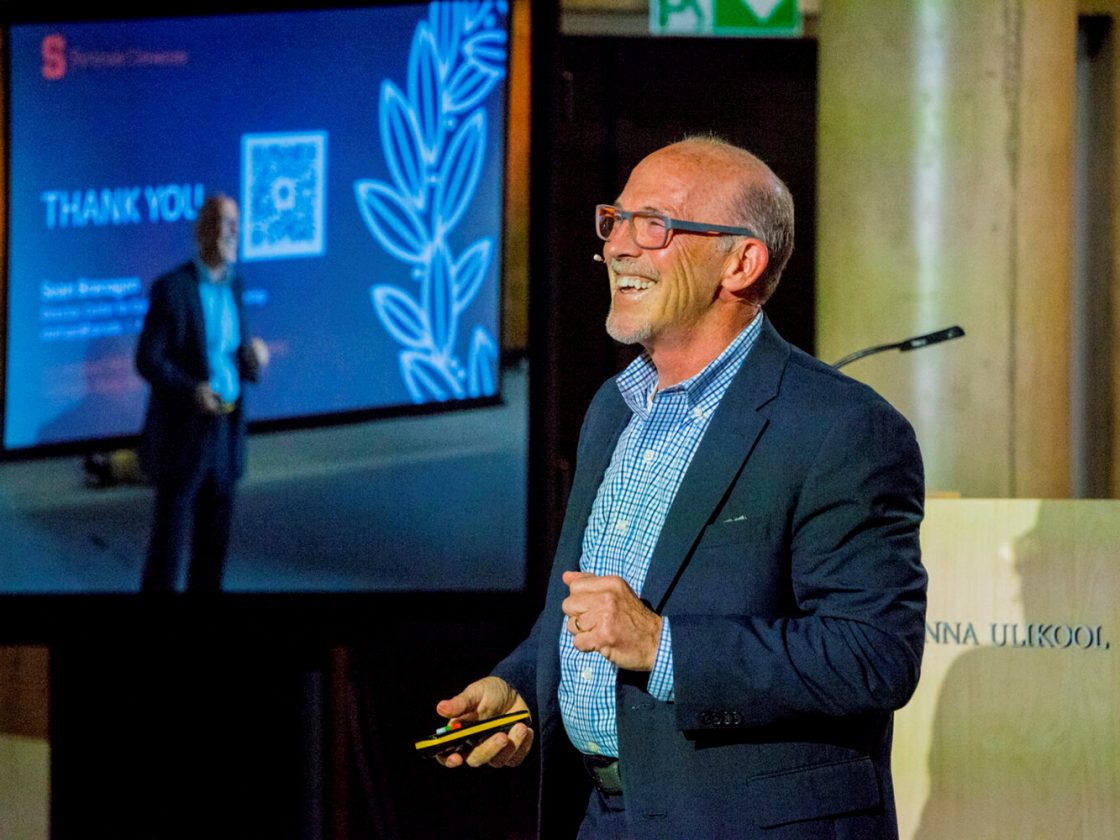
Sean Branagan enjoyed a Fulbright project in Estonia in 2022 then returned as keynote speaker for the 2023 ScreenME-Net Summit on Media Entrepreneurship. (Photo courtesy of Branagan)
Estonia Fulbright Gig Launches Global Entrepreneurial Teaching Tour
As a “serial entrepreneur” and interactive marketer, Sean Branagan has applied his expertise in media innovation and technology across varied careers. More recently, he has worked with global audiences in a dozen countries, sharing his knowledge of the creator economy.
A 1980 graduate of the Newhouse School of Public Communications, Branagan returned to the school in 2011 to found the Center for Digital Media Entrepreneurship and teach media innovation courses.
The center runs the Newhouse Startup Garage, a coworking and creator space where students test digital content and media ideas and connect with faculty and media mentors and entrepreneurs. Branagan has also launched student startup competitions, entrepreneurship programs, the interactive series “StartNow” and Scrappy Capital, a seed fund for tech hub startups. He coaches numerous startups and venture funds.
Branagan’s global journey began with a 2021 Fulbright Specialist grant to help universities in Estonia create media entrepreneurship programs. Affiliated with Tallinn University’s Baltic Film and Media School, he spent two months in 2022 conducting workshops, making presentations and immersing himself in the country’s startup scene.
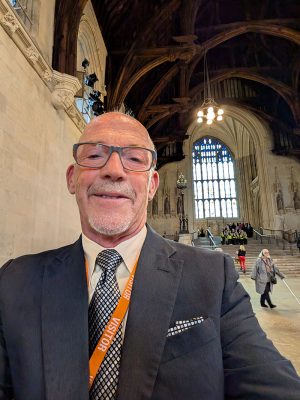
He returned to Estonia to keynote the 2023 ScreenME-Net Summit on Media Entrepreneurship. The organization is comprised of European university professionals focused on improving research into and teaching entrepreneurship teaching for the screen media industry.
More speaking requests followed. He has since spoken to journalism students in Belgium, government officials and business leaders from across the African continent in Ethiopia, sports leaders in Ireland, media researchers in Lithuania, corporate communicators in Germany, musicians in Slovakia and policy makers in the United Kingdom.
He has also participated virtually at universities and conferences in India, Nepal and South Africa, and is teaching creative entrepreneurship in a virtual format to 500,000 high schoolers across India, Indonesia and the Middle East. Recently, he traveled to the U.K. to brief members of Parliament on the creator economy and existing technologies as they considered a bill proposing to ban cell phones in schools. In December he (along with Newhouse Professor Srividya Ramasubramanian and other education technology and government leaders) will address hundreds of top students at the GetKruu.com summit at Kuaraguru College of Technology in Coimbatore, India.
We asked Branagan about those experiences, his reaction to questions he receives from media innovators worldwide and how his global work impacts his teaching.
I didn’t anticipate that, but I am incredibly fortunate that it did. The timing and topic were perfectly aligned. Since then, as word spread, I’ve addressed all types of groups. It has been an amazing experience.
I am most surprised that participants at these events come from all over the world and from nearly all walks of life. The concept resonates with [everyone from] high school students [to]…an Olympic organizing committee in Australia. Many startups and tech companies [want] to leverage the creator economy for growth or new offerings. Others seek insights into its future. Some economies view it as a vital uplift for people to tell their stories and earn a living. In more developed economies, the focus is on building a vibrant creator economy.
There are now more tangible examples. Five years ago, I described the potential of creators; now I point to concrete successes like “Flow” [a Latvian animated film] winning an Oscar, over 50% of Grammy winners being independent artists and numerous successful online shows.
People are increasingly interested in discussing technology, especially AI and its impact. While there is concern about job security, I emphasize how this new economy shifts access, control and ownership, empowering creators to develop and own their audience relationships and directly monetize their content.
My dad used to say that immigrants to America were tailors, butchers, dressmakers, deli owners and dreamers … all looking for opportunity to start something [new]. The creator economy is almost the reverse. It comes to you, wherever you are!
Powered by digital channels with built-in capabilities and access to global markets, anyone can be a creator, develop an audience and generate a living. And startups are smaller, faster, global and making money faster because of AI. Particularly in the media and entertainment sectors, there is a lot happening in this ‘AI economy.’
I generally advise them to enact laws that hold media platforms accountable, exactly as Congress’ 1996 enactment of Section 230 of the Communications Decency Act did for television, publishing and media companies here for decades.
The act’s goal was to encourage expansion of the internet by protecting online service providers from being treated as ‘publishers’ of user-generated content. We can now see [its] unintended consequences. With GenAI tools, [countries] also need to understand how these systems work so they can augment copyright and legal rights of individuals … and creators of all kinds.
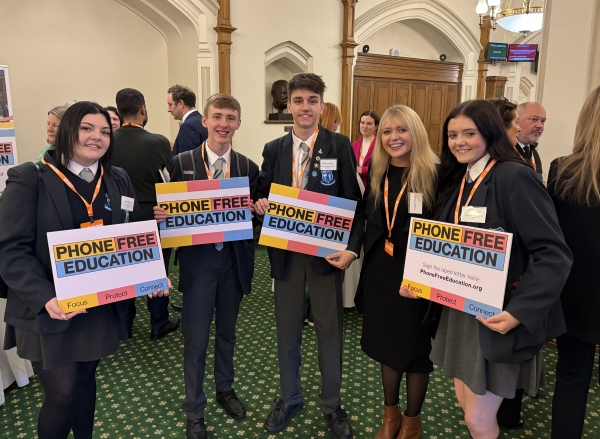
It has significantly boosted my credibility and enhanced my ability to explain what my students are already witnessing online. They’ve watched “Squid Game” and they see the K-pop movement. They fluidly follow media and channels and personalities from all over the world without even thinking about it. I help them rethink what they might want to do in their careers and where they might live and work.