The Science of Black Holes: Secrets of the Cosmos
Eric Coughlin’s groundbreaking research explores the feeding habits of super-massive black holes using a predictive model forecasting when a star will be shredded.

Black holes are among the most studied, but least understood cosmic phenomena for astrophysicists. These objects derive their name from the fact that nothing, including light, can escape the grasp of their immense gravitational field.
College of Arts and Sciences physicist Eric Coughlin, who researches how stars are consumed by black holes, explains that black holes range in mass, with the smallest—comparable to our sun—forming from stellar evolution.

Starting with hydrogen, massive stars burn through fuel in their cores through nuclear fusion. Between fusion stages, the core contracts, releasing gravitational energy that causes the star’s outer layers to expand. This process progresses through increasingly heavier elements like helium and carbon until the star produces iron, at which point the fusion process halts.
“The star can’t release any more energy through fusion, and all the pressure being generated from that energy release stops,” Coughlin says. “The core starts to collapse under its own self-gravity. That collapse continues until it forms a neutron star, which can ultimately collapse to a black hole.”
Coughlin has examined black holes and tidal disruption events, one of the cosmos’ most extreme occurrences where the gravitational field of a supermassive black hole repeatedly tears apart or shreds a gigantic star. His team’s groundbreaking research offers a rare glimpse into the feeding habits of a supermassive black hole using a predictive model to forecast when stars will be shredded and torn apart as it is spaghettified.
Coughlin stopped by the “‘Cuse Conversations” podcast to discuss the different types of black holes, how hungry black holes can shred distant stars and other cool secrets of the cosmos.
They are regions of space and time that are disconnected from the regions in which we live. Positions in space and time in relativity are known as events, and there are two special locations associated with a black hole. One is the event horizon. It’s the farthest that you can peer into the region around this black hole. Things interior to the event horizon cannot exit; they’re forever closed off from the outside universe and vice versa. It’s the point of no return.
The second special place is called the singularity at the center of the black hole, which is where time and space get infinitely compressed. Another way to say it is that the curvature of space-time becomes infinite, but things also become infinitely small.
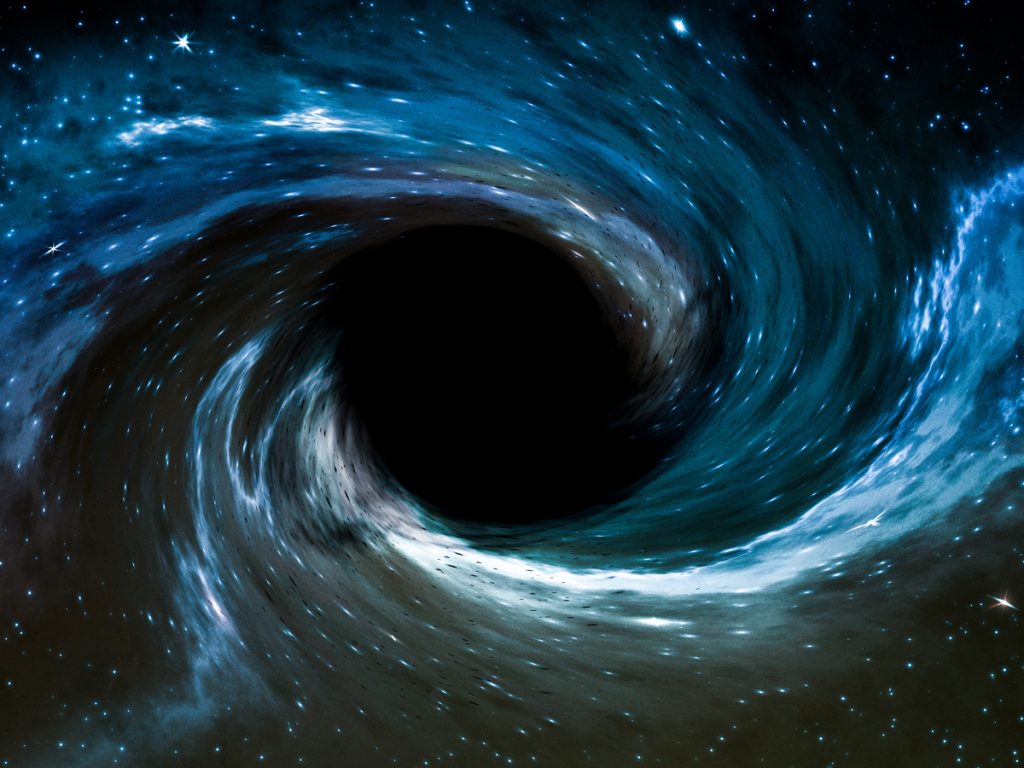
If you were to dive into a black hole, you could measure time or you could look at your watch and you could count the seconds that go by as the falling observer. You would careen right through the event horizon and hit what’s called the singularity at the center in a finite amount of time. You would be torn apart and completely obliterated throughout that whole process.
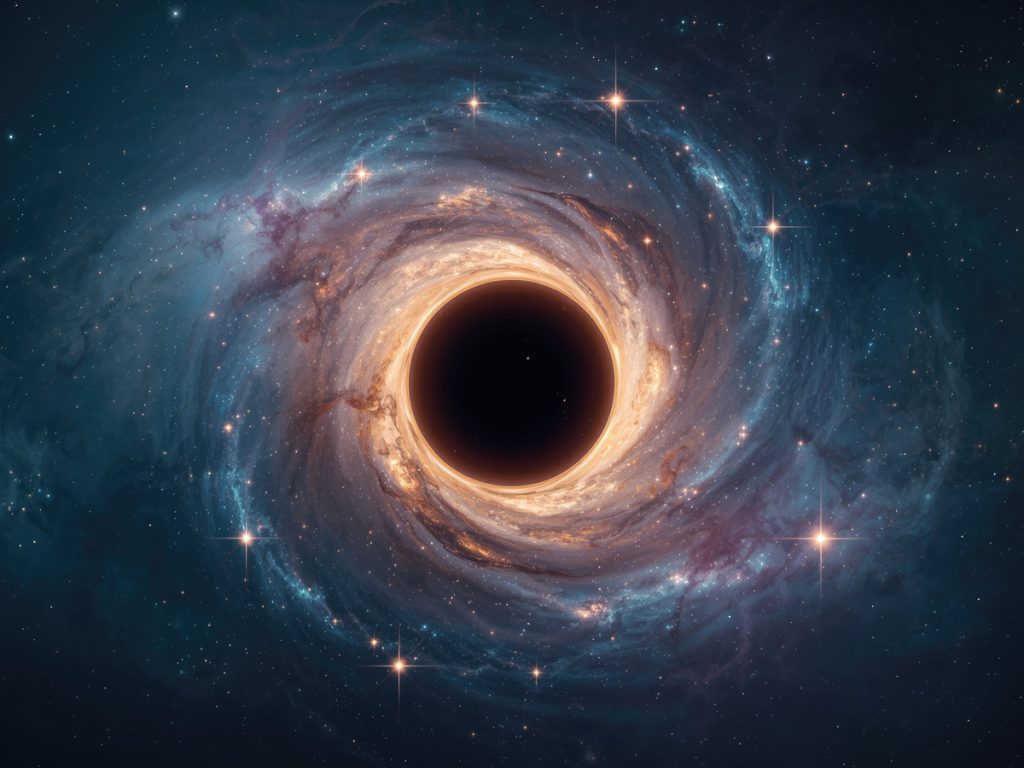
What’s confusing is that, according to an outside observer, that’s not actually what we would see. We would see you get closer and closer to this special location known as the event horizon, but you would actually never fall through it. As an outside observer, our time coordinate continues into infinity, while you, as the plunging observer going into the black hole, stop and get pasted onto the event horizon.
Carl Sagan had this very famous statement where human beings are “made of star stuff.” When the universe was born, when the Big Bang happened, there was mostly just hydrogen and helium. But on Earth we are made up of carbon. All that carbon came from stars, and through the subsequent star formation processes, all that material gets amalgamated into various places. One of those places is us. We are recycled star material in some way. That’s a profound way of thinking about some of these processes and how they affect us.