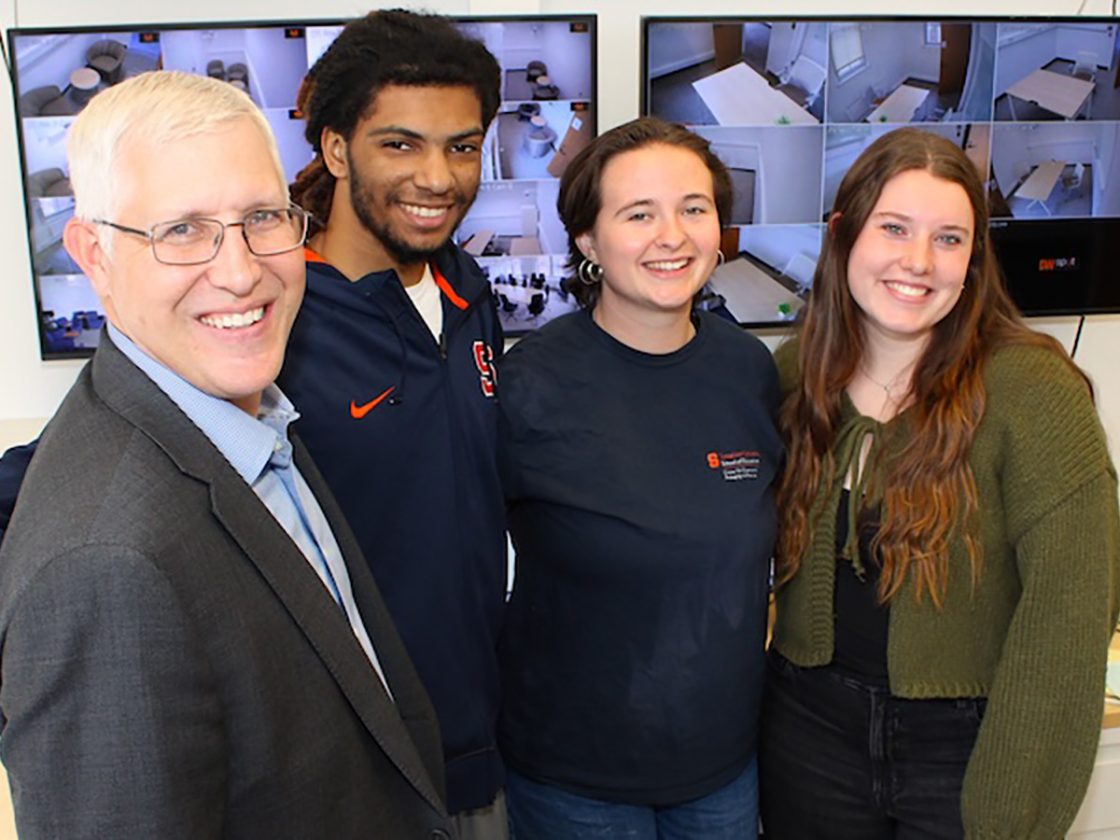
Center for Experiential Pedagogy and Practice (CEPP) Director Ben Dotger, left, with CEPP New Design Scholars Aidan Hodari Rogers, Bella Cecchinelli and Margaret “Maggie” Poulin.
Grant Puts Undergraduates at the Center of Clinical Simulation Research and Design
The Center for Experiential Pedagogy and Practice (CEPP) at the School of Education has received a $10,000 grant from The John Ben Snow Foundation to create three New Design Scholar positions for undergraduates.
Inaugural scholars receiving stipends for 2026-27 are Margaret “Maggie” Poulin ’28 (inclusive adolescent education/math), Bella Cecchinelli ’29 (inclusive childhood education) and Aidan Hodari Rogers ’29 (inclusive adolescent education/history). Each works five to seven hours a week, helping with the logistics and design of clinical simulations and the analysis of the data they generate, while being mentored by CEPP-affiliated doctoral students.
Amazing Addition
As New Design Scholars, Hodari Rogers and Cecchinelli are developing a simulation as part of CEPP’s collaboration on Falk College’s “Character Development Through Sport Fan Engagement” project, which is part of the Educating Character Initiative led by Wake Forest University’s Program for Leadership and Character and supported by Lilly Endowment Inc.
Poulin is writing up data from a simulation that addresses how teachers approach mid-20th-century racial segregation and redlining in the United States. Her analysis will contribute to an article for a peer-reviewed scholarly journal. In late October, she also took part in a simulation demonstration at the University’s Los Angeles center, portraying the student teacher.
“Learning how to analyze my own performance in SIMs and now working in a position where I argue for their importance has been invaluable and an amazing addition to my undergraduate experience,” Poulin says.
Practice Tool
In a clinical simulation for teacher preparation, an actor typically portrays a parent, administrator or other professional in a realistic, one-on-one scenario, which might address student discipline, a curriculum issue, issues for students with disabilities or a similar authentic situation.
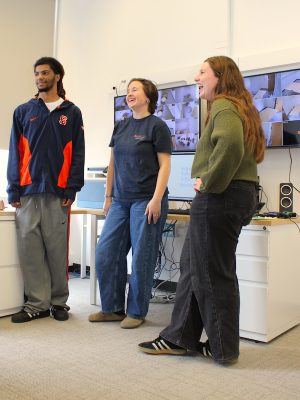
“The easiest way to describe simulation is as an ‘introduction to difficult conversations,’” says Poulin, who first encountered SIMs in Clinical Simulations in K-12 Teacher Preparation (EDU 106). She says they serve as “a hands-on practice tool to prepare and support students entering the field of education and beyond.”
Cecchinelli sees simulations as filling a gap. Teacher education programs often cover curriculum, instructional methods and theory, she observes, but simulations “cover those awkward, hard conversations that a straightforward teacher education program could skip over.” They also show candidates “where they fit into the system and how they contribute to it,” from involving parents and guardians to knowing when to turn to administrators or counselors.
Hodari Rogers describes the experience as “stressful in a good way.” Teachers are expected to “maintain composure and lead by example” when difficulties arise, he explains, and simulations leave “little room for error, so you must think on your feet and approach each response carefully, as you would in a real conference.”
Although it may feel stressful initially, Hodari Rogers adds, “each simulation was important to making me feel more comfortable as a prospective teacher.”
Going the Extra Mile
For Professor Ben Dotger, CEPP director, help from undergraduate research assistants is welcome given that the center continues to expand its operations and requires more capacity to run SIMs for an ever-expanding roster of collaborators, across and beyond campus.
The center conducted 1,211 SOE simulations in 2025-26 alone, not including those run for the Whitman School of Management, the University’s Reserve Officers’ Training Corps (ROTC) program and the Creative Arts Therapy program in the College of Visual and Performing Arts.
The three students were chosen in part for how they embraced EDU 106. “All three are awesome students and very involved,” Dotger says, noting that they went “the extra mile” in their simulations class, “so it was very easy to invite them on board.”
“When introduced to clinical simulations, I was told that it would be most helpful to embrace the initial awkwardness,” says Poulin. “I’m guessing that’s what Professor Dotger means when referencing our participation in class. I am so excited to be an educator, and this class was a great way to address the smaller details of my future profession.”
Hodari Rogers was drawn to how simulations “forced me to think fast and critically while creating an environment that was realistic but free of consequences.” He contrasts the approach with programs that spend the first years of undergraduate study on lectures alone: “there are very few classes I have taken in my lifetime that have engaged me and informed me as well as EDU 106.”
Developing Valuable Skills
The scholars program reflects three School of Education strengths: robust experiential education, undergraduate research and partnerships beyond campus.
That community reach was part of the Snow Foundation’s interest. “We were impressed with the impact of Dr. Dotger’s simulation training on student learning and saw broader context for its use within the Syracuse community outside of the university,” says Program Officer Elizabeth A. Snow.
Snow sees supporting CEPP as “a win for the students in obtaining valuable skills for their future, a win for the university in enhancing students’ growth and learning through additional simulations, and a potential win for the Syracuse community if these simulations are adapted to work-force development or other current critical areas of focus.”