Lasting Symbol of Peace: Revisiting ‘Gayaneñhsä•ʔgo•nah’ on the Quad
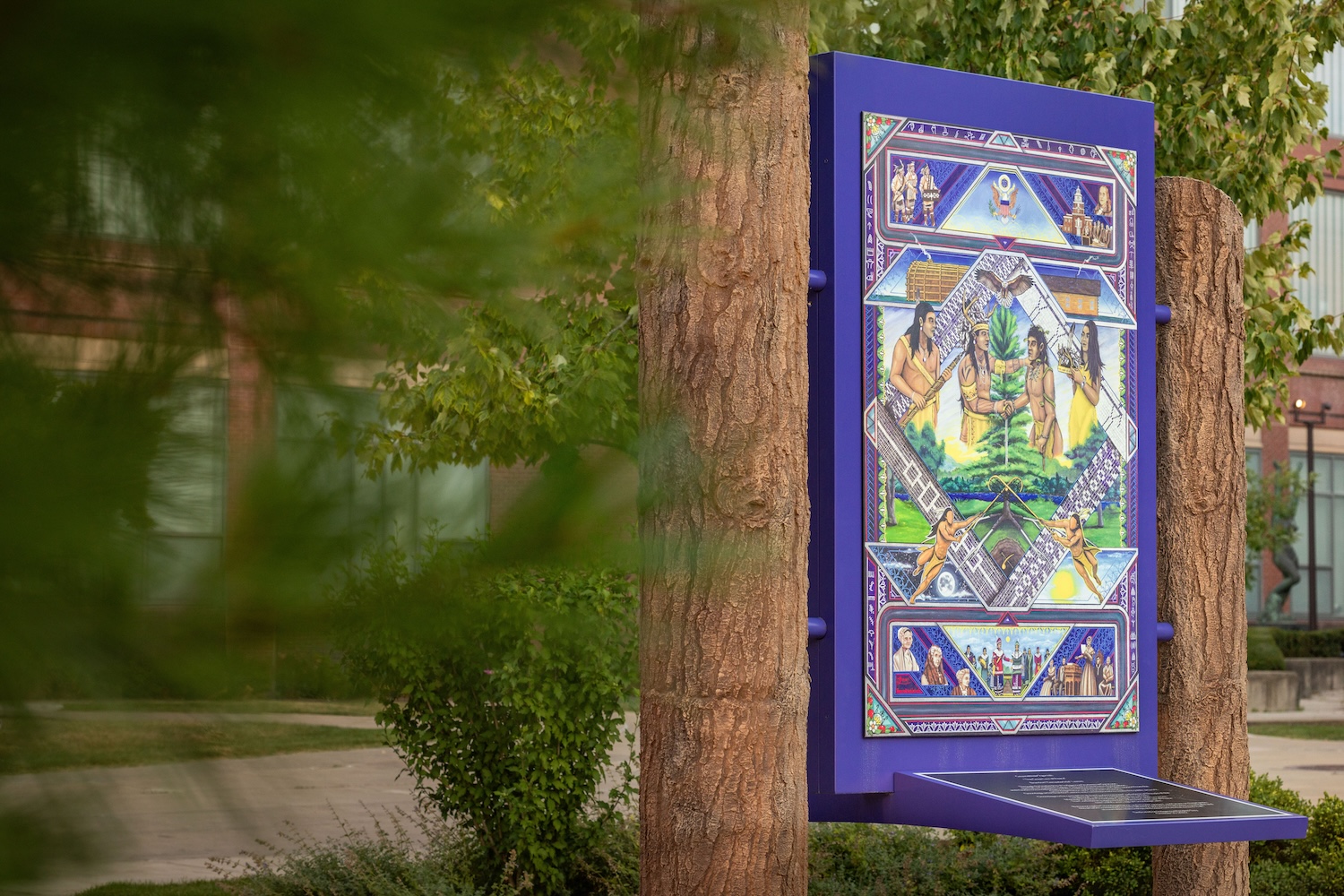
Four years ago, a work of public art honoring the Haudenosaunee Confederacy was unveiled on the Shaw Quad. Now, a new University webpage provides a deeper look at the installation and the story behind it.
The work, “Gayaneñhsä•ʔgo•nah” (“the Great Law of Peace”), was created by artist Brandon “Ganyada•kda” Lazore, Onondaga Nation, snipe clan, who was commissioned by a group of Indigenous students, alumni and staff. The artwork is rich with symbolism, showcasing critical elements of the Haudenosaunee creation story and celebrating Haudenosaunee influence on the founding of the U.S.
Onondaga is the central fire of the Haudenosaunee Confederacy, which was founded under the Great Law of Peace more than 1,000 years ago at Onondaga Lake. Lazore’s painting brings together images depicting the women’s suffrage movement, Benjamin Franklin, lacrosse and the formation of the Great Law of Peace. A white pine towers over the installation, representing peace among all the nations.
The idea for a digital showcase of the work came when Cameron L. Kline, a Ph.D. candidate in history in the Maxwell School of Citizenship and Public Affairs, met Lazore at the University’s “Monumental Concerns” symposium in 2023. What followed was a three-year, collaborative project involving a working group of alumni and University staff, most of whom are Indigenous. Kline facilitated.
“The ‘Gayaneñhsä•ʔgo•nah’ is significant because it commemorates the Haudenosaunee Confederacy, the Great Law of Peace and the enduring political, cultural and spiritual traditions of the Haudenosaunee,” he says.
“I saw this as an opportunity to help make the monument’s meaning accessible to the University community and the broader public,” says Kline, whose dissertation focuses in part on colonial and Haudenosaunee diplomacy and culture. “I am lucky to have this modern-day connection to my dissertation and a space to learn and ask the experts questions.”
Kline says the “knowledge, experiences and perspectives” of those experts were central to the project.
In consultation with Lazore and Haudenosaunee leadership, and through dozens of meetings, drafts, revisions and cross-unit collaborations, the working group interpreted the artwork and created rich visual and written content for the digital portal.
The key, final phase of the project will be the placement of signage with a QR code near the installation, providing visitors with direct access to the webpage that contextualizes the work so it does not “exist in silence,” Kline says.
“I believe the project demonstrates an important principle of public history: explaining is not optional, it is essential.”
Visit the webpage at www.syracuse.edu/about/welcoming-to-all/great-law-of-peace.