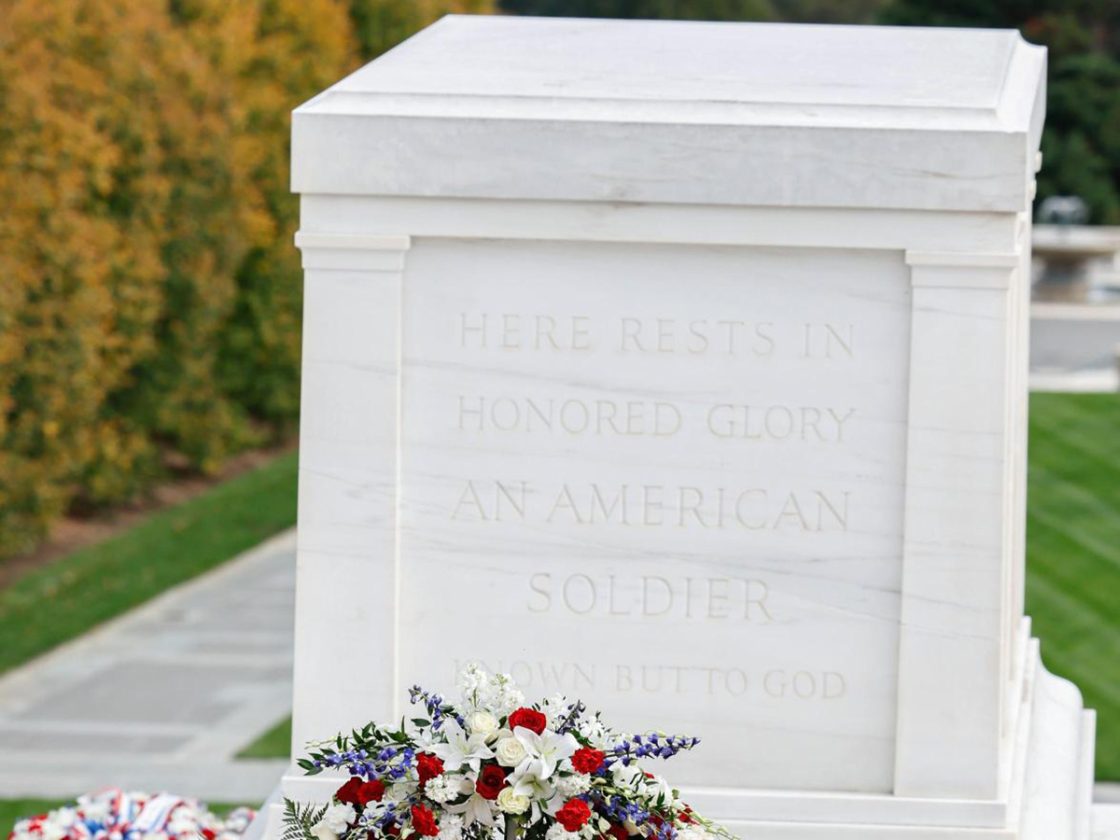
The Tomb of the Unknown Soldier at Arlington National Cemetery
Remembering the Syracuse Architect Who Made Silence Visible
In 1914, a young man from Camden, New York, left Syracuse University with an architecture degree and a head full of drawings. Within a few years, he went into service as a U.S. Army infantryman in World War I. Lorimer W. Rich had spent years imagining the creation of buildings. Now, he experienced the destruction of war.
When the fighting ended, Rich continued his studies in Italy. Returning to the United States, he joined the architectural firm of McKim, Mead & White in New York City, and after eight years he struck out on his own.
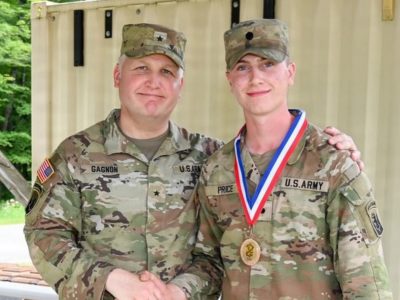
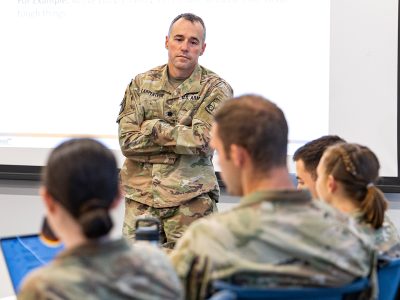
The commission that defined him came early. The nation had buried an unidentified soldier at Arlington National Cemetery in 1921 and now wanted a monument worthy of him. In 1928, Rich won the commission to design the Tomb of the Unknown Soldier through a national competition. He worked with sculptor Thomas Hudson Jones to design the tomb, which had no grand statue but only plain white marble and a quiet inscription for a man who would never be named. Rich understood that the best memorial to anonymity is simplicity. The monument was completed in 1932. Last month, Chancellor J. Michael Haynie and two students laid a wreath at the memorial.
Lawrence Chua, associate professor in the School of Architecture, says the Tomb of the Unknown Soldier is one of a series of such monuments erected by former Allied powers after World War I to commemorate the unidentified war dead in Britain, France, Canada, Portugal and Italy. All of the monuments show a similar restrained approach to ornament.
“The restraint you see in all of these monuments isn’t just a style. These monuments commemorate an imperialist war of unimaginable human devastation, and their relative blankness can be understood as an acknowledgment that such loss ultimately resists representation,” Chua says. “Rather than relying on elaborate symbolism or patriotic narrative, they allow the fact of burial itself, the presence of the unknown dead and the public rituals of remembrance to carry the meaning. The focus is placed not on military triumph but on the human cost of war.”
Chua says that Rich’s commitment to this commemorative tradition is reflected in another memorial Rich designed later in his career, the Tomb of the Unknown Soldiers of the American Revolution in Rome, New York. “Although very different in form, this 1976 monument is also similarly unornamented,” he says.
In a career spanning over five decades, Rich became one of the nation’s most prolific designers of government buildings, post offices, courthouses and churches. At Syracuse University, he designed the E.I. White College of Law, several residence halls and the Arnold M. Grant Auditorium and led the renovation of Archbold Gymnasium in the late 1940s and early 1950s. He also taught as a design critic at Columbia University and the Pratt Institute. He was a fellow of the American Institute of Architects and elected to the National Academy of Design. Syracuse University awarded him an honorary doctorate in fine arts in 1940.
Rich retired in 1971 to his hometown of Camden. After his death in 1978, President Jimmy Carter personally approved his burial at Arlington, so he could be near his creation. He is buried directly behind the Tomb of the Unknown Soldier and the Memorial Amphitheater.
Today Rich’s work resides in the Syracuse University Archives. His papers span 1917 to 1978 and include architectural plans, correspondence, photographs, negatives and sketches, with notable materials on the Tomb of the Unknown Soldier. They fill about 98.5 linear feet, the record of a man who made silence visible.