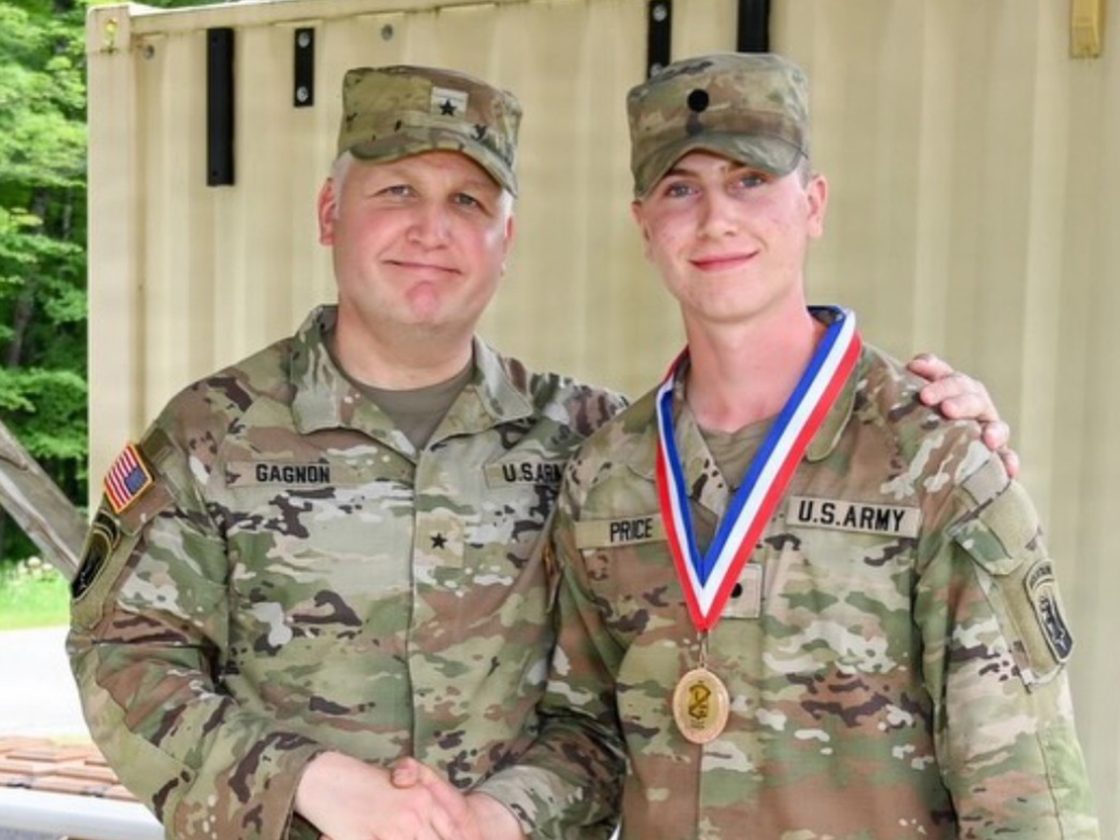
Cadet Orrin Price, right. a soldier in the Vermont National Guard and undergraduate with the Falk College of Sport, earned the Governor’s Twenty tab after placing in the top 20% of shooters during the annual marksmanship competition.
Stalwart Battalion Cadets Dominate Summer Training, Earn Top National Ranks
The cadets and cadre of Syracuse University’s Army ROTC program are celebrating a summer of high-performance and accomplishments as the new semester kicks off.
Cadets attending different phases of Cadet Summer Training (CST) earned high distinctions at the individual level and as a unit, ultimately achieving 4th place on Army Fitness Test scores among 227 ROTC programs nationwide. On the individual level, six Syracuse cadets finished in the top 5% nationally, another seven in the top 15%, and 15 more in the top 50%.
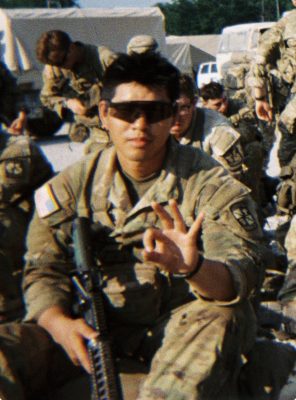
“These results are a testament to the quality of our cadets, the work of our cadre and staff, and the tremendous support the University provides our program. The University’s investment is directly contributing to the development of some of the highest-performing future Army officers in the nation,” says U.S. Army Lt. Col. Jared Larpenteur, professor of military science and senior officer of the Stalwart Battalion. “We are extremely proud of what these cadets accomplished this summer and look forward to building on that momentum during the academic year.”
CST has several key components aspiring Army officers must complete to receive a commission. Their performance also impacts a cadet’s ranking, which can determine if they get the military occupational branch desired or having to accept what is available.
The Advance Camp, a mandatory 35-day capstone event between the cadet’s junior and senior years, tests individual and platoon-level leadership, tactical skills, land navigation and problem solving in various operational scenarios. Cadets can also attend Cadet Advanced Individual Training, which are specialized military schools such as Airborne School, Air Assault School and Mountain Warfare School. There are also opportunities for specialized programs such as Cadet Troop Leader Training and the Nurse Summer Training Program for those who qualify.
“The Army ROTC program here at Syracuse University consistently trains the cadets to a very high standard, which is why I believe I did not achieve such a high score on my own. I give credit to the legacy that the previous classes have set, and to my friends, as we continually sharpen each other every day,” says Bryan Hsieh ’27, a Falk College of Sport undergraduate who placed in 16th out of 5,778 cadets nationwide.
The five Army ROTC cadets joining Hsieh in the top 5% of performers in the nation are:
- Cadet Jacob Simonetty ’28, Maxwell School of Citizenship and Public Affairs
- Cadet Michael Gammel ’27, Falk College of Sport
- Cadet John DeGeorgie ’28, School of Information Studies
- Cadet William Clegg IV ’27, School of Information Studies
- Cadet Jack Patti ’27, Maxwell School of Citizenship and Public Affairs
In addition to being among the nation’s top performers this summer, Hsieh, Simonetty, Patti and Cadet Alex Johnson ’27, an undergraduate in the College of Visual and Performing Arts, earned the elite Recondo Badge, a highly coveted personal award given to those cadets who exceed high-performance standards across multiple physical and tactical events on their first attempt, including:
- A score of 270 or above on the Army Physical Fitness Test with a minimum of 90 points per event.
- Land Navigation score of 90% or higher on the written test and five out of six points on both day and night land navigation courses.
- Qualify as sharpshooter or better on the pop-up rifle range.
- Pass all first aid, chemical, biological, radiological, nuclear and Call for Fire tasks.
- Complete a 12-mile foot march with rucksack within 90 minutes or less.
- Maintain a clean record with no founded disciplinary actions or failures of Army standards.
In addition to CST, some cadets excelled in other training events around the nation and earned individual distinction for their accomplishments. Cadet Orrin Price ’27, a soldier in the Vermont National Guard and undergraduate with the Falk College of Sport, earned the Governor’s Twenty tab after placing in the top 20% of shooters during the annual marksmanship competition, as well as third place overall in the U.S. Army Excellence in Competition marksmanship program for the individual combat rifle event.
Price attributes his marksmanship proficiency to learning basic marksmanship while growing up as a hunter, as well as the structured training he has received as an ROTC cadet.
“Last year we were lucky enough to go to the range twice and were able to spend some time in the EST (Engagement Skills Trainer), which simulates the qualification range. All of that together allowed me to have a ton of repetition,” says Price, who also earned the Military Order of the World Wars award during CST. “If you can do it enough to become muscle memory, then it becomes a lot easier over time. Thankfully my National Guard unit also takes marksmanship pretty seriously. We go through a good amount of training to make sure everyone knows what to do, and that repetition helps a lot.”
Looking ahead to next summer’s training, Hsieh offered a piece of advice for cadets preparing for their own turn at Advanced Camp and looking to carry on the Stalwart Battalion’s reputation for success.
“My advice for the MSIIIs and the newer cadets who hope to succeed is simple: trust the training. The high success rate of the current MSIVs at CST is a testament to the preparation, mentorship and high standards of Stalwart Battalion. Success at CST is achieved long before you arrive at Fort Knox. So, give 110% during PT and lab, accomplish the mission, pass your knowledge down the line, then go one more,” says Hsieh.
For more information on the Stalwart Battalion and the University’s historic commitment to supporting military-connected students, please visit the Office of Veteran and Military Affairs website.