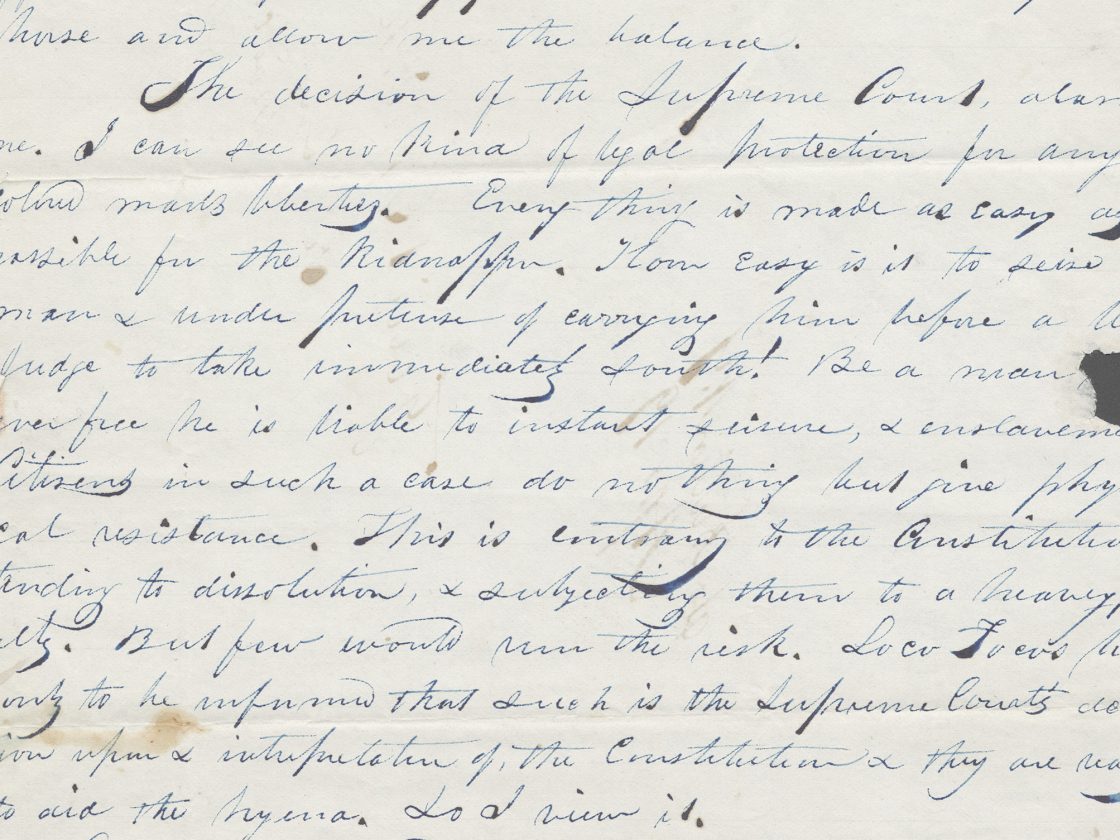
A handwritten letter from Samuel Ringgold Ward to Gerrit Smith, April 18, 1842 (Photo courtesy of the Gerrit Smith Papers, Special Collections Research Center, Syracuse University Libraries)
Libraries Receives $300K CLIR Grant to Digitize Hidden Collections
Syracuse University Libraries has received a $300,000 grant from the Council on Library and Information Resources (CLIR) through its Digitizing Hidden Collections: Amplifying Unheard Voices program to digitize the 19th-century correspondence of abolitionist Gerrit Smith. The Special Collections Research Center (SCRC) and Department of Digital Stewardship will lead the project, “Voices from the Text: The Creation of a Digital Collection and Computational Data Set from the 19th Century Correspondence of Abolitionist Gerrit Smith,” with Déirdre Joyce, head of digital stewardship and the Digital Library Program, and Nicolette A. Dobrowolski, director of SCRC, as co-principal investigators.
Over the next three years, the Libraries will digitize approximately 90,000 pages of correspondence from the Gerrit Smith Papers, part of SCRC’s Activism and Social Reform collections.
Smith (1797-1874) was a Central New York abolitionist and social reformer whose correspondents included Susan B. Anthony, Elizabeth Cady, Henry B. Stanton, Frederick Douglass, Sojourner Truth and more.
The completed project will establish public access to the full correspondence through a dedicated web portal, offering researchers a way to engage with Smith’s correspondents on a deeper level. To support this work, the Libraries will convene a Community Advisory Board to serve as project ambassadors to diverse constituencies and help develop an outreach plan for broad community and scholarly engagement.
“Gerrit Smith’s correspondence has always been about more than one man,” says Dobrowolski. “This project will help shift focus to the many lesser known and unknown individuals whose stories can be found in the letters. By recentering the voices in the text, we can restore, honor and amplify them for students, educators and communities everywhere.”
At its core, “Voices from the Text” will ensure persistent, long-term access to the full corpus of Smith’s incoming and outgoing correspondence through robust description and transcription, persistent identifiers and state-of-the-art digital preservation practices. The project will also offer experiential learning and employment opportunities to students, who will assist with materials preparation and gain practical experience in description, transcription and data work.
In the 2027-28 academic year, Libraries-sponsored “transcribe-athons” will invite students and the public to engage directly with the letters of selected correspondents, and their transcriptions will inform the AI handwriting recognition tools used on the project. Finally, the project will enable the Libraries to continue developing descriptive workflows that mindfully combine human judgment with artificial intelligence-assisted tools and support the creation of open computational data as a standard deliverable for digitized content.
“This project shows our Digital Library Program at its best, uniting digital stewardship and digital scholarship,” says Joyce. “Voices from the Text will create and expand broad public knowledge of this foundational era in American history to researchers of all types, eliminate socioeconomic barriers related to traveling to Syracuse University to engage with these materials, and ensure long-term persistent access to the digitized letters, their transcripts and the data derived from them for years to come.”
“This work is an outstanding example of Syracuse University Libraries’ leadership and commitment to open access, making resources freely accessible online,” says David Seaman, dean of the Libraries and university librarian. “Allowing this treasure trove of research to be accessed by a worldwide audience online not only contributes to greater equity but empowers new knowledge creation. This body of work would not be possible without the support of CLIR, so we are immensely grateful to receive this grant.”