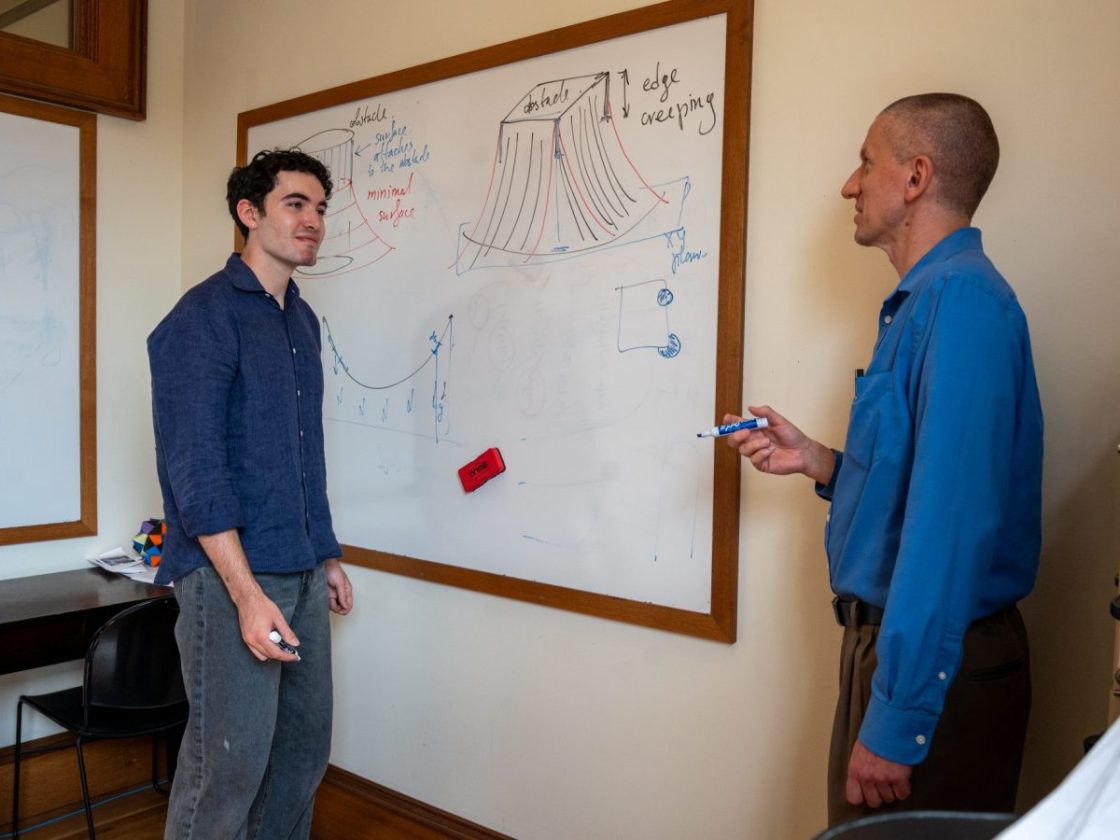
Aidan Humbert, left, found how much he enjoys open-ended research after a summer project with Professor Leonid Kovalev, right. (Photo by Amy Manley)
What Solving a Complex Math Riddle Taught a Student About Himself
Aidan Humbert ’28 had always learned math from textbooks, where the problems come with answers. Last summer, he took on one that didn’t—and supplied the solution himself, making an important discovery about the mathematical concept of edge creeping. The project also taught him about his love of learning driven by curiosity.
“It was a first for me to take on a research project like this with an applied math problem to solve,” says Humbert, a mathematics major in the College of Arts and Sciences (A&S).
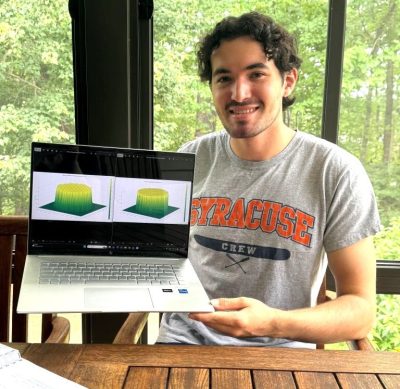
“This has been so enlightening. It’s been the perfect mix between pure intangible knowledge and something I could visualize. I’m definitely taking lessons from this to my classwork and to the rest of my college experience. That’s how passionate I am about it. Learning with curiosity is the driving factor, not a deadline or a GPA.”
Working remotely from North Carolina over the summer, the undergraduate was paired with Leonid Kovalev, professor and associate chair of mathematics in A&S, on a project sponsored by the Syracuse Office of Undergraduate Research and Creative Engagement (SOURCE).
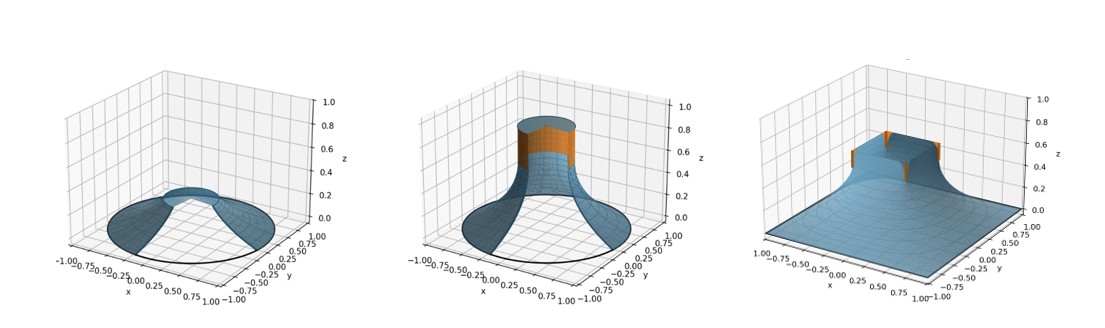
Humbert studied the math of minimal surfaces—how a shape uses the smallest area possible when stretched across a boundary, such as a soap film stretched across a wire loop. He used computer modeling to repeatedly test what happens when both round and square pegs are inserted into a thin film. With a round peg, the film forms a cylinder around it, but with a square peg, the film never attaches to touch the object at the center. Its flat sides cling to the form’s vertical edges, a phenomenon called edge creeping.
Edge creeping has been observed experimentally and studied in theory but hasn’t been completely understood. Kovalev says Humbert’s finding the exact height at which edge creeping begins on a square form offers new insights into how thin films behave—a subject of interest in architecture, chemistry, engineering and medicine. It’s also an impressive personal feat for Humbert, because he had not yet had a chance to take the advanced math courses that teach the concepts involved in the project. “But he was willing and able to learn as he went,” Kovalev says.
Humbert credits Kovalev for his success. “He gave me so much of his time over the summer—not just meeting recaps, but ideas he thought I might be able to explore in the coming week. And if I ever had a question, he’d send a nicely detailed response back with annotated pictures. It was everything I could possibly need to help me move forward.”
For Humbert, both math and Syracuse are a family tradition. He is the grandson of alumnus Harvey Schuman, ’65, G’68, G’75, a mathematician whose time at the university was followed by a long career in electrical engineering and who is currently a fellow at Syracuse Research Corporation.
“I’ve loved math since I was a kid counting beads on a string with my grandfather,” Humbert says. His parents and other family and friends attended Syracuse as well. “Their tales of the amazing math professors here drew me in.”