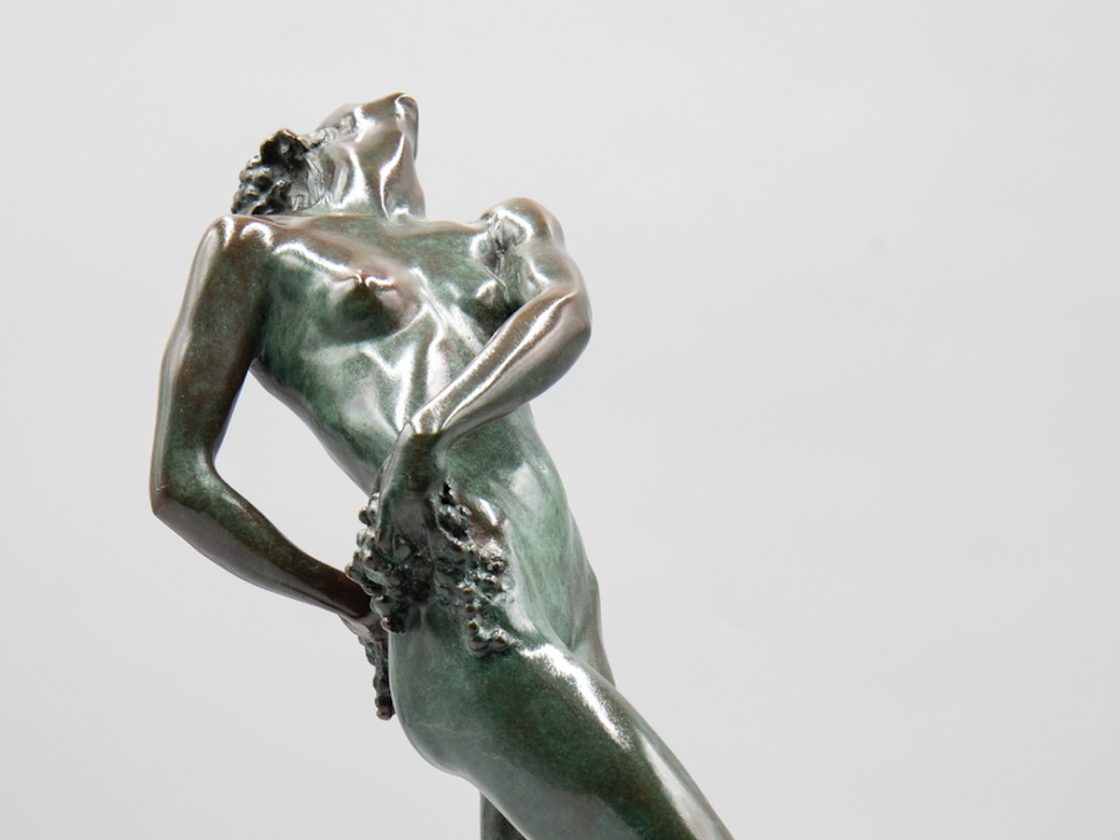
Wild Grapes, 1926. Harriet Whitney Frishmuth (1880-1980). Bronze. Gift of the Ruth Talcott Estate.
Harriet Whitney Frishmuth’s Bronze Dancers On View in Manhattan
The Syracuse University Art Museum presents “‘And she had a pose that was fascinating’: Harriet Whitney Frishmuth’s Models and Sculptures,” now on view through Feb. 4, 2027, at the Louise and Bernard Palitz Gallery at the Joseph I. Lubin House in New York City.
In the early 20th century, Frishmuth earned critical acclaim for her small bronze figures of dancers caught in motion. Later in her life, she received less attention than some of her peers after moving from New York City to live a private life in Philadelphia.
This exhibition marks her first solo exhibition in nearly 20 years, inspired by curator Em Spencer G’26’s art history graduate capstone project last spring.
Bronze sculptures and drawings from the Art Museum’s collection highlight Frishmuth’s dynamic depiction of the human body. Her focus on modern dance and her close relationships with her models, often ballerinas, breaks from the static poses and traditional artist-model relationships of her classical training as a sculptor. Her friendships made the studio a collaborative space, where the dancers, unusually, contributed to the art being made by choosing their own poses.
Spencer first came across Frishmuth’s work during a graduate seminar with art history professor Sascha Scott, where the assignment was to find an understudied artist in the Art Museum’s collection. Spencer spent more than a year working with her papers in Special Collections Research Center at Bird Library, while working at the Art Museum as a collections assistant. With curator Melissa Yuen, Spencer developed their capstone into this fully-fledged exhibition.
“For this exhibition, we wanted to focus on what set her apart from how women were being depicted at that time: why her sculptures were different and what makes them compelling,” Spencer says.
Spencer connects the intimacy of the figures to how closely Frishmuth worked with her models.
“Looking at them in person, you really get a feel for how talented she really was,” Spencer says.
The second floor of Syracuse University’s Lubin House, located at 11 E. 61st Street in New York City, is home to the Louise and Bernard Palitz Gallery, the Museum’s visual arts venue in midtown Manhattan. For more information, visit museum.syr.edu.