3 Postdoctoral Researchers Honored for Impactful Research
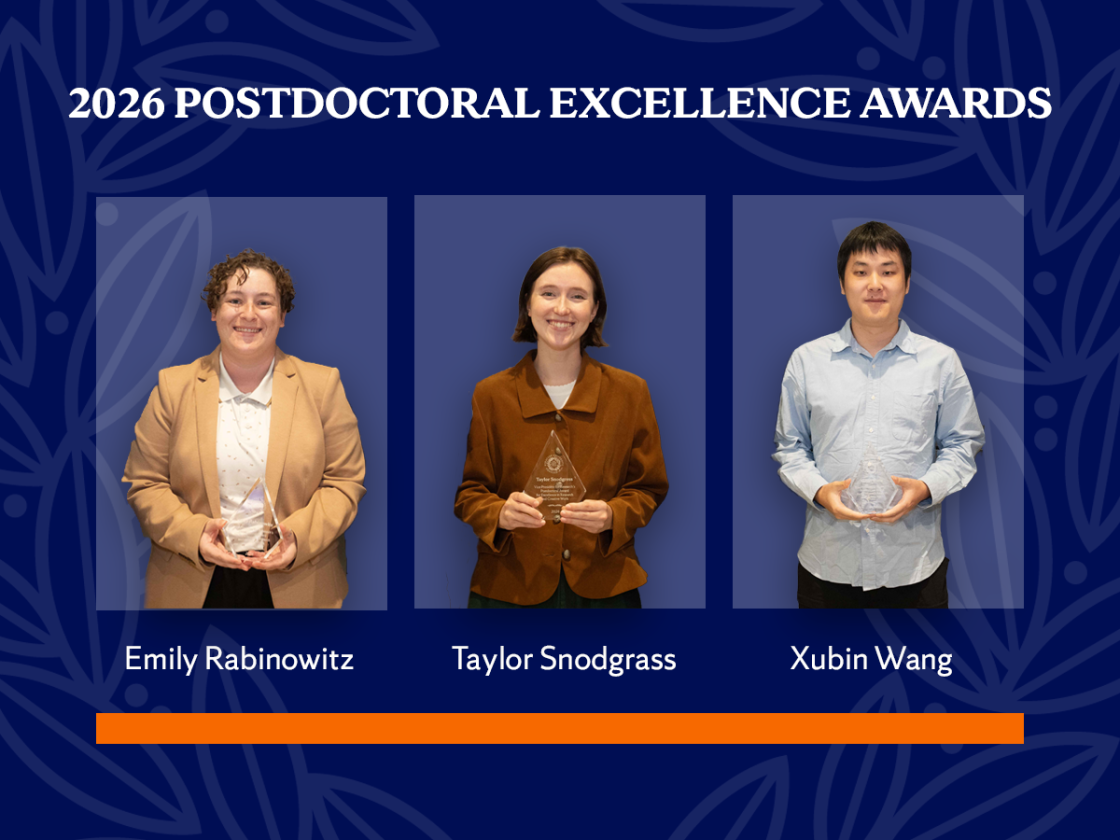
Three postdoctoral researchers were honored for the quality and impact of their research and creative activity at this year’s Postdoctoral Appreciation Awards dinner.
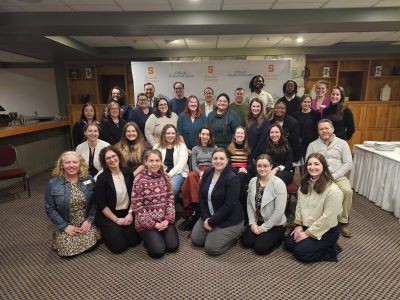
The Office of Postdoctoral Affairs and the Graduate School co-host the annual celebration to honor the postdoctoral community and recognize the scholars, who are joined by their guests, faculty mentors and University leaders. Each recipient received a $750 award and presented a research summary at the event.
In honoring them, Vice President for Research Duncan Brown said the University’s 80 postdoctoral scholars are a crucial component of its research enterprise.
“Our postdoctoral scholars are central to Syracuse’s research mission,” he said. “They create new knowledge, mentor our graduate and undergraduate students in cutting-edge research and creative work and empower our faculty. The scholars we recognize this year reflect the ambition and rigor that exemplify Syracuse University’s research and creative enterprise.”
Honorees are:
Emily Rabinowitz, “Trauma, Health, and Recovery: Advancing Veteran Behavioral Health Research at Syracuse University.” (Center for Health Behavior Research and Innovation (CHB), D’Aniello Institute for Veterans and Military Families. Faculty mentor: Joseph Ditre, professor of psychology and director, CHB)
Rabinowitz’s research explores how physical injury during military deployment shapes service members’ psychological health. She found those who experienced a traumatic injury had greater psychological distress than both those exposed to trauma without injury and those with no injury. Her project is part of a larger program of research examining factors related to military and veteran well-being.
Taylor Snodgrass, “Beyond the Current Error: What a Child’s Speech History Reveals About Treatment Success.” (Department of Communication Sciences and Disorders, College of Arts and Sciences (A&S). Faculty mentor: Jonathan Preston, professor of communication sciences and disorders)
Snodgrass examines why children with residual speech errors—sounds like “r” that persist past the typical age of mastery—respond differently to treatment based on their developmental history. She found that children with an early, broader speech history show smaller treatment gains than those identified later. Her work suggests that speech-language pathologists should consider both developmental history and a child’s ability to notice and work with the sound structure of spoken language when setting treatment expectations.
Xubin Wang, “Decoding Earth’s Breathless Past to Predict Our Marine Future.” (Department of Earth and Environmental Sciences, A&S. Faculty mentor: Zunli Lu, Thonis Family Professor, earth and environmental sciences)
Wang’s research looks hundreds of millions of years into the Earth’s past to understand how oceans respond to dramatic climate change and what that history says about their future. His findings challenge a long-held assumption that severe deoxygenation—the loss of life-supporting oxygen from oceans—is mainly a feature of global warming; he showed it also recurred during some of Earth’s most severe ice ages. He also uncovered how changes in continental weathering reshaped ocean chemistry and helped enable the evolutionary rise of animals with mineralized skeletons. In addition, Wang developed a new geochemical “redox ladder,” a powerful way for scientists to reconstruct oxygen levels in Earth’s ancient oceans.