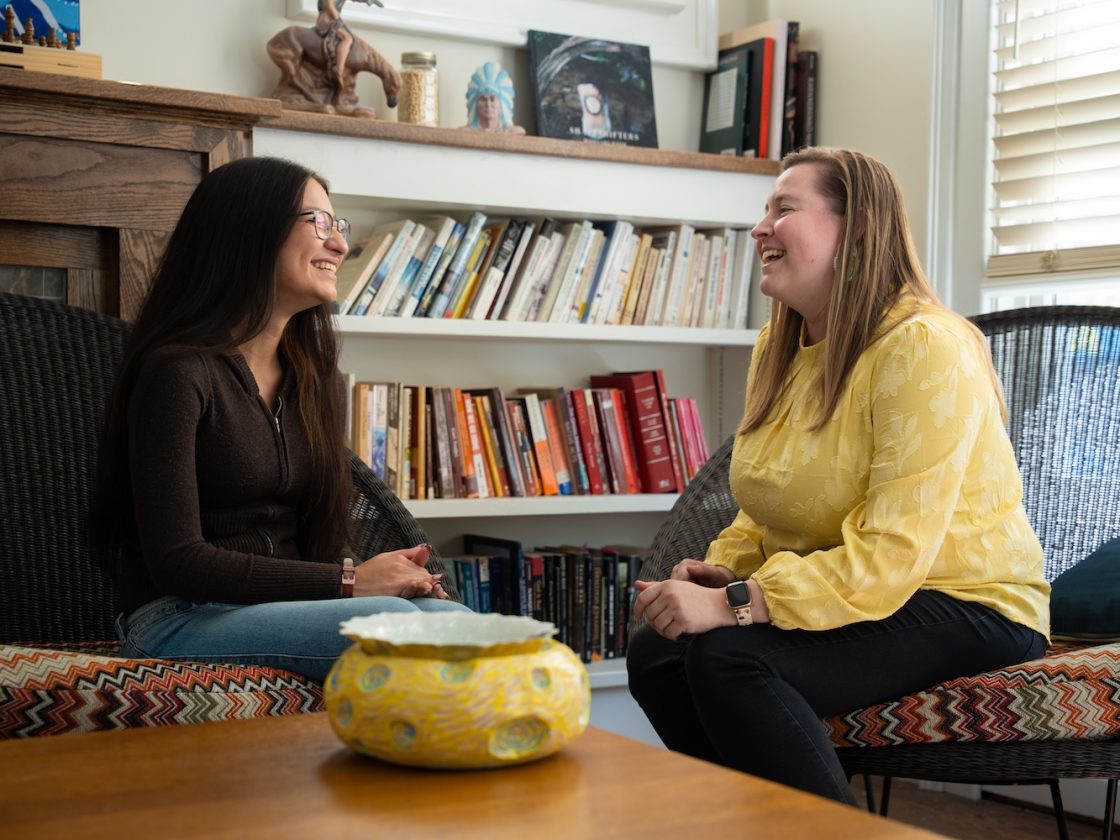
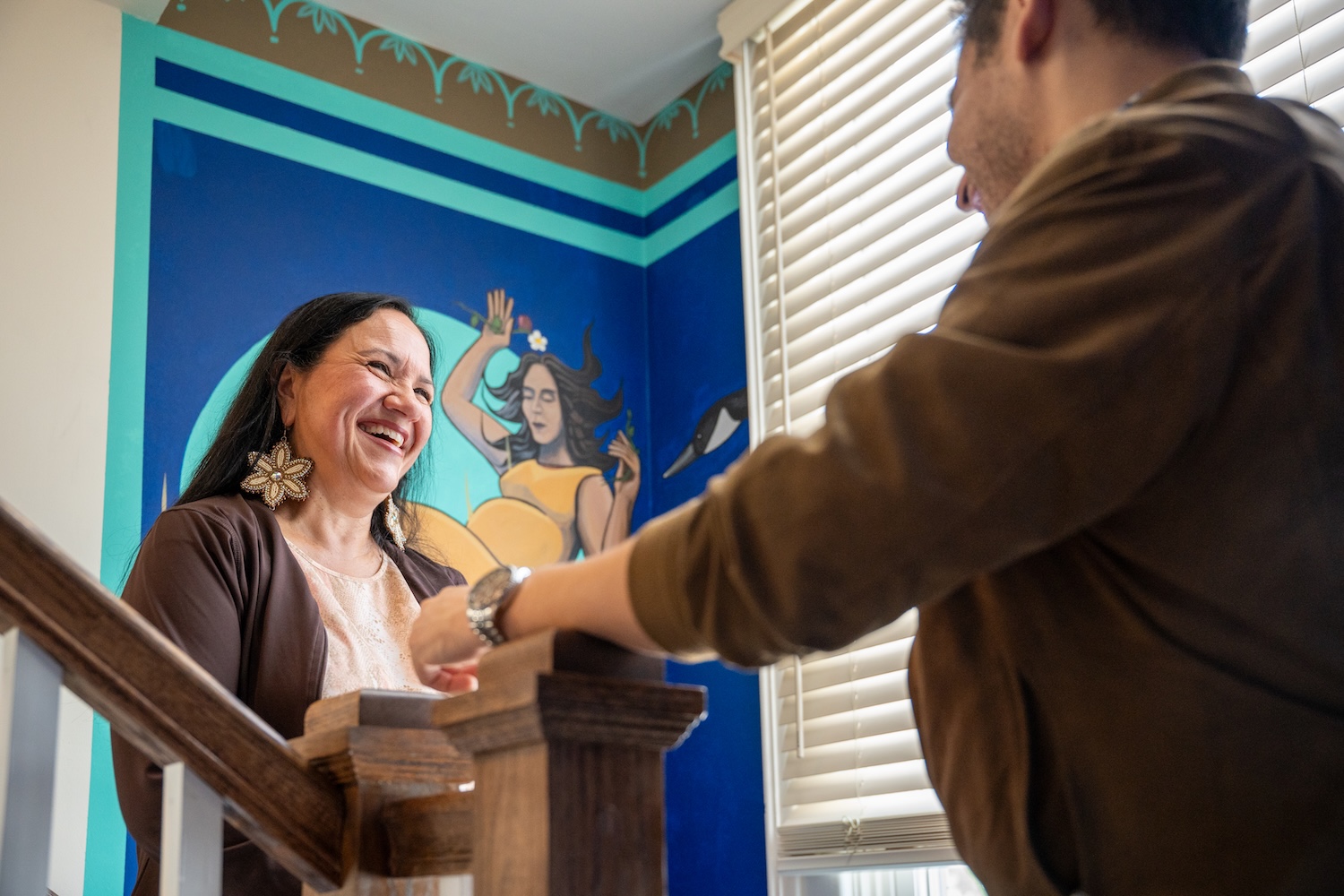
Jadalyn George (left) and Becky Rose, assistant director of academic and career advising in the School of Education (Photo by Amy Manley)
New Program Prepares Next Generation of Indigenous Teachers for the Classroom
Growing up as an Akwesasne Mohawk in Central New York, Jadalyn George ’30 knew that seeing herself reflected in her teachers fostered a sense of belonging.
“It also made me a better student,” she says.
Convinced that representation matters in the K-12 classroom, George is part of the new Indigenous Teacher Preparation Program (ITPP) in Syracuse University’s School of Education (SOE).
She is pursuing a bachelor’s degree in inclusive childhood education while minoring in Native American and Indigenous studies. The program enables her to be certified in New York state to teach grades 1-6 and students with disabilities in all grades.
George is excited to interact with other “native educator minds” on campus.
“I have so many knowledgeable peers,” she says. “I also have spaces where I can study, eat and hold meetings with people with similar interests and backgrounds.”
Reducing Barriers
George found out about ITPP from Tammy Bluewolf-Kennedy ’04, G’10, an assistant director of admissions who is in charge of Indigenous recruitment and supports partnership programs.
The Oneida Nation citizen has worn many hats at the University, but it’s her current one of which she’s proudest—not just for what it represents but also the tasks associated with it.
“ITPP is personal to me,” Bluewolf-Kennedy says. “Young Indigenous minds need to see themselves in their teachers, who, in turn, must understand their students’ cultures, histories and lived experiences.”
ITPP offers the Hoñwanahahoñ•nyeñ•nik Scholarship, the result of an anonymous $150,000 gift.
The scholarship, whose name is Onondaga for “They Build a Path for Them,” is awarded up to seven undergraduates per cohort. In addition to covering 30% of each student’s tuition, it underwrites the costs of professional development, conference participation and study-away opportunities.
“We’re reducing financial barriers for Indigenous students who want to become inclusive education and community teachers,” says Bluewolf-Kennedy, who also chairs the University’s Native Faculty and Staff Association, as well as the Native American Indian Education Association of New York. “It’s mission critical.”
Learning on Sacred Ground
The lack of consistency in Indigenous teacher preparation programs is well documented. The barriers are financial, cultural and systemic.
“Most teacher training programs are local in scope,” Bluewolf-Kennedy says. “Ours extends to the nearly 600 sovereign Nations across the United States and Canada. This breadth is reflected in our faculty and curricula.”
Becky Rose, assistant director of academic and career advising in SOE, notes the holistic nature of ITPP.
She explains that students can pursue a B.S. in inclusive childhood education or inclusive adolescent education, the latter of which leads to New York state-certification to teach grades 7-12 and students with disabilities in all grade levels.
“ITPP is completed in eight semesters, five of which have a field component,” says Rose, ITPP’s dedicated academic advisor. “We offer many experiences in the Syracuse area and throughout New York City via [SOE’s] Bridge to the City program.”
Another selling point is ITPP’s many nonacademic offerings—from the Native Student Program and the Indigenous Students at Syracuse group, both housed at 113 Euclid Ave., to the Indigenous Living Learning Community in Shaw Hall.
“These supports are coordinated for student success,” says Rose, a tribally enrolled member of the Echota Cherokee.
“Syracuse University stands on the ancestral lands of the Onondaga Nation, Firekeepers of the Haudenosaunee Confederacy,” says Bluewolf-Kennedy. “Whether you’re Indigenous or not, you’re learning on sacred ground.”