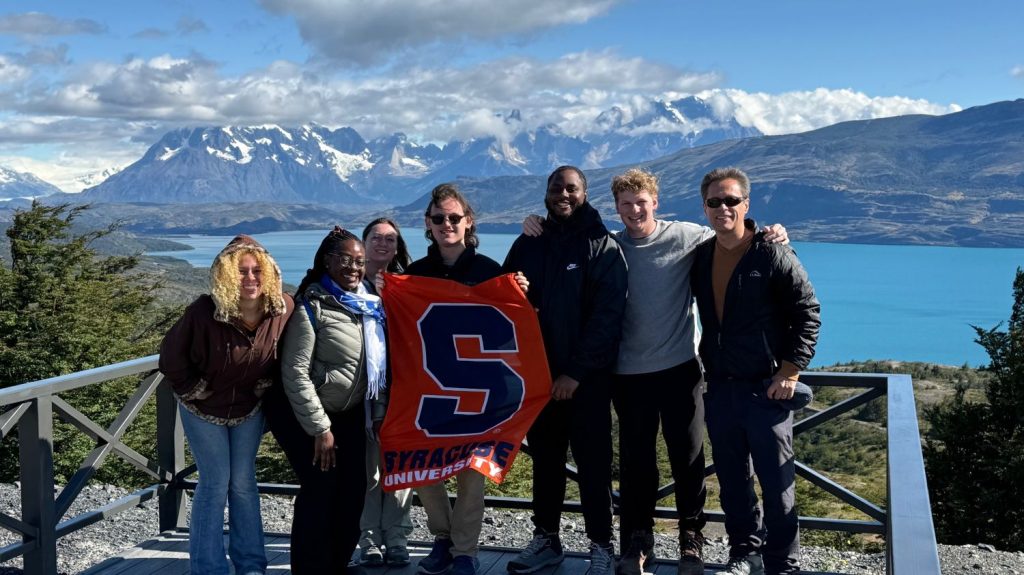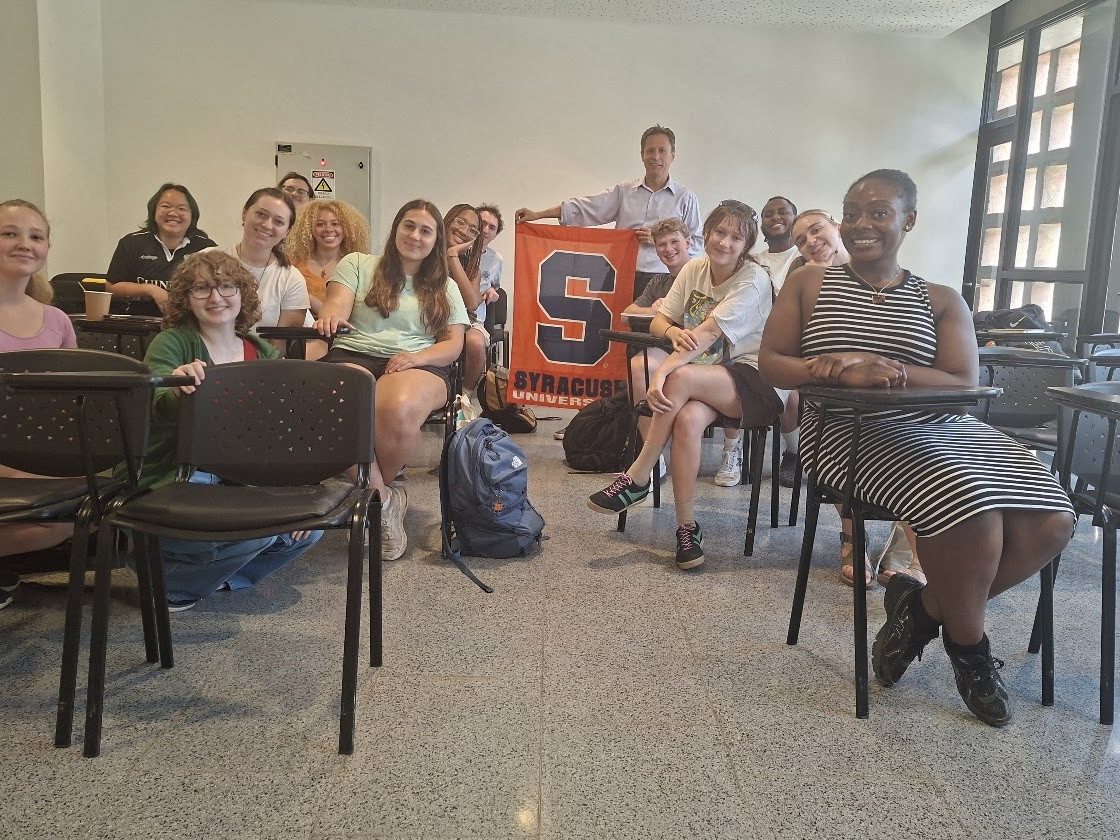
Students in the Spring 2026 cohort in Santiago, Chile, including 2026 Lender Global fellows, pose with course instructor and director of the program, Mauricio Paredes (standing). The fellows took the course, Dictatorships, Human Rights and Historical Memory, as part of their research for Lender Global.
From Santiago to Syracuse: Students Report on Chilean History Research
Student researchers participating in the 2025-26 Lender Global fellowship in Santiago, Chile, will discuss their cultural experiences and research findings at a campuswide symposium Thursday, Sept. 24.
The researchers took part in the Lender Center for Social Justice program, which pairs selected fellows with academic programs offered at Syracuse Abroad locations. The center has offered campus-based student-faculty research fellowships on social justice issues for eight years and began offering shorter-term global research opportunities two years ago.
Students will share findings from their research on human rights issues arising from the Augustus Pinochet dictatorship in Chile.
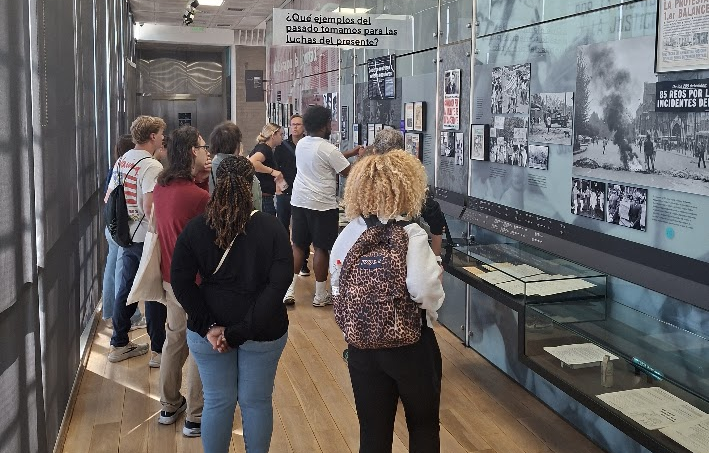
Ohemaa Asibuo ’27 analyzed archived lists of victims of political retribution from records at Santiago’s Museum of Memory and Human Rights. The international relations and Spanish dual major in the Maxwell School of Citizenship and Public Affairs and the College of Arts and Sciences analyzed data regarding Chileans who once supported Pinochet’s leadership but were later labeled as traitors.
Mauricio Paredes, director of Syracuse Abroad’s Santiago program, says Asibuo’s research of presenting the victims by demographic categories broke new ground and set the stage for further museum staff findings.
Asibuo regards her commemorative education work as “extremely important in preventing these types of things from occurring again. I hope to continue to advocate for using past historical events as warnings to help us navigate how we approach our futures.”
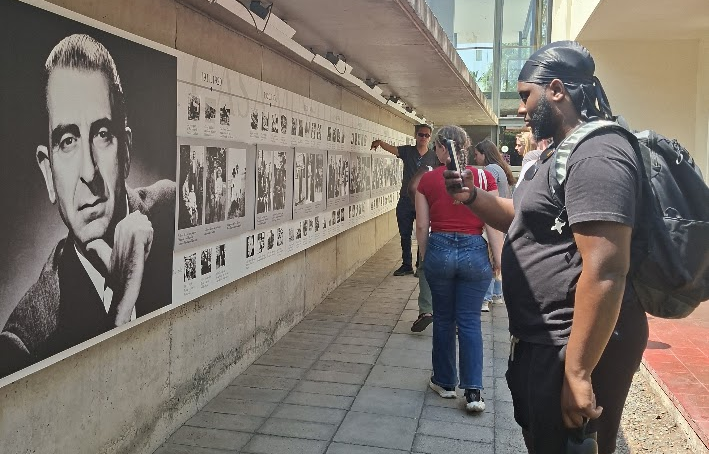
Jherlyn Brady ’27, a communication and rhetorical studies major in the College of Visual and Performing Arts, learned that Chile’s educational system “was used by the dictatorship to raise nationalism and neoliberalism. They closed institutions responsible for educating teachers; elites and the military created and governed their own schools. That exacerbated economic disparities that still affect Chileans today.” The experience “let me see the institution of education in a different context,” she says. “It can be either a source of social control or a tool of liberation.”
College of Arts and Sciences and Maxwell School political philosophy major Laila Terrell ’27 analyzed the rhetoric of CEMA-Chile, a women’s organization run by Pinochet’s wife. Though the group taught women skills for work and involvement in their communities, it also promoted the regime’s mantras and ideas about what women should be, Terrell says.
She observed that “these women could genuinely benefit from CEMA while also being part of an organization that helped support a violent dictatorship, making the idea of ‘empowerment’ much more complicated than it first appears.”
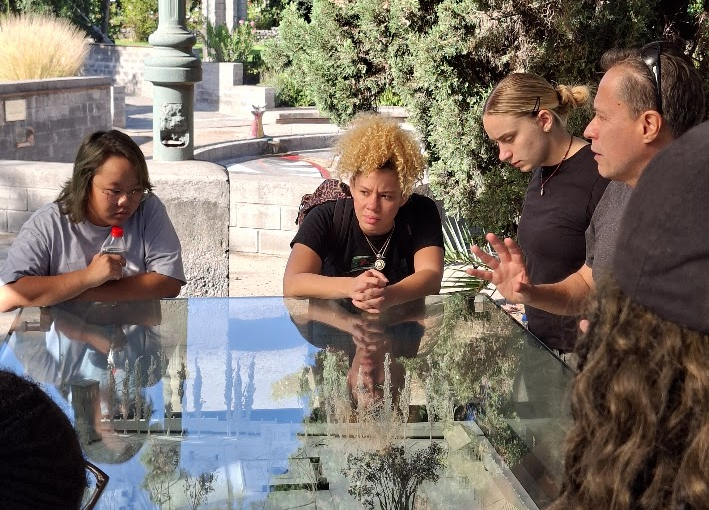
Sophia Ortiz-Heaney ’27, a Maxwell School economics and international relations dual major, says chatting with local residents and visiting former clandestine detention centers helped her “understand Chilean society on a more profound level. [They] pushed me to think about how history and movements shape the built environment…[and] understand the true extent to which the dictatorship has and still does impact the experiences, opportunities and everyday lives of Chileans.”
Also presenting are Mason Rosenbaum ’27 and Grant Montonye ’28, both international relations majors in the Maxwell School. Rosenbaum recalls conversations with Museum of Memory staff as “a particularly moving experience.” Montoye studied how Chilean constitutions were developed to justify Pinochet regime actions.
Madiou Bah ’27, a broadcast and digital journalism major in the S.I. Newhouse School of Public Communications, analyzed the use of propaganda and how governments use fear and media to control and maintain power.
Other students in the Syracuse Abroad Santiago Center program will now continue exploring those themes using teaching and learning materials developed by the Lender Global fellows, particularly those in the new Environment, Health and Policy program.