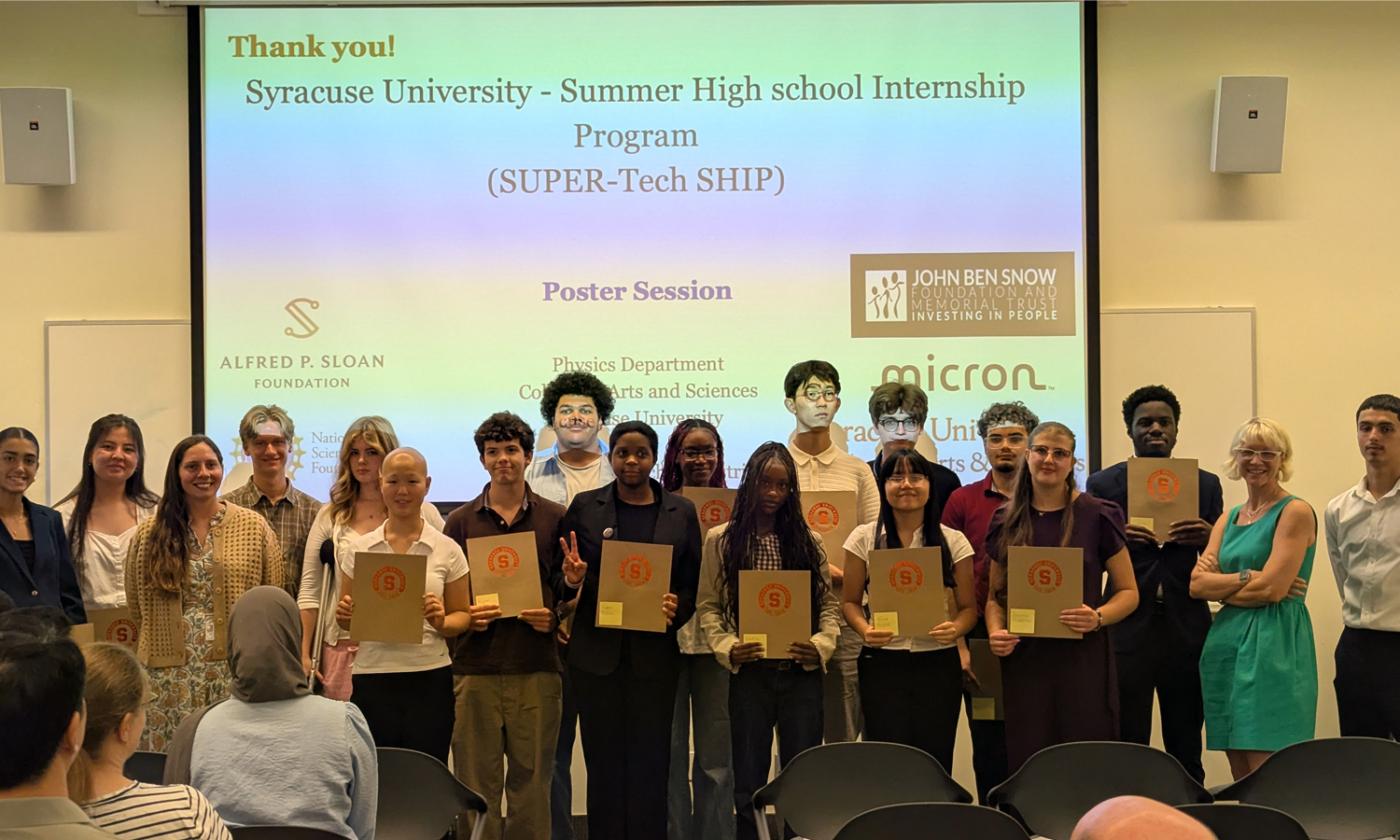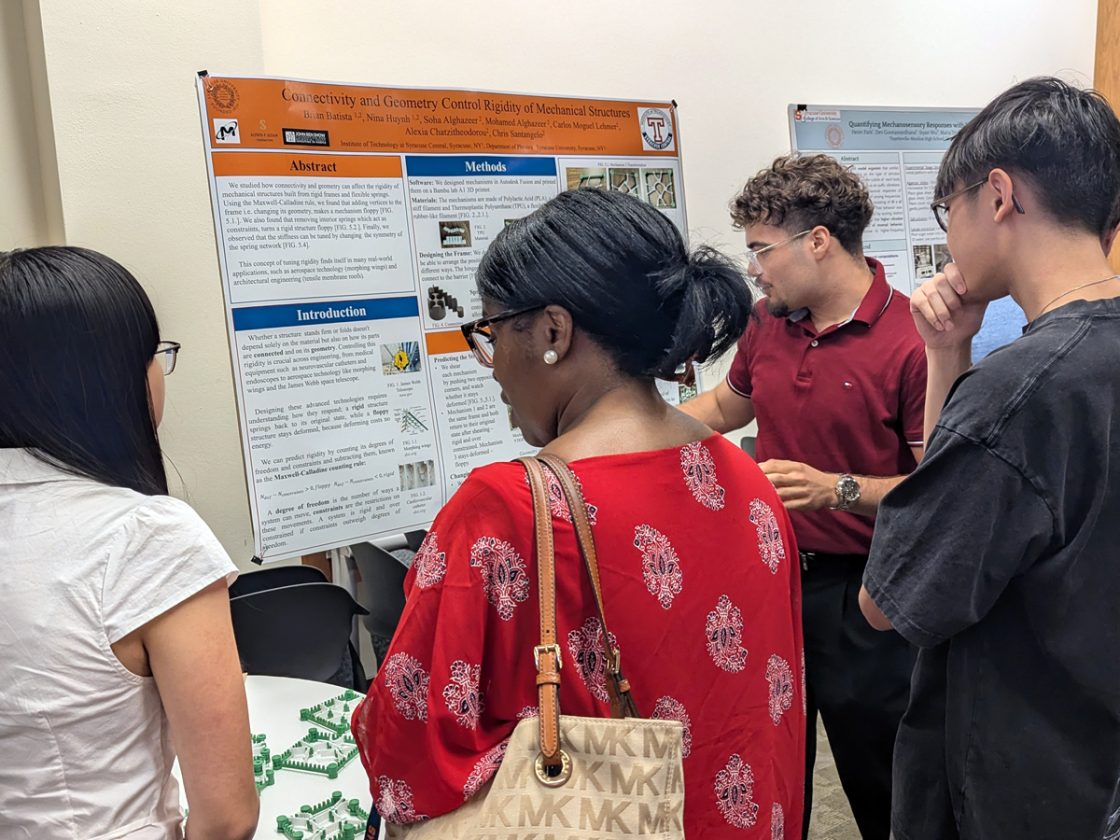
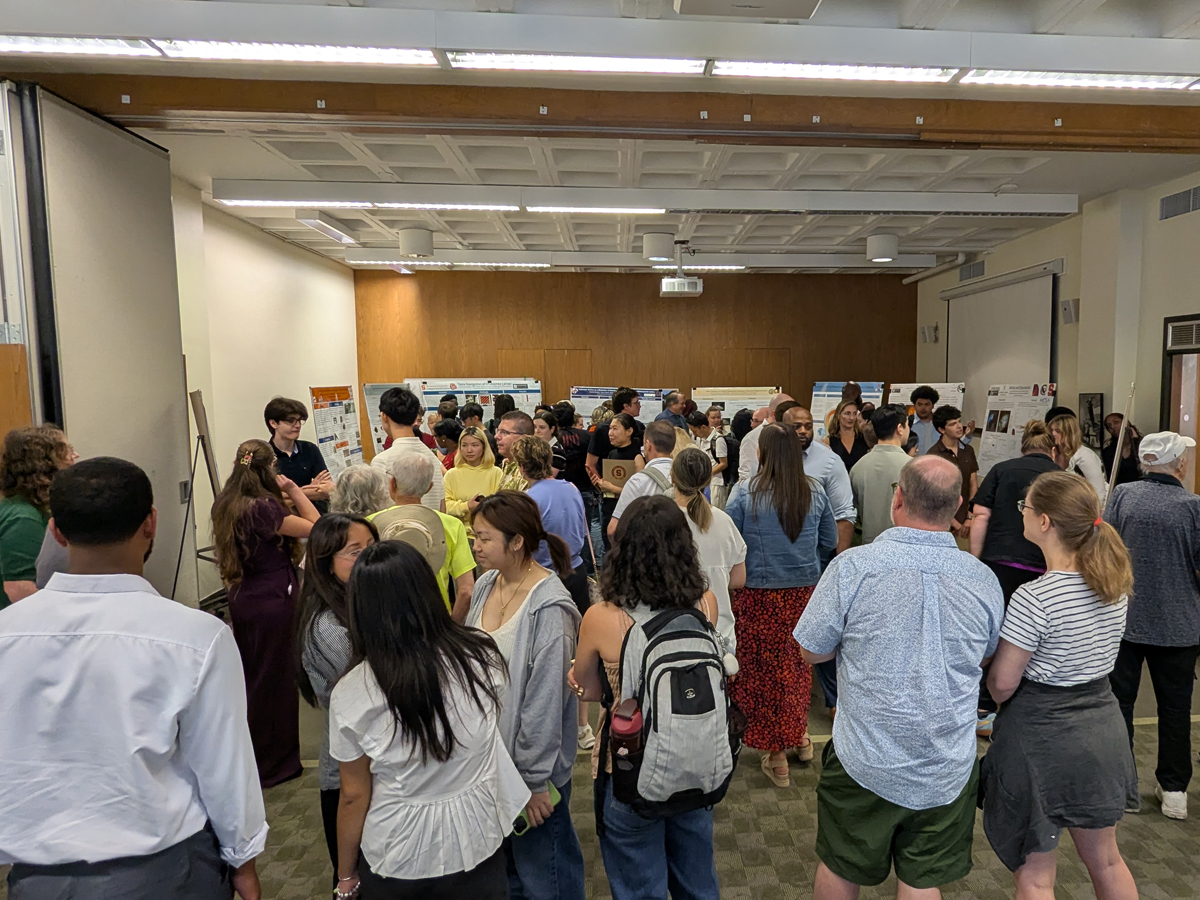
For the fifth summer, Syracuse University put its physics labs and faculty mentors to work for 12 high school students from the Syracuse City School District (SCSD). Students were led through six weeks of college-level research that culminated in a poster session and celebration on Aug. 7 in the Physics Building.
The Syracuse University-Summer High School Internship Program (SU-SHIP) gives students hands-on laboratory experience alongside faculty, graduate and postdoctoral students in the College of Arts and Sciences’ (A&S) Department of Physics.
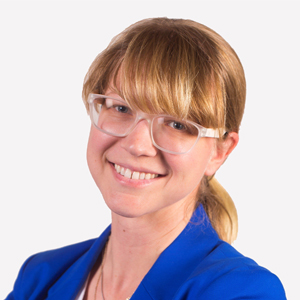
“This is a full-time job over the summer for these students, most of whom are really interested in physics and engineering,” says Jennifer Ross, professor of physics and the founding director of the program. “We offer these students a pre-college experience where they can study and learn from each other and from our faculty and students. It’s the perfect way to help them further their passion for science and engineering.”
This year, thanks to the efforts of Chancellor J. Michael Haynie, Ross says the program received “essential” funding from Micron. Additional funding was provided by the John Ben Snow Foundation and Memorial Trust, research funds contributed by faculty members across campus and an anonymous gift.
Removing Barriers, Building Community
The idea for SU-SHIP, which launched in the summer of 2022, stemmed from a conversation Ross had with Ruell Branch ’24, an SCSD graduate who was seeking out hands-on experiences in a physics lab over the summer after his freshman year.
Branch recognized that SU-SHIP would strengthen the University’s connection with the community and inspire students like himself to pursue STEM careers. As a Henninger High School student, Branch excelled in physics under the guidance of Melanie Pelcher G’11, who organized classroom visits where Ross and SU-SHIP faculty could meet with interested students.
“From the beginning, this was a great opportunity to partner with the Syracuse City School District and provide training and hands-on research experiences,” Ross says. “It’s really important that we tap into the technical science and engineering talent that we have here locally, and that we show them what’s possible.”
Ross says the program was designed to remove obstacles that often keep students from pursuing this path. SCSD students each receive a $6,000 stipend, breakfast and lunch, and free daily transportation courtesy of Jim Dispenza ’98, who owns and operates Carebridge Transport.
“Transportation is one of the biggest barriers for these students, who could spend upwards of two hours taking the bus to and from the program,” Ross says. “You don’t want to make it harder for someone to pursue this path.”
Making Physics a Full-Time Summer Job
Students log approximately 35-40 hours each week honing their research skills. Between testing out theories in the lab, students eat in the University’s dining halls, explore the campus maker spaces and learn why Syracuse University could be their college destination for studying physics.
The program accepts any interested student, regardless of funding availability. Volunteers from neighboring Jamesville-DeWitt and Fayetteville-Manlius high schools joined the recent cohort for the full experience.
Research That Sparks Curiosity
The list of SU-SHIP projects from this summer was diverse, with students working on the following projects:
- studying how cells organize themselves during division
- understanding bacteria biofilm mechanics
- observing how fruit fly maggots respond to vibration
- simulating what happens when black holes tear apart stars
- understanding mechanics of origami
Before diving into specialized lab work, all students complete a two-week boot camp covering experimental research skills, electronics, computational science, biotechnology and 3D printing, giving them a shared foundation across multiple scientific disciplines.
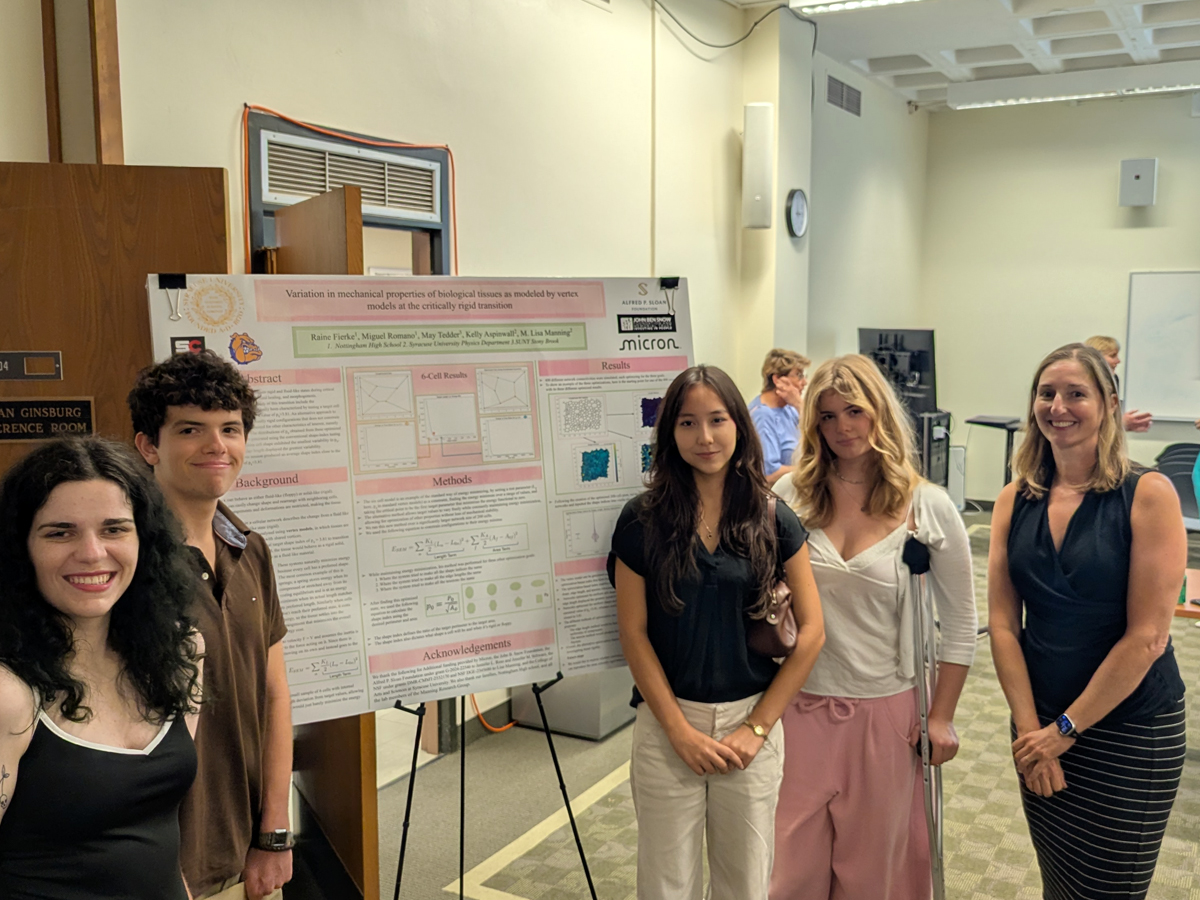
“You need to understand how physics research works, and we provide that background,” Ross says. “Our students learn the basic skills of biotechnology, microscopy, additive manufacturing and math, and they’re exposed to everything they will encounter in the lab.”
That research experience teaches students something their previous classroom experiences often can’t: that failure is part of discovery, not something to fear.
“Failing the right way means you’re learning something,” Ross says. “There’s a learning process that comes from watching and iterating on it. What happens with research is very different from the classroom.”
This year’s program welcomed 12 SCSD students who received a full stipend to attend, along with a record number of students from neighboring districts and nine returning students who served as near-peer mentors.
Seven faculty research groups hosted student researchers, including physics faculty members Christian Santangelo, Eric Coughlin, Alison Pattison, Lisa Manning, Mirna Mihovilovic Ganada and Earth and environmental sciences faculty member Tripti Bhattacharya.
The program’s first cohort graduated from college this year, with many students continuing to study STEM fields at the University.