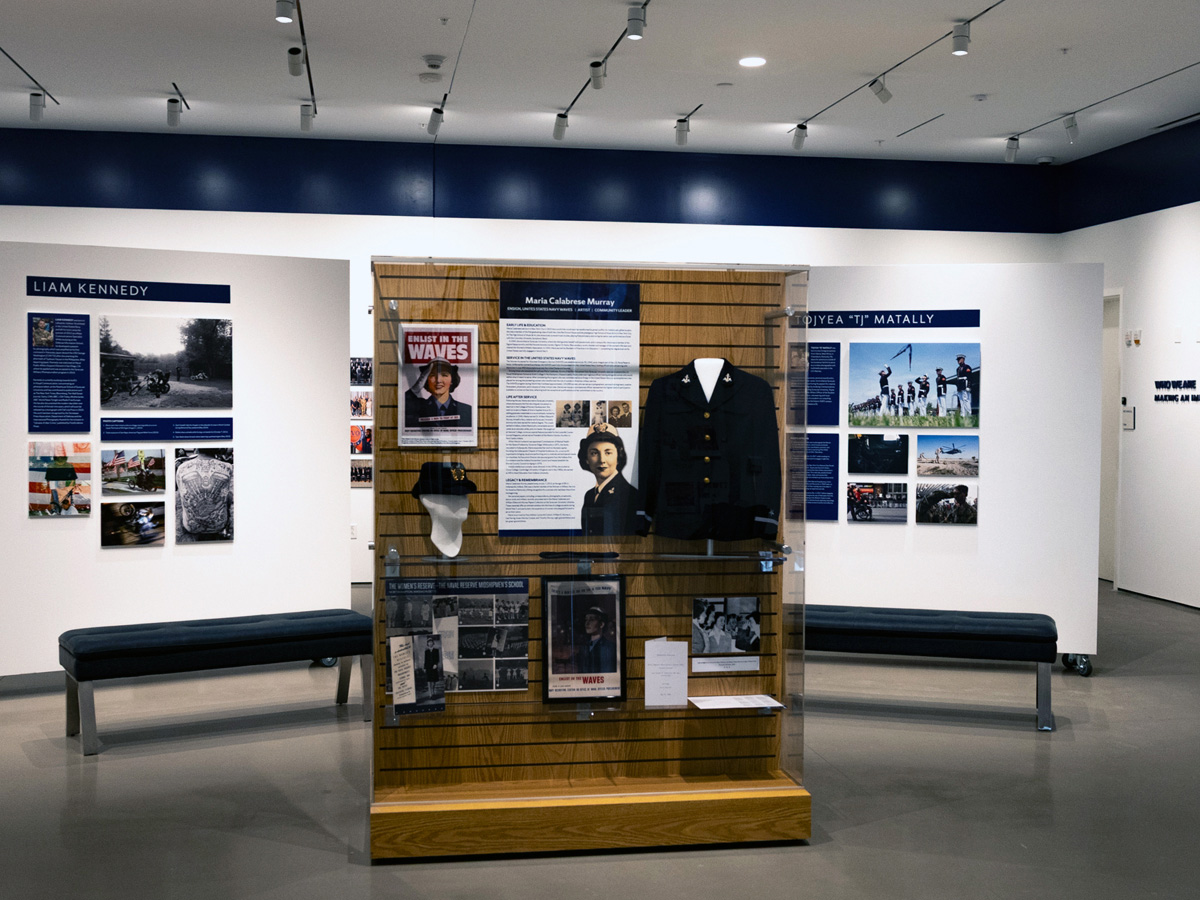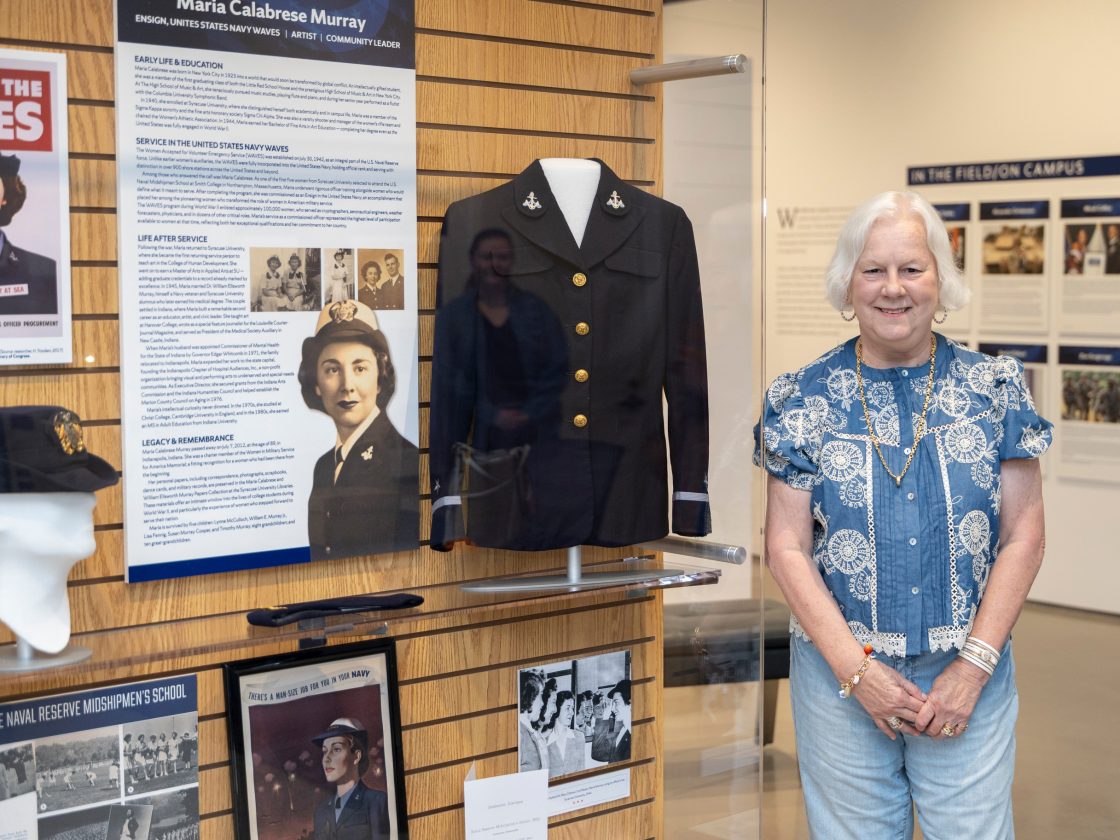
Susan Cooper poses with her mother’s uniform display, which honors her mother, Maria C. Murray '44, as one of Syracuse University’s first Navy WAVES. (Photo by Charlie Poag)
She Charted a Course for Women in the Navy. Now, Her Legacy Has a Home
Maria Calabrese Murray ’44 was 17 when she arrived at Syracuse University in 1940. A talented flutist and pianist, Murray had already performed with the Columbia University Symphonic Band before pursuing higher education in Syracuse. By the time she earned her bachelor of fine arts degree in art education, the U.S. had been fighting in World War II for nearly three years, and women across the country were stepping into roles being opened to them for the first time in the military.
Murray was chosen as one of five women from Syracuse University to attend the U.S. Naval Midshipman School at Smith College in Northampton, Massachusetts, training alongside other women who would help redefine what military service meant for generations to come. She completed the program and was commissioned as an Ensign in the U.S. Navy WAVES, or Women Accepted for Volunteer Emergency Service.
Thanks to a donation from Murray’s daughter, Susan Cooper, a part of Murray’s military legacy is now prominently on display in the gallery at the National Veterans Resource Center (NVRC) at the Daniel and Gayle D’Aniello Building. The informational display contains uniform items from Murray, as well as photos and articles from her time on campus and in the service.
“My mother always spoke of being a WAVE with great pride. Growing up, I didn’t recognize the significance until I was older, particularly after she passed away in 2012,” Cooper says. “She had been living with us for eight years, so I had all of her items in my basement, and I knew it had to find a wonderful home.”
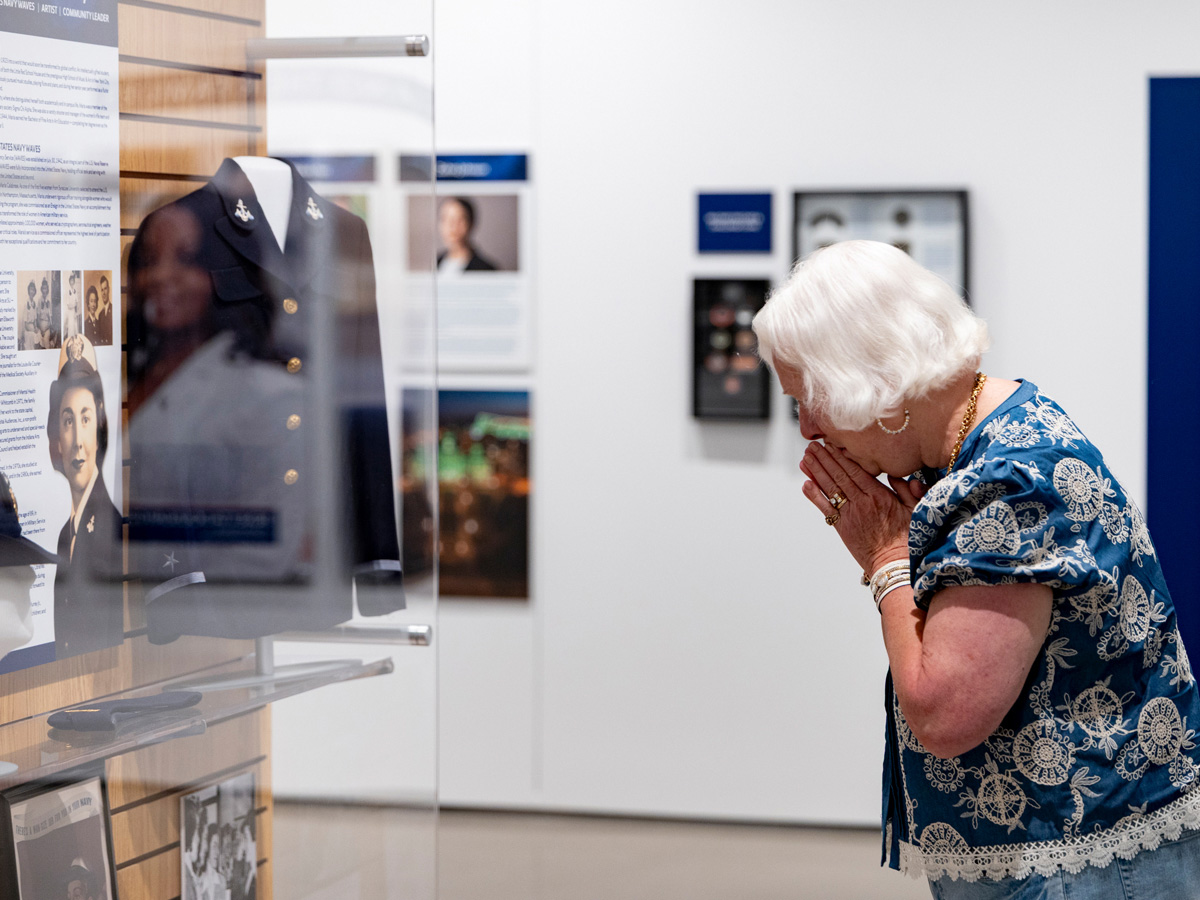
Before her military service, Murray built a record of achievement on campus. She was a member of the Sigma Kappa sorority and the fine arts honor society Sigma Chi Alpha, and she served as manager of the women’s varsity rifle team and chair of the Women’s Athletic Association.
Not long after graduating from Syracuse, she married William Ellsworth Murray, a fellow alumnus and a commissioned medical officer in the U.S. Navy. The couple eventually settled in Indiana, but Murray first returned to Syracuse after her own military service, becoming the first returning service member to teach art in the College of Human Development. She later earned a master’s degree in applied arts from the University.
Murray went on to have a rewarding career as an educator, artist and civic leader in Indiana, where she founded the Indianapolis chapter of Hospital Audiences, Inc., a nonprofit bringing visual and performing arts to underserved and special-needs communities.
Murray died July 7, 2012, in Indianapolis at age 89. She was a charter member of the Women in Military Service for America Memorial, one more marker of a life spent going first. Her personal papers, including correspondence, photographs, scrapbooks and military records, are preserved separately in the Maria Calabrese and William Ellsworth Murray Papers Collection at Syracuse University Libraries.
“Moments like these are both rare and rewarding. Having the opportunity to learn about the incredible impact Maria Calabrese Murray and her service in the WAVES had on our nation and the University during World War II is truly remarkable,” says retired U.S. Army Col. Ron Novack. “Having a piece of that history to share with the University community in our gallery is a great connection to the University’s historic commitment to those who served.”
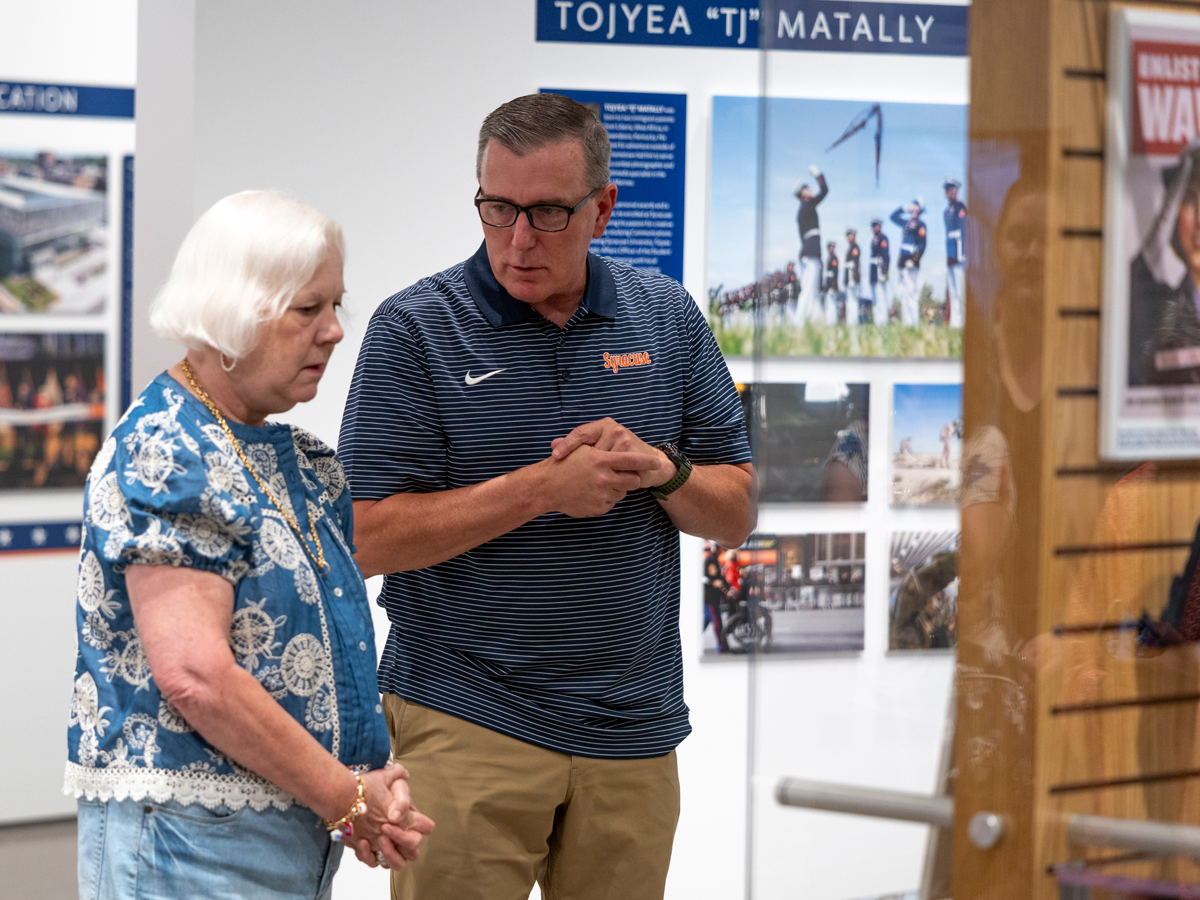
In addition to memorabilia that belonged to Murray, the informational display educates viewers about the WAVES and about programs at the University that supported students preparing for military service. It also contains a draft map of Iwo Jima that Murray drew during her military service.
The Battle of Iwo Jima, fought from Feb. 19 to March 26, 1945, remains one of the most consequential and costly battles of World War II. American forces sought to capture the island’s airfields due to its critically important strategic location in the Pacific Ocean. For military planners, accurate maps and coastline drawings, like the one Murray drafted, were not a luxury but a necessity for operational success.
“Because of her connection to Syracuse, I started thinking that the NVRC is the right home for this. For me, this place feels like a home for her. The Office of Veteran and Military Affairs treated her with tremendous respect, which I admire. She personally wouldn’t have demanded this, but she would have loved every moment,” Cooper says.
While Murray’s uniform and information on the WAVES are already on display in the NVRC Gallery, the map of Iwo Jima she drafted is being carefully prepared to preserve the historical artifact while allowing visitors to understand the complexities of topographic drafting before the development of satellite imagery. It will be featured for public viewing in the near future, but the exhibit can be viewed during regular operating hours at the start of the academic semester.