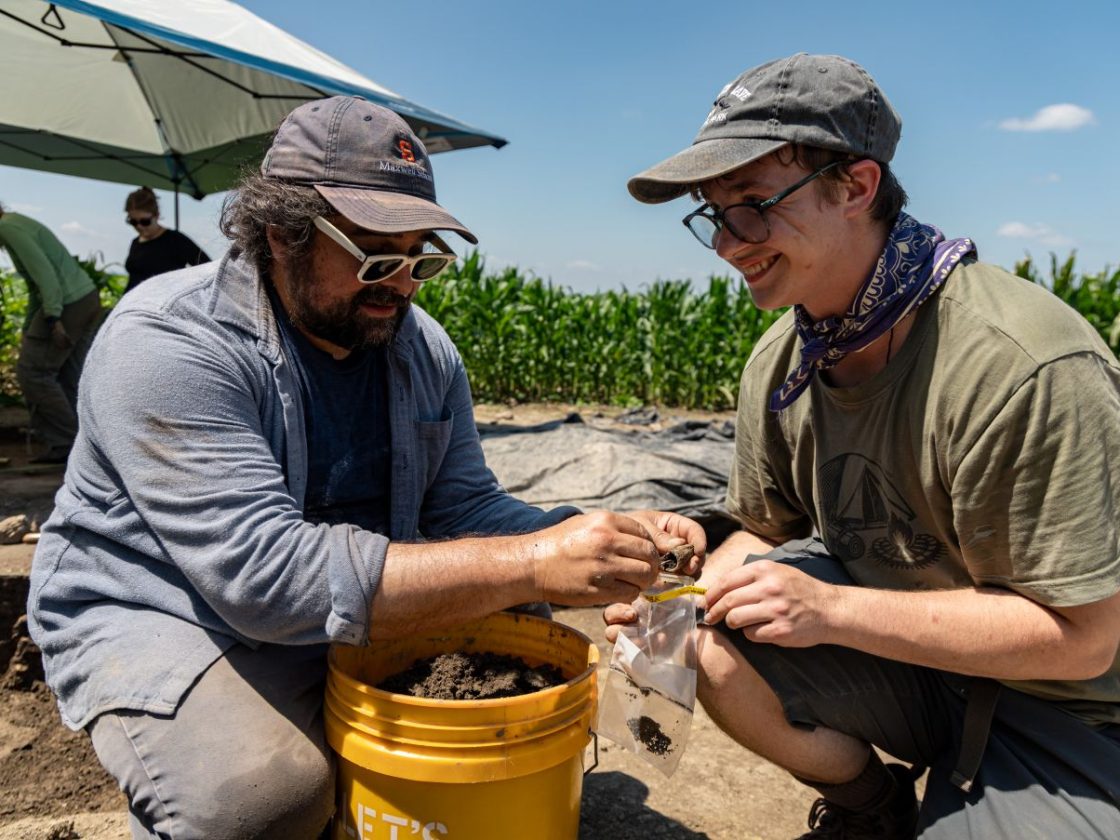
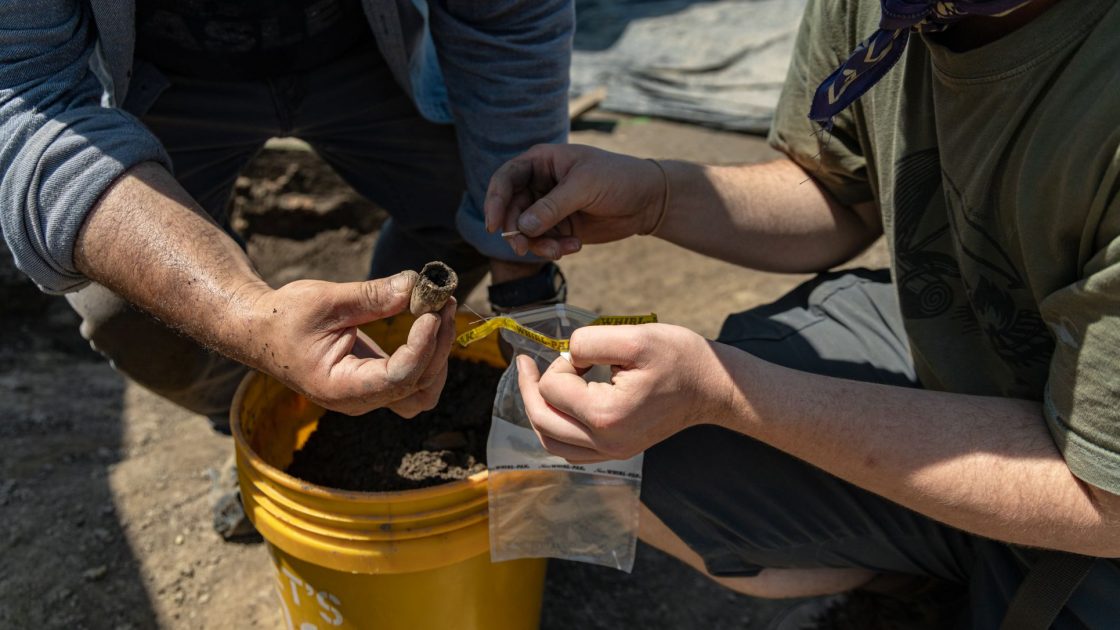
Associate Professor Guido Pezzarossi, left, and student Elliot Johnson '27 extract soil and tobacco from an excavated pipe bowl during their archeological dig in rural Wisconsin. (Photo by Blake Wilson)
Digging for Answers: Student Returns to Wisconsin for Mining Town Excavation
Elliot Johnson ’27 spent four weeks this summer combing a cornfield in rural Wisconsin searching for what’s buried beneath the crops. His research took him to Gratiot’s Grove, an 1820s lead-mining boomtown and later fort, where he was part of a student team that excavated the remains of a cabin that housed the pioneer town’s founder and his family.
Johnson’s research was part of an initiative involving fellow archaeology students led by Guido Pezzarossi, associate professor of anthropology in the Maxwell School of Citizenship and Public Affairs. The undergraduate’s summer research at Gratiot’s Grove is supported by the Syracuse Office of Undergraduate Research and Creative Engagement (SOURCE).
Found in the Ground
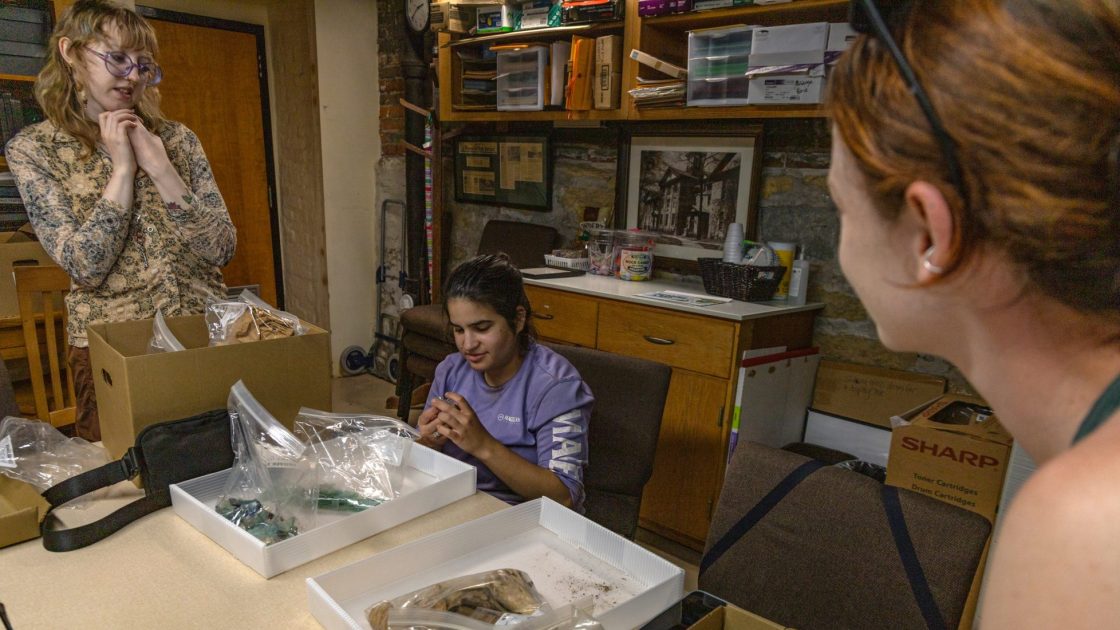
This was Johnson’s second summer at the site. Last year, the Illinois resident learned the fundamentals of archaeology by excavating the site using ground-penetrating radar, digging and recording units, and mapping. For the past three semesters, he spent time in the Lyman Hall archaeology lab cataloging and researching some of the artifacts students collected there.
This June, Johnson returned as part of another student team to collect samples from the excavation. The oldest of those found dates to 1793. The group also identified a rectangular stain in the soil differing in color and texture from the surrounding ground that may indicate the footprint of a structure or other intentional deposits.
Both the physical excavation and the lab examination of artifacts have been enriching experiences because his professor and fellow students have kept education front and center, Johnson says.
“It’s really cool to be on a project where there are still things to learn and that gives all the students here opportunities to explore all possibilities. A couple days ago we found a whole pipe bowl in the feature. I was able to collect a sample that may be burnt tobacco from when it was smoked. We also found ceramic sherds from eating vessels. The hope is that we can do a residue analysis on them back in the lab and possibly determine from material that got trapped in there what people were eating.”
Doing As Learning
The Gratiot’s Grove research combines two of Johnson’s main interests: archaeology and the history of colonialism. The work provides an understanding of how colonialism and capitalism impacted early colonial life in the Midwest. Unearthing remnants of the way settlers and indigenous peoples lived then and reconstructing the range of people, objects and materials that comprised those communities has provided a rich research experience, Johnson says.
“The site has a lot of interesting implications for Native and white settler relationships. Henry Gratiot was able to mine there because the Ho-Chunk provided him with information and allowed him land to build his cabin and eventual homestead. His wife, Susan, [resided] there day-to-day with her kids [alongside] lead miners and Indigenous people. My curiosity revolves around how capitalism and colonization brought these groups together, what those dynamics looked like and how these different groups might have accommodated each other’s different lifeways.”
The learning that occurs during field school has many direct benefits, says Pezzarossi. “Jumping right into an actual research project and participating in the production of knowledge lets you put into practice what you learn in the classroom, and in the process, get a firmer grip on the material. Experiential inquiry also helps demystify the research process. It gives students a chance to see themselves as knowledge producers, researchers and contributors to the state of knowledge. I directly credit my own undergraduate field school experience for putting me on the path to academia and doing research for a living. It let me imagine myself in that role by allowing me to do it.”
An Invested Town
Today’s Gratiot’s Grove is a town of 305 residents, its landscape consisting primarily of farmland. Only two of the original pioneer structures remain: founder Henry Gratiot’s house, a limestone building listed on the National Register of Historic Places, and Berry Tavern.
However, interactions with residents of the Gratiot’s Grove area have made the project as memorable as the group’s unearthed discoveries, Johnson says, because so many of them are interested in the work. Residents regularly visit the site to share knowledge of the town’s history, and interactions with students have generated an easy familiarity. Frequent trips to a local gas station to resupply Gatorade and ice for the researchers have prompted one worker there to refer to Johnson as her “bonus son,” he says.
“Everyone in town is very invested in the project and in the history of the town and this place as its founding site. Even people outside the [archaeology] field often help answer questions about odd artifacts or features. Archaeology is collaborative, and this was a great first field school for experiencing that.”
Pre-Law to the Field
Johnson didn’t begin his academic career intending to become an archaeologist; he entered the University as a pre-law student. Even after declaring anthropology as his major, with law, society and policy as a secondary integrated learning major, he saw the field as an enhancement to his studies rather than his sole focus.
Johnson is set to graduate a year early and plans to work the following year as a cultural resources management field technician. That break will provide him with time to decide his next move: either entering graduate school for archaeology or attending law school, he says.
For now, Johnson is grateful for having had the opportunity to find archaeological gems in that Wisconsin cornfield, and for what those experiences have taught him about the town and the people who lived, worked and made history there—and who still do.
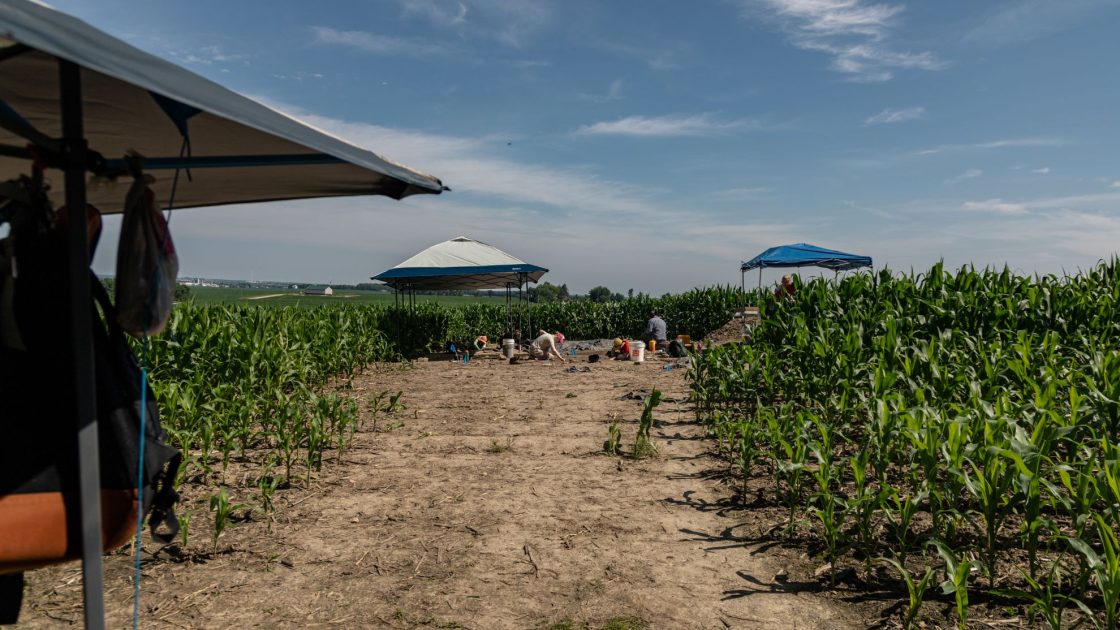
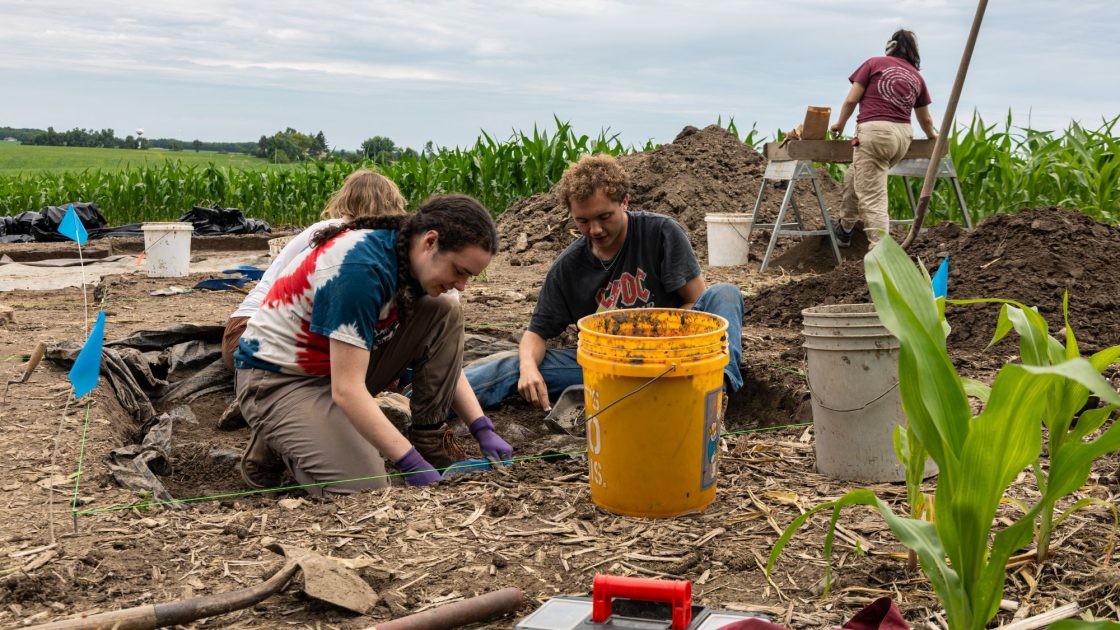
View of the excavation site in a section of cornfield near Gratiot’s Grove where archeological students conducted the dig. (Photo by Blake Wilson)
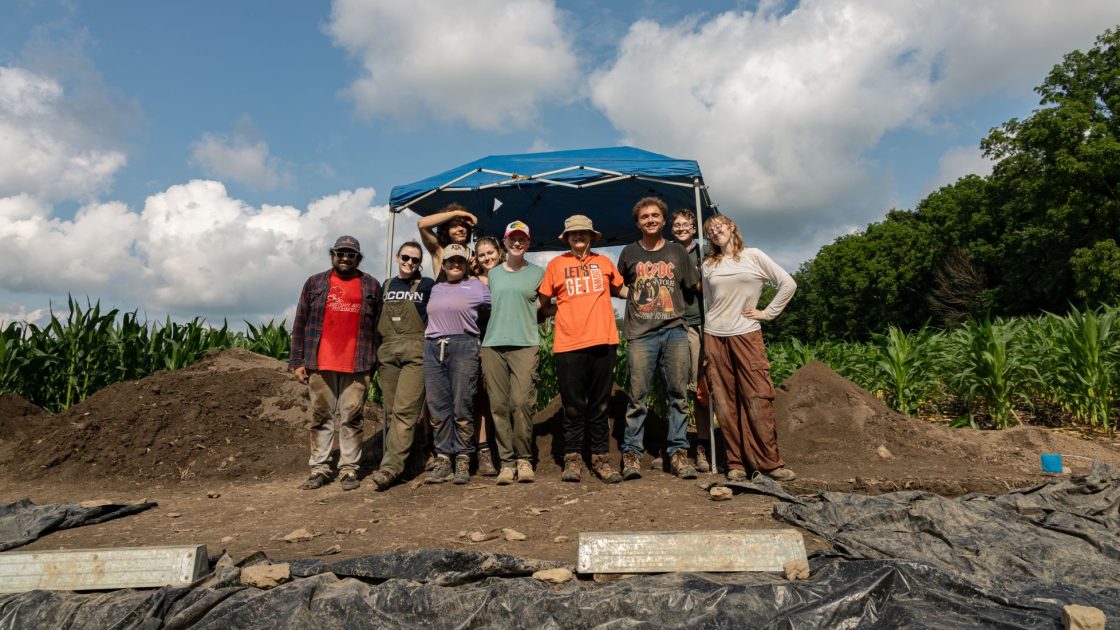
The project team included a faculty member and 10 students. From left: Associate Professor Guido Pezzarossi and student researchers Fiona Jones, Atticus Fleming, Lily Ferran, Ella Burke, Skyler Grimes, Paeton Harrington, Blake Wilson, Elliot Johnson and Ella Hawkins pose in front of backfill piles. (Photo by Elliot Johnson)
Using tools including their hands, a group of students uncover and screen dirt from a previously excavated section of ground. (Photo by Elliot Johnson)
A closer look at the pipe bowl artifact. (Photo by Blake Wilson)
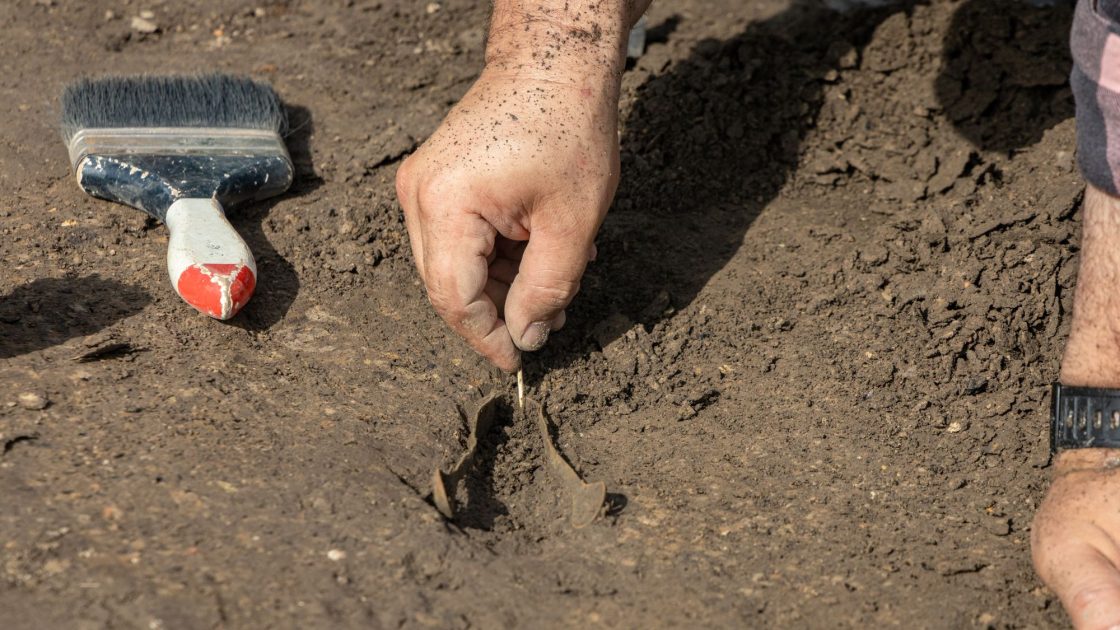
Researchers use a toothpick to carefully extract another object found in the dirt at the site: metal sugar tongs. (Photo by Atticus Fleming)
Student researchers (from left) Ella Hawkins, Lily Ferran and Fiona Jones discuss items from a group of bagged artifacts being held at the Platteville Mining Museum. (Photo by Elliot Johnson)
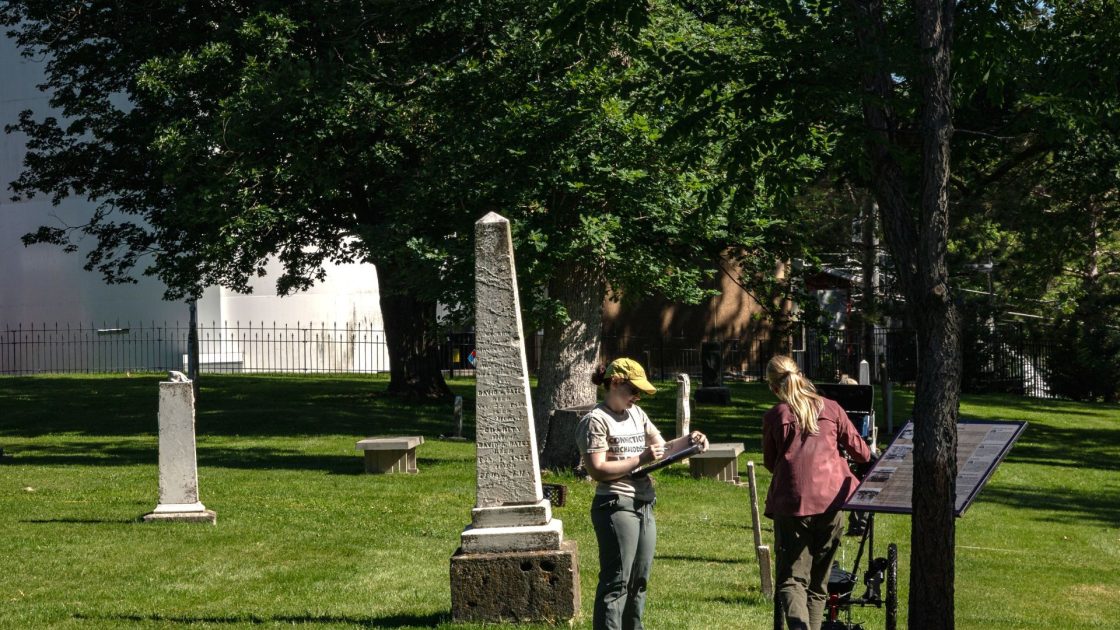
Graduate students Fiona Jones and Skyler Grimes work with a ground-penetrating radar machine in a Galena historic graveyard to map burials. The machine helps researchers “see” what’s underground by bouncing electromagnetic pulses into the soil. The pulses bounce back in unique ways based on what type of materials are in the ground. (Photo by Elliot Johnson)