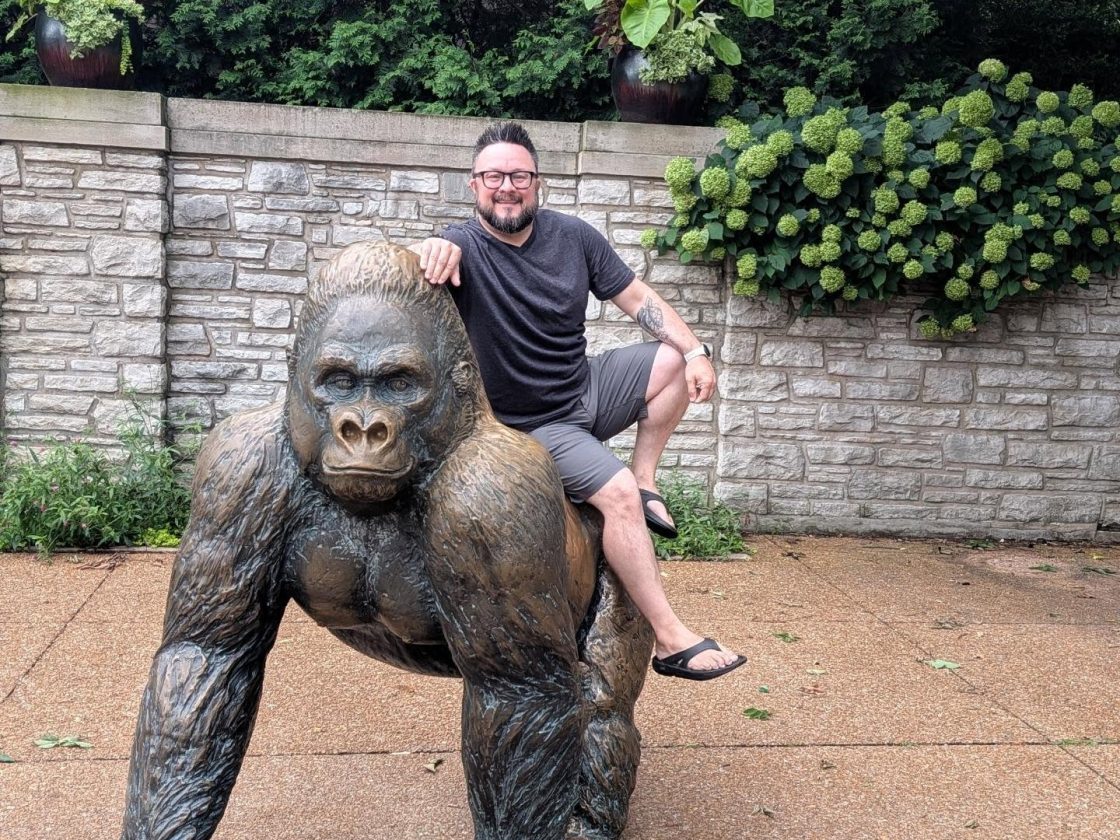
As an adult, Professor Nick Bowman still feels pulled to return to this special hometown place and to pose for a photo with "Phil," the gorilla statue at the St. Louis Zoo. (Photo courtesy of Nick Bowman)
From Hometowns to Gotham City, How We Connect to Our ‘Special Places’
Several factors shape how people bond with a beloved place, whether it’s a childhood hometown or a vacation spot. Usually those locations are physical ones, but with increasingly realistic digital and online worlds that can be accessed from almost anywhere, virtual spaces can easily keep pace in creating those deep connections.
That’s why some people feel so gratified playing a favorite video game like World of Warcraft, become immersed in Gotham City streetscapes watching a Batman movie, or get caught up in living out an assumed persona in a Second Life online community.
Those concepts reflect an arm of ongoing research by Professor Nick Bowman, who oversees doctoral and master’s programs in mass communications and media studies at the S.I. Newhouse School of Public Communications.
Bowman studies the cognitive, emotional, physical and social demands of interactive media content and how people experience emotional connections to meaningful locations in their lives.
Below, he shares how people develop bonds to places real and virtual, and why that happens.
We often become attached to places as we experience them phenomenologically—through direct, subjective and personal experience—and not something we measure from the outside. It’s called “sense of place.”
Scholars believe people understand places as constructed experiences just as much as objective locations. That applies to both physical and virtual special places.
They are what our research calls “SPIREs”—a combination of the symbolism, purpose, identities, relational orientation and/or emotions—that someone associates with a place. The spaces where we live, work and play give context to our daily experiences. Those five things are about the experience of a place more so than a place being physical or digital.
When places hold symbolic meaning, have a purpose, give us a sense of identity, help us make and sustain relationships and trigger emotional reactions, we connect with them. The things that help us feel a deep and meaningful sense of place don’t really require anything to be physical.
So, just as much as Syracuse University’s campus provides these things for me, so does a highly social video game. In both places, I’m making friends and feeling emotions and doing worthwhile and meaningful things.
Digital worlds can provide experiences and feelings equal to physical realities; we can form a sense of place for digital worlds that rival physical ones.
We don’t always have to return physically to bygone places to feel connected to them. And memories alone don’t sustain a connection to a place, though they certainly help keep those places alive in our minds and hearts. The ephemeral nature of digital worlds lets us (re)visit them in ways not possible with physical reality.

Professor Nick Bowman (left) and his brother regularly visited the statue of “Phil” the gorilla at the St. Louis Zoo in their hometown. (Photo courtesy of Nick Bowman)
For more information about SPIRE and “Sense of Place,” see “Symbolism, Purpose, Identity, Relation, Emotion: Unpacking the SPIREs of Sense of Place Across Digital and Physical Spaces,” (Poetics, Bowman and Banks.)