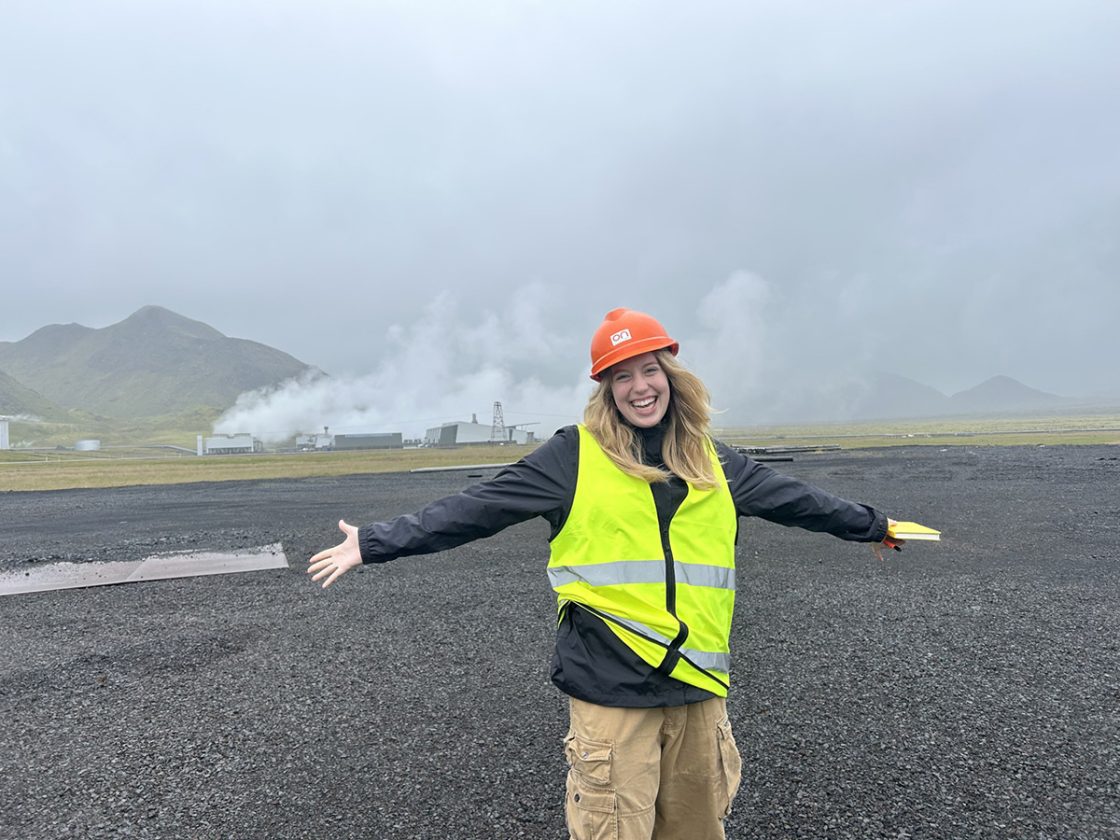
While most rising seniors are thinking about what lies ahead, Kenna Cummings ’27 is thinking about what lies beneath—the ice sheet in Greenland and a supervolcano in New Zealand, to be specific. Cummings, a geology major in the College of Arts and Sciences (A&S) has been named a 2026-27 Astronaut Scholar by the Astronaut Scholarship Foundation (ASF).
Founded by the Mercury 7 astronauts, the foundation awards scholarships to students in their junior or senior year who are pursuing a science, technology, engineering or mathematics (STEM) degree with intentions to pursue research or advance their field upon completion of their degrees. Astronaut Scholars are among the best and brightest minds in STEM who show initiative, creativity and excellence in their chosen field.
The Astronaut Scholarship provides funding of up to $15,000 toward educational expenses, a paid trip to the ASF Innovators Week and Gala in Houston in August and lifelong mentoring and engagement opportunities with astronauts, Astronaut Scholar alumni, industry leaders and the ASF.
Tapping the Planet’s Hidden Heat
Cummings, who was also named a Goldwater Scholar earlier this year, is currently wrapping up her semester of research in the Taupō Volcanic Zone (TVZ) on New Zealand’s North Island. There, she utilizes microscopy and geochemistry to study the subsurface magma system that both feeds eruptions and heats deep geothermal fluids.
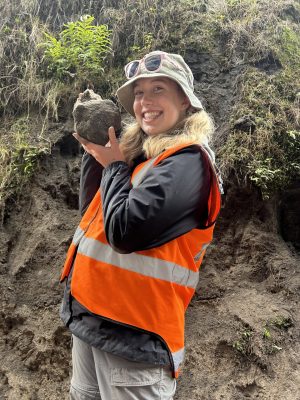
“The TVZ is an incredible example of how active geothermal systems can be used for energy production as well as numerous direct uses, such as timber drying and greenhouse heating,” she says.
Cummings considers herself lucky to be able to undertake research at points around the world, such as Iceland and NewZealand, where some of the most innovative developments in geothermal energy are happening. She has studied the Greenland ice sheet remotely through the lab of Josh Russell, assistant professor of seismology in the Department of Earth and Environmental Sciences in the College of Arts and Sciences.
In Greenland, Cummings studies what a system like the one in New Zealand looks like long after its heat source has moved on. Using seismology—mapping how seismic waves travel through the earth—she traces the path that ancient hotspot took and measures how much heat remains below the ice sheet.
“From this research, I’ve learned about the range of settings that can have heightened geothermal gradients without dramatic volcanic activity,” she says. “Understanding the many ways geothermal areas can be formed and studied will help me scale innovative solutions for settings across the U.S.”
Bridging Academia and Industry
Cummings’ long-term goal is to run a research lab inside an industry geothermal company.

“I am very passionate about clear communication between academia and industry, since academic research is only made applicable through commercial viability,” she says. “To me, the line between academic research and commercial application is done right when both sectors are working to their strengths, supporting each other and building toward the same end goal that will have positive impacts on the public at large.”
Cummings says that her selection as an Astronaut Scholar is an incredible honor that comes with life-changing financial support and academic and career opportunities.
“The Astronaut Scholarship Foundation has a robust alumni network that provides opportunities to learn about various fields of science and industry,” she says. “I plan to take advantage of mentorship opportunities within the ASF alumni network as well as present my research at the Innovator’s Symposium. I know this scholarship will open doors for me in both grad school and career applications. I am grateful for the numerous ways becoming an Astronaut Scholar has already begun to change the trajectory of my future research career.”
Created in 1984, ASF awarded its first seven scholarships in honor of the Mercury 7 astronauts—Scott Carpenter, Gordon Cooper, John Glenn, Virgil “Gus” Grissom, Walter Schirra, Alan Shepard and Deke Slayton. Seven students received $1,000 scholarships. Since its inception, the ASF has awarded more than $10 million to more than 950 college students.
As a university partner of the ASF, Syracuse University can nominate two students for the Astronaut Scholarship each year. Interested students should contact Center for Fellowship and Scholarship Advising (CFSA) for information on the nomination process (cfsa@syr.edu; 315.443.2759). More information on the Astronaut Scholarship Foundation can be found online.