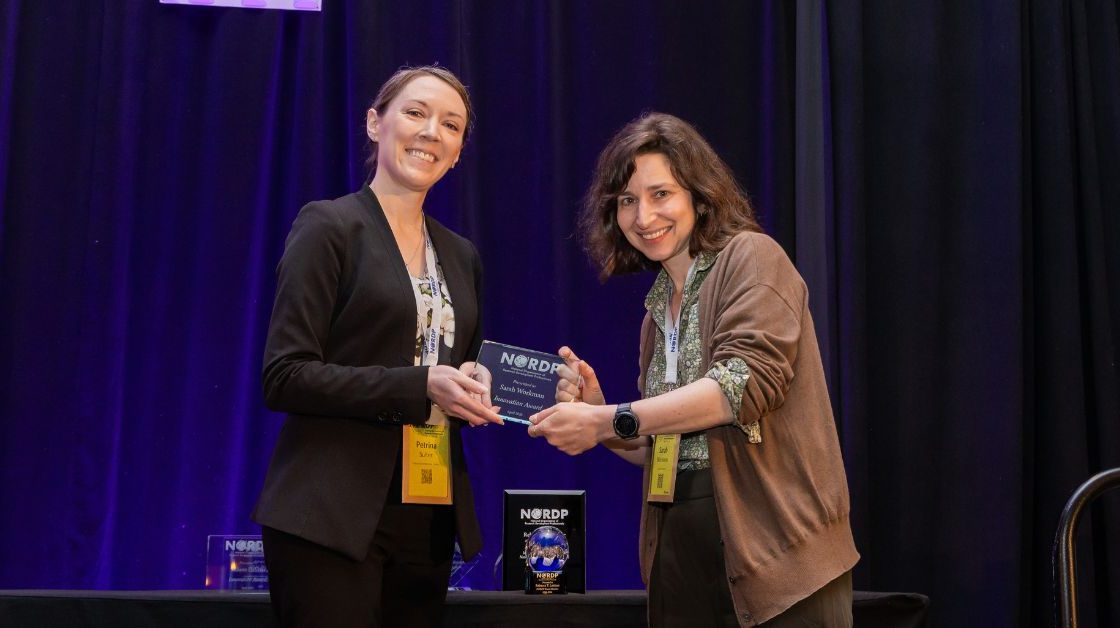
Sarah Workman (right) receives the NORDP Innovation Award at the organization's 2026 annual conference in Indianapolis. Presenting the national honor is Petrina Suiter, NORDP awards official. (Photo courtesy NORDP/Studio 13)
Research Professional Cited for Growing Arts and Humanities Support Network
Sarah Workman, director of research development for the arts and humanities in the Office of Research and the College of Arts and Sciences (A&S), has been recognized with the 2026 Innovation Award from the National Organization of Research Development Professionals (NORDP).
The award recognizes professionals who advance research development through partnerships, new tools and techniques or the creation and sharing of knowledge that produces demonstrable results. Workman and her NORDP colleague, Allison DeVries of Chapman University, received the award in recognition of the evolution of the Creative Arts, Social Sciences and Humanities (CASSH) affinity group, which they founded in 2022. The group, which has grown to more than 150 NORDP members across the country, helps them marshal and create collective resources and share best practices, case studies and challenges in support of faculty in the humanities, creative arts and social sciences areas.
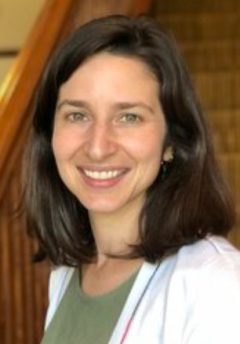
“I’m honored to receive this award and proud to have had a part in bringing the CASSH group together four years ago when it seemed rare to have a designated arts and humanities research development staff member housed in an R1 institution,” Workman says. The group has gained momentum “because higher education recognizes the value of this support nationwide as integral to the national research landscape and vital to an individual institution’s research ecosystem,” she says.
Workman came to Syracuse in 2019 and built a dedicated arts and humanities research development infrastructure from scratch. She now connects with more than 200 faculty across eight schools and colleges and partners with Syracuse University Libraries and several University-affiliated arts organizations.
Beyond campus, she is part of the Central New York Humanities Corridor, an 11-university consortium for collaborative research, teaching and programming. She co-leads its HF4 Corridor Futures and Initiatives working group with program manager Aimee Germain to offer professional development opportunities for faculty.
Impact on Faculty and Funding
Prior to Workman’s arrival, scholars navigated grant funding alone or through informal networks, often missing critical opportunities, says Chetna Chianese, senior director of research development in the Office of Research, who co-nominated Workman for the award.
She says Workman has contributed to faculty winning prestigious awards, including National Endowment for the Humanities summer stipends, a National Endowment for the Arts “Our Town” award and a Creative Capital grant. Workman has also supported a New York Foundation for the Arts fellowship, an American Council of Learned Societies digital justice grant and several successful Fulbright Scholar applications.
In 2025, Workman supported 64 grant proposals seeking $44 million in funding. She recently helped nine arts faculty and five organizations secure New York State Council on the Arts awards, making Syracuse the only university in the state to receive multiple awards in that cycle, Chianese says.
Vivian May, professor of women’s and gender studies and director of the Syracuse University Humanities Center and the Central New York Humanities Corridor, says Workman’s Corridor support has deepened scholarly community across the region and has had significant impact on Syracuse faculty success.
“Sarah has been instrumental in several prestigious Mellon awards, including our first and ensuing New Directions fellowships and many other highly competitive awards and grants,” says May, who co-nominated Workman for the award. “Many of these awards have been substantial enough to transform individual career trajectories and drive transformational work at the University and in wider communities locally and nationally.” May says faculty frequently remark about how much they enjoy collaborating with Workman and appreciate her support.
Cary Peñate, assistant professor of music history and cultures in A&S, credits Workman with helping her secure a National Humanities Center Select Summer Residency, a first for Syracuse among 200 competing institutions. “I am deeply grateful for her thoughtful engagement with my research and for helping make its relevance accessible to a broader interdisciplinary readership,” Peñate says.
PJ DiPietro, associate professor in women’s and gender studies in A&S, says Workman’s guidance “proved instrumental in shaping two grant proposals into competitive, fundable projects. Her careful feedback led to key revisions that directly contributed to securing a major award from a private funder. In a context of shrinking funding, Sarah’s leadership has been indispensable for the success of humanities’ interdisciplinary, social justice-centered research.”
While Workman focuses on the arts and humanities, the Office of Research supports faculty across disciplines through a broader research development team. Researchers across campus partner with team members on proposal development, funding searches, cohort writing programs for competitive federal awards and strategic guidance on funding opportunities. Faculty interested in support for their projects can learn more about available assistance on its website.