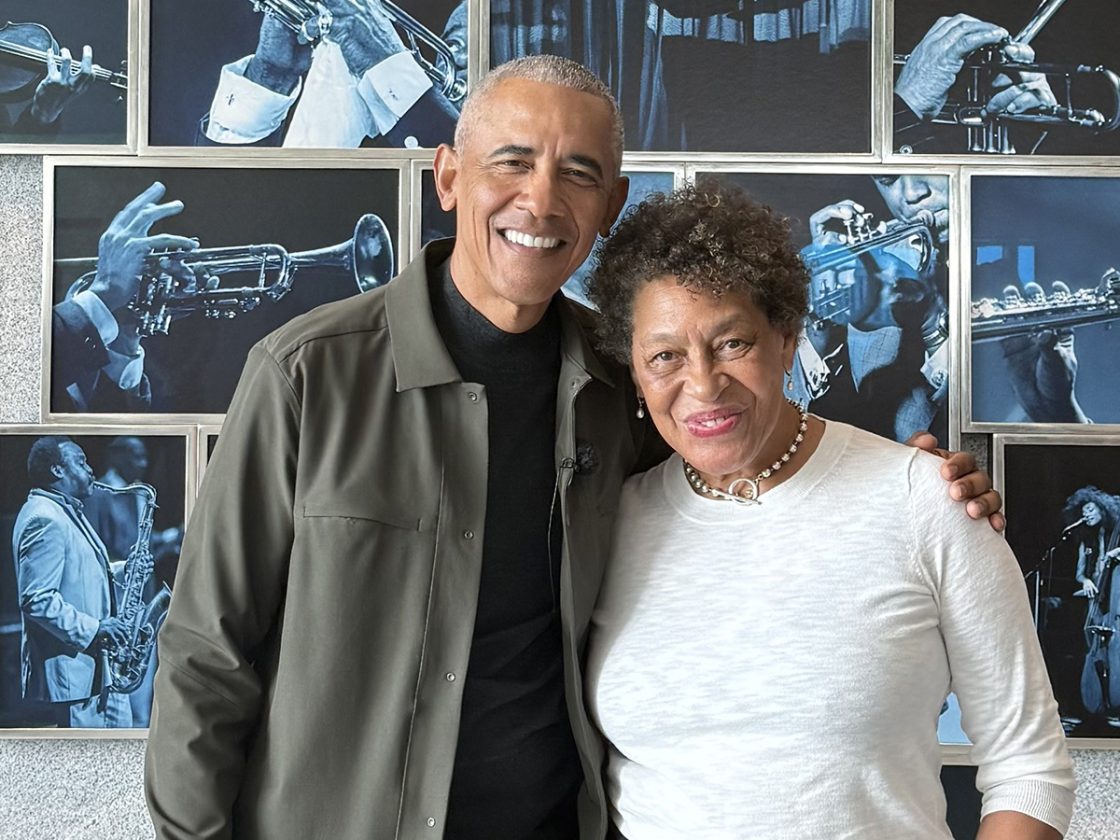
Carrie Mae Weems, right, with former President Barack Obama. Weems has contributed a permanent installation to Obama's presidential library, opening in Chicago in June. (Photo courtesy of Weems)
Legendary Artist Carrie Mae Weems Concludes Her University Residency
The first time Carrie Mae Weems H’17 came to Syracuse, she was an emerging artist with a restless curiosity and a camera. That was in the early 1980s, when Light Work—the internationally recognized artist residency program on the Syracuse University campus—invited her to come and work. She did not yet know that the city, and the University, would shape her life in ways she could not have anticipated, including meeting her husband, photographer and Light Work director Jeffrey Hoone.
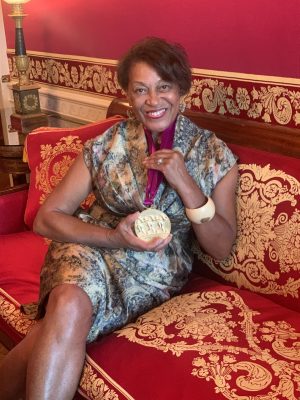
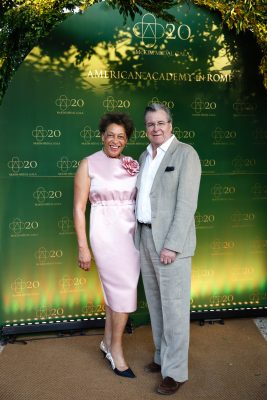
Nearly 45 years later, Weems has come full circle. Appointed in January 2020 as the University’s inaugural artist in residence, Weems spent six years weaving herself into the fabric of the institution she had first encountered as a young artist. She is now concluding that tenure, leaving behind a legacy as layered and far-reaching as the bodies of work that have made her one of the most celebrated artists of her generation.
“Carrie Mae Weems’ work has long challenged the world to see with greater honesty and imagination, and she brought that same spirit to Syracuse University. Her presence here has strengthened our academic community in meaningful ways,” says Candace Campbell Jackson, senior vice president and chief of staff to Chancellor Emeritus Kent Syverud. “We thank her for her leadership, her artistry and the lasting imprint she has made on this campus. Carrie has defined possibilities for what the artist in residency can be, and for this we are truly grateful.”
A Legendary Career
Over four decades, Weems has built a practice that spans photography, text, audio, video, installation and performance. Her series “From Here I Saw What Happened and I Cried” repurposed 36 appropriated images from the 19th and 20th centuries to interrogate the relationship between African American subjects and photographic history. Her “Kitchen Table Series” turned domestic space into a stage for intimate, complex narratives of Black womanhood.
The institutions that hold her work read like a map of the world’s great museums: the Metropolitan Museum of Art, the Museum of Modern Art, the Tate Modern, the Whitney Museum of American Art, the Brooklyn Museum and the National Gallery of Canada, among many others. In 2014, she became the first African American woman to receive a solo retrospective at the Guggenheim Museum, a milestone she noted had arrived “really late in the day.” Rather than simply presenting her exhibition, she transformed the Guggenheim’s auditorium into a five-day convening of artists, thinkers and performers
Her honors include the 2013 MacArthur Fellowship, the 2023 Hasselblad Award, the Ford Foundation’s Art of Change Fellowship, the BZ Cultural Prize and the U.S. Department of State’s Medal of Arts. In October 2024, President Joseph R. Biden Jr. presented her with the National Medal of Arts at a White House ceremony, the highest honor the United States government bestows upon artists. She was the first African American female visual artist to receive it. Weems has installed a permanent work that will be featured in the Barack Obama Presidential Library, opening to the public in Chicago on June 19.
Yet for all the accolades, some of Weems’ most telling work during her Syracuse residency happened in studios, classrooms and conference rooms.
Mentorship Flowing in Both Directions
When the COVID-19 pandemic arrived, Weems went to her studio. She designed posters, billboards and campaigns that honored frontline workers. What began as a response to the situation in Syracuse became a national effort, eventually spreading worldwide. Shopping bags carrying text that she composed were distributed at food banks. Buttons, masks and murals went out by the thousands. Students were at the center of the work, packaging materials, designing alongside her and earning wages she insisted upon.
That insistence on reciprocity, on the idea that mentorship flows in both directions, threads through everything she did at the University. She founded the Institute of Sound and Style, a rigorous workshop for teenagers in Syracuse struggling against the weight of community violence.
Graduate students served as her assistants on the project, and she was candid about what she received in return. “As much as I found that I was helping them,” she said, “they were helping me as much as I was helping them. I’m not simply the giver. I’m also the receiver.”
In April 2024, she traveled to Florence to deliver a public lecture—”Resistance as an Act of Love”—to students enrolled in the Daniel and Gayle D’Aniello Syracuse University Program in Florence, reviewing the work of studio arts students there. She then brought eight of those students to Venice for the Black Portraitures conference, held in concert with the Venice Biennale.
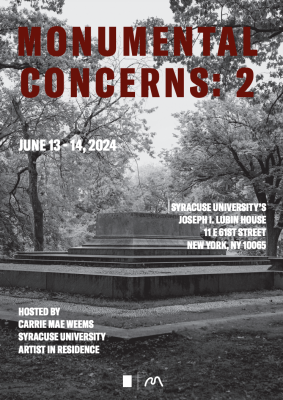
Her “Monumental Concerns” convenings, which she organized through the University and were held at the Museum of Modern Art, drew hundreds of scholars, artists and thinkers into conversation about monuments, memory and contested public space.
Engaging Deeply
“Through her residency, Carrie Mae Weems has created opportunities for Syracuse University to engage deeply with some of the most pressing cultural conversations of our time,” says Miranda Traudt, the University’s assistant provost for strategic initiatives and director of arts. “By bringing together artists, scholars and communities, she has helped make this campus a hub for dialogue that shapes contemporary art and culture.”
At the celebration marking the close of her residency, held March 16 at Light Work, Campbell Jackson reflected on what it had meant to work alongside her. “You’ve shown us how essential creativity is to the strategic future of this institution,” she said, “and to our broader society.”
Weems herself was characteristically humble. “I never think that I’m doing anything that is important,” she said. “I just feel that I need to work at things that matter to me, that uplift me, that inspire me, that carry me.”