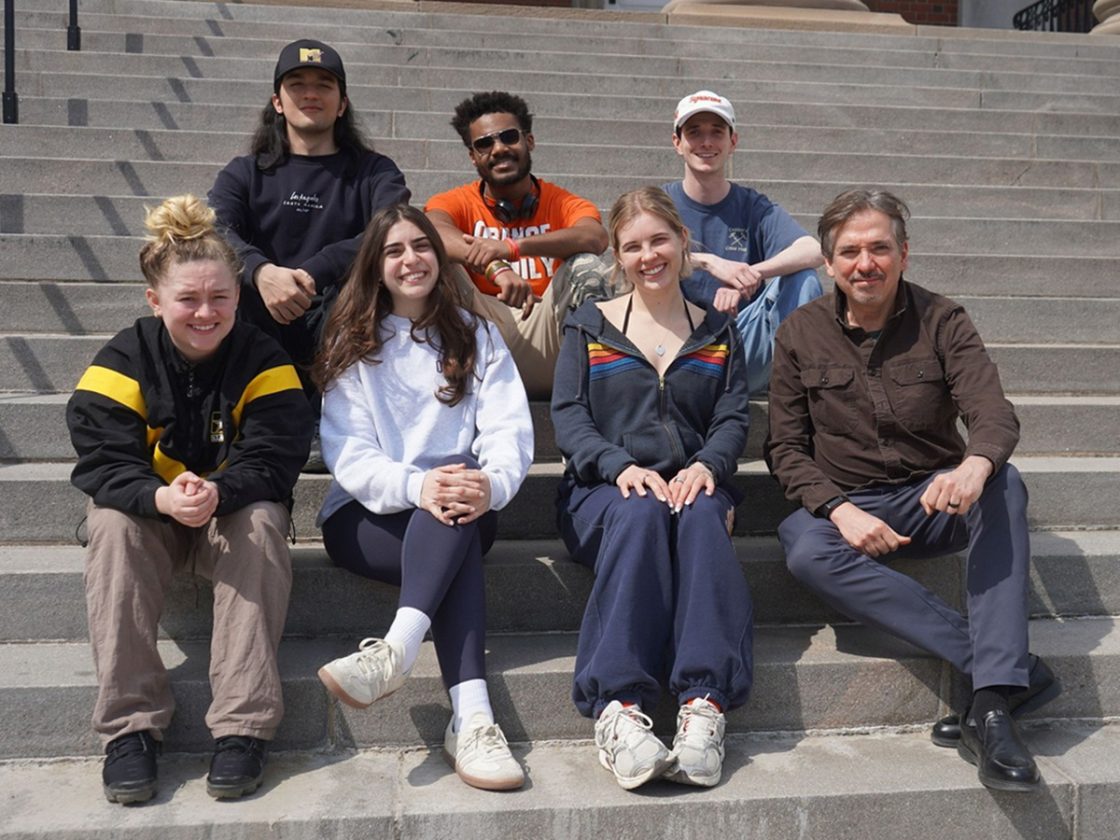
Members of the Intertext editorial team, a journal featuring undergraduate writing from the Department of Writing Studies, Rhetoric and Composition, along with community partners. Pictured front row, left to right: Alexis Kirkpatrick, Jules Vinarub, Chloe Fox Rinka and associate professor Patrick W. Berry; back row: Cruz Thapa, Kairo Rushing and Jack VanBeveren.
A&S Students Find Purpose in Writing
In an age when artificial intelligence can generate content instantly, the human ability to write with clarity, originality and critical insight has become more essential than ever.
Students in the College of Arts and Sciences (A&S) have ample opportunity to strengthen their writing through a rich landscape of publications and digital platforms. Aurantium, Broadly Textual, Intertext and Mend are among the outlets where students build strong portfolios, sharpen their professional communication skills and engage in experiential learning that prepares them for careers in writing, publishing, media and advocacy.
Aurantium: Making Philosophy Accessible and Alive
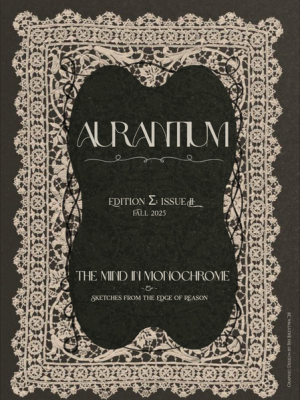
Like its namesake, Aurantium (the Latin word for orange) is vibrant, inviting and full of fresh perspective. Founded in 2023, this student-led undergraduate philosophy journal was created to invite curiosity, creativity and conversation across disciplines. Supported by the Department of Philosophy and the Philosophy Club, the journal publishes two issues each year: one focused on the Syracuse University and SUNY ESF community and another open to contributors worldwide.
Essays, reflections, creative writing and artwork all find a home in Aurantium, making it a space where philosophy is explored not as an abstract exercise, but as a living, interdisciplinary practice.
For editor-in-chief Brielle Brzytwa ’28, discovering philosophy was anything but immediate. “In high school it felt abstract, inaccessible and frustratingly stuffy,” she recalls. It wasn’t until college that philosophy began to feel meaningful, and that transformation shaped her vision for Aurantium. “Philosophy doesn’t have to be confined to dense texts or exclusive academic spaces,” she says. “It can—and should—invite curiosity and conversation.”
As editor-in-chief, Brzytwa has made accessibility a guiding principle. She describes the journal as a place where ideas are not only preserved but “shared, challenged and reimagined,” with an emphasis on amplifying a range of undergraduate voices.
Broadly Textual: Building Community Through Public Scholarship
 For graduate students eager to share their ideas beyond the boundaries of academic journals, Broadly Textual offers an inviting and meaningful platform. Overseen by William P. Tolley Distinguished Teaching Professor Harvey Teres, the online publication highlights graduate student work designed for public audiences, featuring literary and cultural commentary, videographic criticism, and thoughtful explorations of digital media and identity. With its focus on a broad variety of subject matter, the publication encourages students to see scholarship as both collaborative and accessible.
Co-editor Elena Selthun first encountered Broadly Textual as a contributor during their first year of graduate study and quickly recognized its value. They describe the experience as “low-pressure and supportive,” an ideal introduction to publishing. Equally important, Selthun was drawn to the publication’s commitment to public humanities. “The public-facing nature of the blog allows graduate students to apply what we learn beyond academia,” they say.
For fellow co-editor Meg Healy, the appeal initially lay in skill-building and community engagement. Over time, she gained a deeper appreciation for the publication’s role in demystifying the publishing process. “There is a strong incentive to publish while in graduate school, but that can be daunting,” Healy says.
Both editors emphasize the sense of connection the publication fosters. Selthun points out that graduate research can often feel siloed, and “Broadly Textual” helps bring students across departments into conversation.
Intertext: Celebrating Writing Across WRT Courses
For more than three decades, Intertext has celebrated writing by undergraduate students in the Department of Writing Studies, Rhetoric and Composition (WRT), and community partners. In April 2026, editors and contributors gathered to mark the release of the journal’s 34th volume.
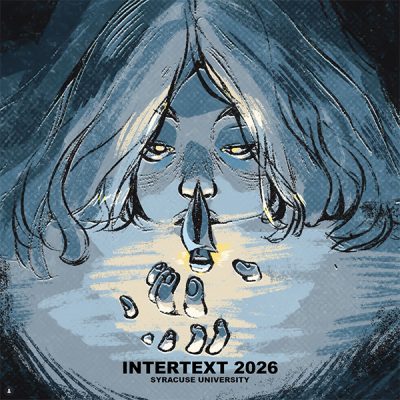
Reflecting on their involvement, editors Jules Vinarub and Kairo Rushing wrote in the introduction to the 2026 issue, “This publication relies on the willingness of Syracuse University students to be vulnerable enough to let their truth be on display—sharing themselves with you, allowing you to hear and see their stories.”
Throughout the year, students met with publishing professionals and authors like Rand Timmerman, member of the Veterans’ Writing Group at Syracuse University, whose essay about a U.S. Marine’s tense and surreal Christmas Eve spent on night watch in Vietnam is published in the 2026 issue along with a video interview.
Any student who has taken a WRT course can submit their work to “Intertext,” and submissions are accepted on a rolling basis. Students interested in joining the editorial team can enroll in WRT 340: Advanced Editing Studio. For more information, contact Professor Patrick W. Berry.
Mend: Amplifying Voices, Honoring Stories and Creating Purpose
Mend is an annual publication started by Patrick W. Berry, WRT associate professor, and is dedicated to celebrating the lives and creative work of incarcerated and formerly incarcerated people, as well as individuals impacted by the criminal legal system. Featuring fiction, poetry and nonfiction on a wide range of topics, the publication offers contributors the freedom to explore personal experience while centering dignity, creativity and voice.
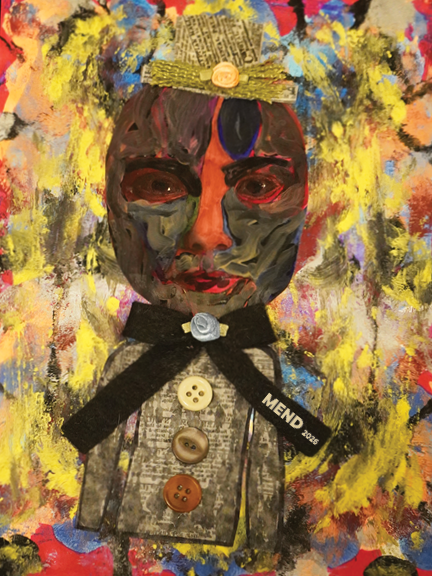
Editor Drew Murphy ’26, who is majoring in writing and rhetoric, and in psychology in A&S, first encountered Mend as a junior through an Engaged Humanities course, WRT 413: Rhetoric and Ethics after Prison, taught by Berry. Guest visits from formerly incarcerated writers involved with Mend left a lasting impression.
“Their stories represented a powerful intersection of my two majors, writing and rhetoric and psychology,” Murphy says, describing the experience as one that immediately sparked curiosity on both personal and professional levels. When Murphy learned about internship opportunities with Project Mend, the decision felt natural.
“The opportunity to work with impacted individuals while contributing to a publication that shares their stories has been meaningful for both my academic studies and future career ambitions,” she explains.
As Murphy prepares for graduate study in social work, she credits Mend with deepening her belief that thoughtful writing can contribute to meaningful change.