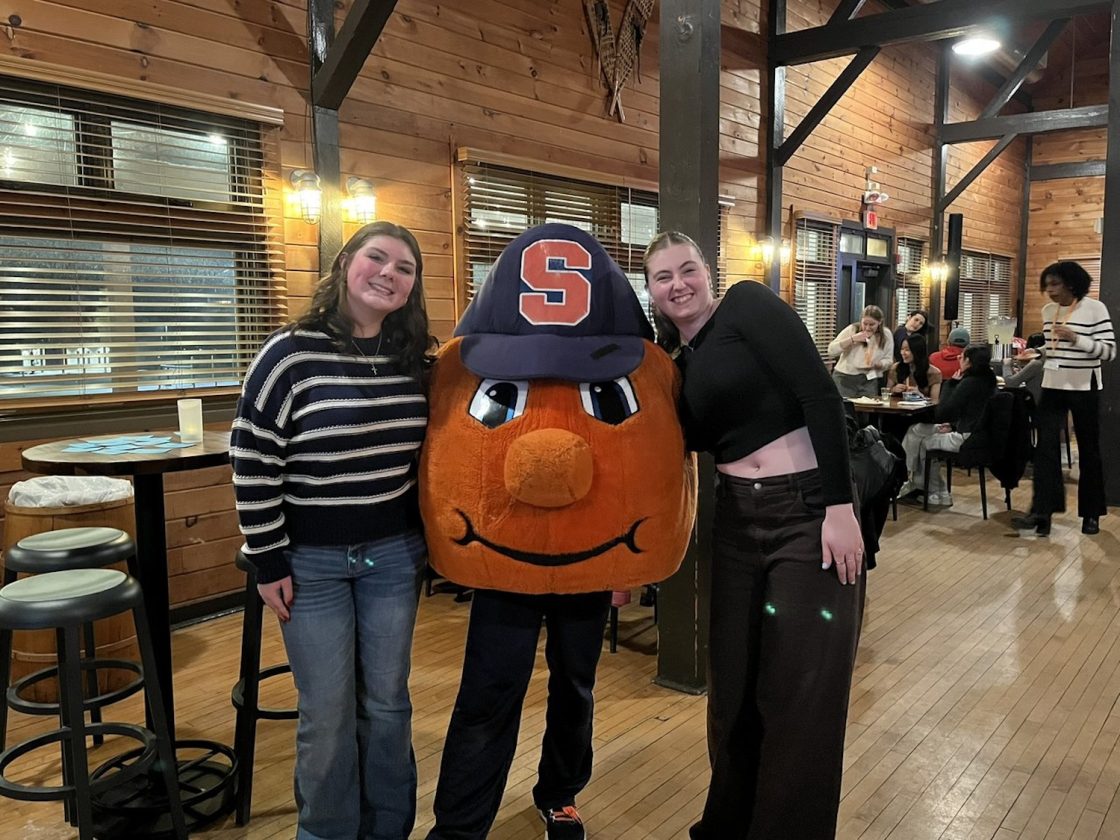
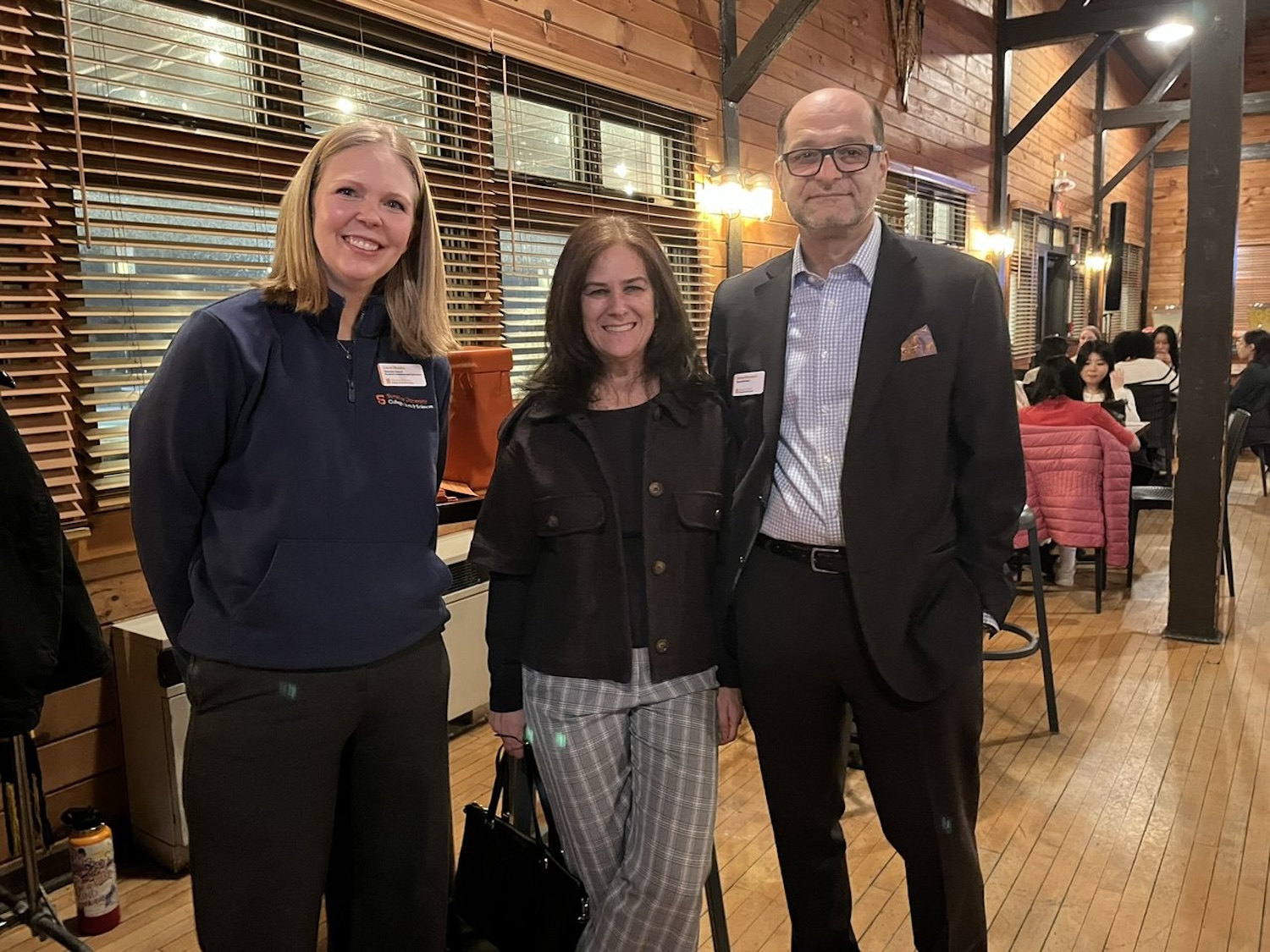
Scholars attended social and academic events, including dinner at the Inn Complete with Otto.
Building Community in A&S
Even small gains in a student’s sense of belonging can meaningfully increase their chances of graduating. A new College of Arts and Sciences initiative is putting that finding into action, connecting its highest-achieving first-year students with the community and support they need to thrive, so that they can make the most of their time in college.
Earlier this academic year, more than 300 A&S students were recognized at a Universitywide banquet for earning the Invest in Success Scholarship. The ceremony was only the start of the college’s plan to support its top students.
“In Arts and Sciences, this banquet is just the beginning,” Laura Machia, A&S associate dean for academic initiatives and curriculum, told the scholars. “We have a whole series of events planned for you.”
The program builds on the University’s Invest in Success Scholarship, a $500 award granted to all first-semester students who earn at least a 3.75 GPA. This year, 302 students with an A&S major or who were undeclared and enrolled in the college qualified. Machia and Steve Schaffling, assistant dean for student success, launched the initiative to help those students form a community unique to A&S.
“What I wanted to do is help them find their people within their disciplines and their pathways faster,” Machia says.
To do that, 15 upper-division students serve as peer mentors, drawing from Coronat scholars, the Renée Crown University Honors Program, the College’s international peer mentoring network and recommendations from faculty and advisors. Each mentor was matched to a group of scholars by academic discipline, giving students a point of contact and a cohort of peers who share their academic interests.
“I’m grateful for being part of a community of students who have similar struggles and experiences to me,” Jonathan Bispott ’29 says. “Especially having mentors who overcame trials I will soon face and having access to their ‘future knowledge’ has been really impactful.”
Events span social and academic programming. Scholars met for dinner at the Inn Complete where Machia placed icebreaker questions on the tables to spark conversation. An invitation to sit together at a Syracuse women’s basketball game followed. Lastly, Schaffling’s office organized a career immersion trip open exclusively to Success Scholars—an opportunity typically more common for upperclassmen—giving first-year students an early introduction to professional networking and alumni connections.
Brooke MacDonald ’29, a psychology major with minors in business marketing and Asian/Asian American studies, says she appreciates the many opportunities now open to her.
“It’s led me to meeting some amazing new people as both friends and networks,” she says. “I found it super helpful to have a mentor I could contact with any questions. With them being in the same major, it opened up perspectives for me.”
“I loved playing a part in making students feel like they could tell me about what they wanted out of the experience and supporting them in the process on a more personal level,” says mentor Madeline Battista ’26, a psychology major. “Sometimes, as a student, you don’t have the opportunity to build a foundational relationship with your advisor, especially when entering the sophomore year with a new advisor. I looked forward to being someone who was stable, reliable and approachable and refined those essential skills throughout the journey.”
Another key event was an advising mixer designed to smooth one of the more anxiety-inducing transitions in a student’s first year: moving from working exclusively with a first-year advisor to working with an upper-division one. Rather than learning about the change through an email, scholars met their new advisors in person—introduced by the advisor they already knew.
“Things that can be done via email, but you do in person, bring people together,” Machia says.
She notes that scholars have expressed gratitude for having a dedicated space to meet people outside of large lecture courses.
While the A&S Success Scholar community initiative is still in its infancy, Machia is already thinking about how to grow it. The peer mentor ratio—roughly one mentor for every 20 students—is at the top of her list. Next year, she hopes to draw on this year’s mentees to build a mentor cohort of around 50, bringing the ratio closer to 1-to-5.
“It’s going to get better and better,” Machia says.