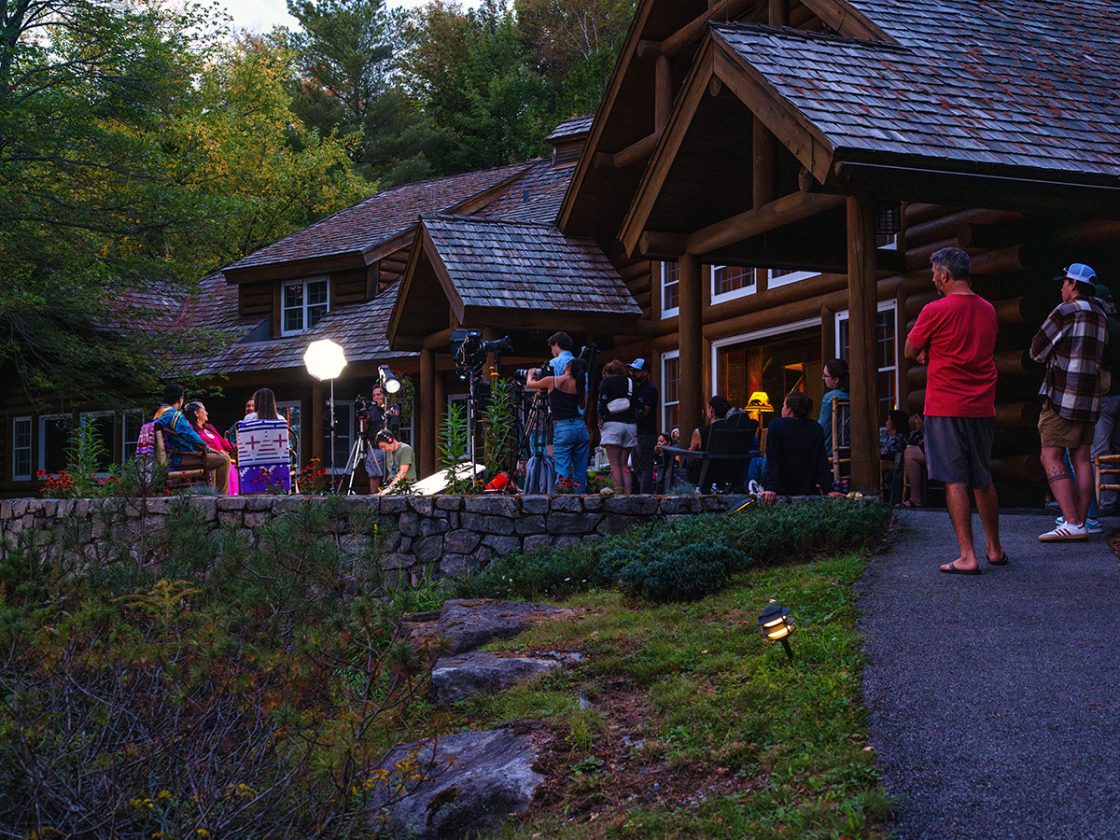
Behind the scenes of the "Rematriated Voices" set at Minnowbrook Conference Center in the Adirondacks. (Photo courtesy of Rematriation)
Groundbreaking Talk Show Series Brings Indigenous Voices to the Mainstream
When Ricana Walker ’27 saw an email seeking student production assistants for a film project in fall 2024, she had no idea she was about to be part of something historic—or that the experience would change her understanding of the land beneath her feet as a Syracuse student.
“I had very limited knowledge of Native American culture, especially the Haudenosaunee people,” says Walker, a television, radio and film (TRF) major in the S.I. Newhouse School of Public Communications. “I thought it’d be a perfect opportunity for me to not only gain professional experience but also learn about the land Syracuse is built on.”
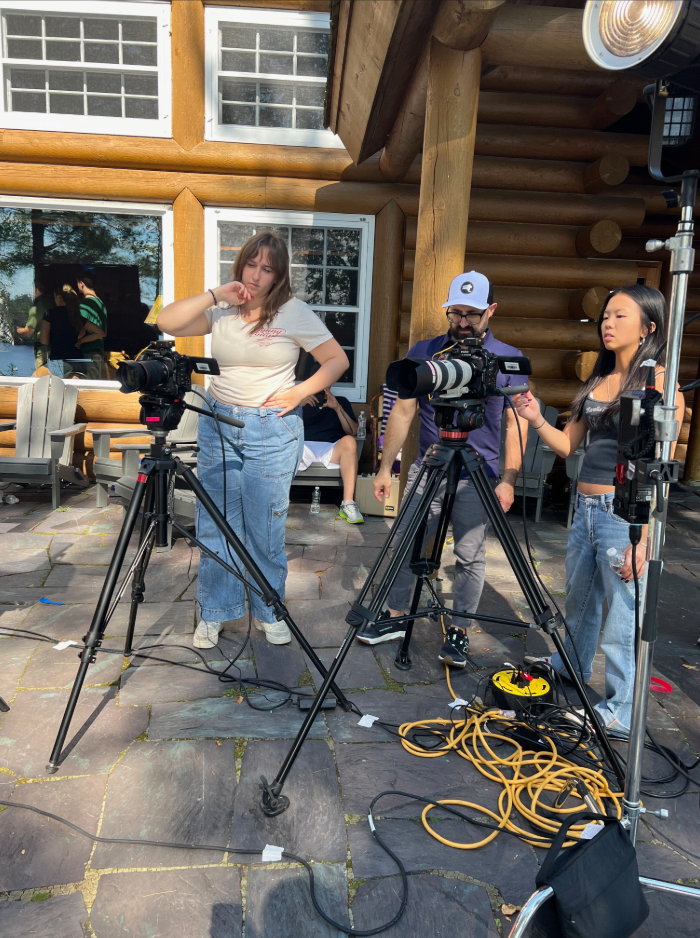
Walker was one of 10 students who spent a weekend at the University’s Minnowbrook Conference Center in the Adirondacks filming “Rematriated Voices With Michelle Schenandoah,” a five-part talk show and podcast series that premiered on WCNY-TV in October.
The project represents an innovative collaboration between the Special Collections Research Center’s Access Audio storytelling initiative, the Haudenosaunee women-led nonprofit Rematriation, Orange Television Network (OTN) and the audio arts program in the College of Visual and Performing Arts and Newhouse School.
Hosted by Michelle Schenandoah G’19, founder of Rematriation and a member of the Oneida Nation Wolf Clan, the series convenes Indigenous thought leaders, traditional knowledge keepers and allies to discuss topics often missing from mainstream education—from the Doctrine of Discovery to the Haudenosaunee influence on American democracy and women’s rights.
3 Years in the Making
“Rematriated Voices” was three years in the making, from initial research and development through filming and post-production. Schenandoah, who holds a graduate degree in magazine, newspaper and online journalism from Newhouse and law degrees from New York Law School, had long dreamed of creating a talk show format that could extend Indigenous education beyond in-person speaking engagements.
“A lot of our people are invited into spaces to speak on these topics, but you’re limited to whoever’s in the room at that time,” Schenandoah says. “By creating this talk show and podcast series, it allows the information and dialogue to expand further into the world.”
The project evolved from Access Audio’s earlier podcast series “The Land You’re On: Acknowledging the Haudenosaunee,” which featured candid interviews with Indigenous community members. Schenandoah was an interviewee for that 2022 series, which was also produced at Minnowbrook.
When Schenandoah approached Jim O’Connor, Access Audio producer and co-producer of “Rematriated Voices,” about creating another series, she saw an opportunity to expand beyond the podcast format into a video series.
O’Connor assembled a crew of alumni, students, faculty and staff, working with OTN General Manager Meg Craig to recruit student videographers. The production crew hired storytelling consultants, including Mohawk filmmaker Katsitsionni Fox, Rachel Porter and University Ombuds Neal Powless, to ensure the production honored the principles at the heart of the conversations.
“The opportunity to collaborate with Rematriation to produce this project and amplify the significance of Indigenous matrilineality has been a formative one,” O’Connor says.
“Being on set and facilitating experiential learning by bringing emerging filmmakers and media producers into the presence of such renowned changemakers and traditional knowledge holders was a tremendous education for these students, and everyone involved.”
Hands-On Learning Meets Indigenous Knowledge
The decision to involve students was central to the project’s mission. A one-credit experiential learning opportunity was offered for students with interest and experience in video production.
As a camera operator on the three-camera setup, Walker filmed interviews that ran two to three hours each—later edited down to one-hour episodes.
“I definitely gained a better understanding of production workflows,” Walker says. ” I’ve worked on student sets, but obviously things are more serious on a professional set.”
Between filming sessions, students absorbed conversations with guests, including Mohawk Bear Clan Mother Louise “Mommabear” McDonald Herne, botanist and author Robin Wall Kimmerer, historian and author Sally Roesch Wagner (who passed in June of this year) and traditional leaders from across the Haudenosaunee Confederacy.
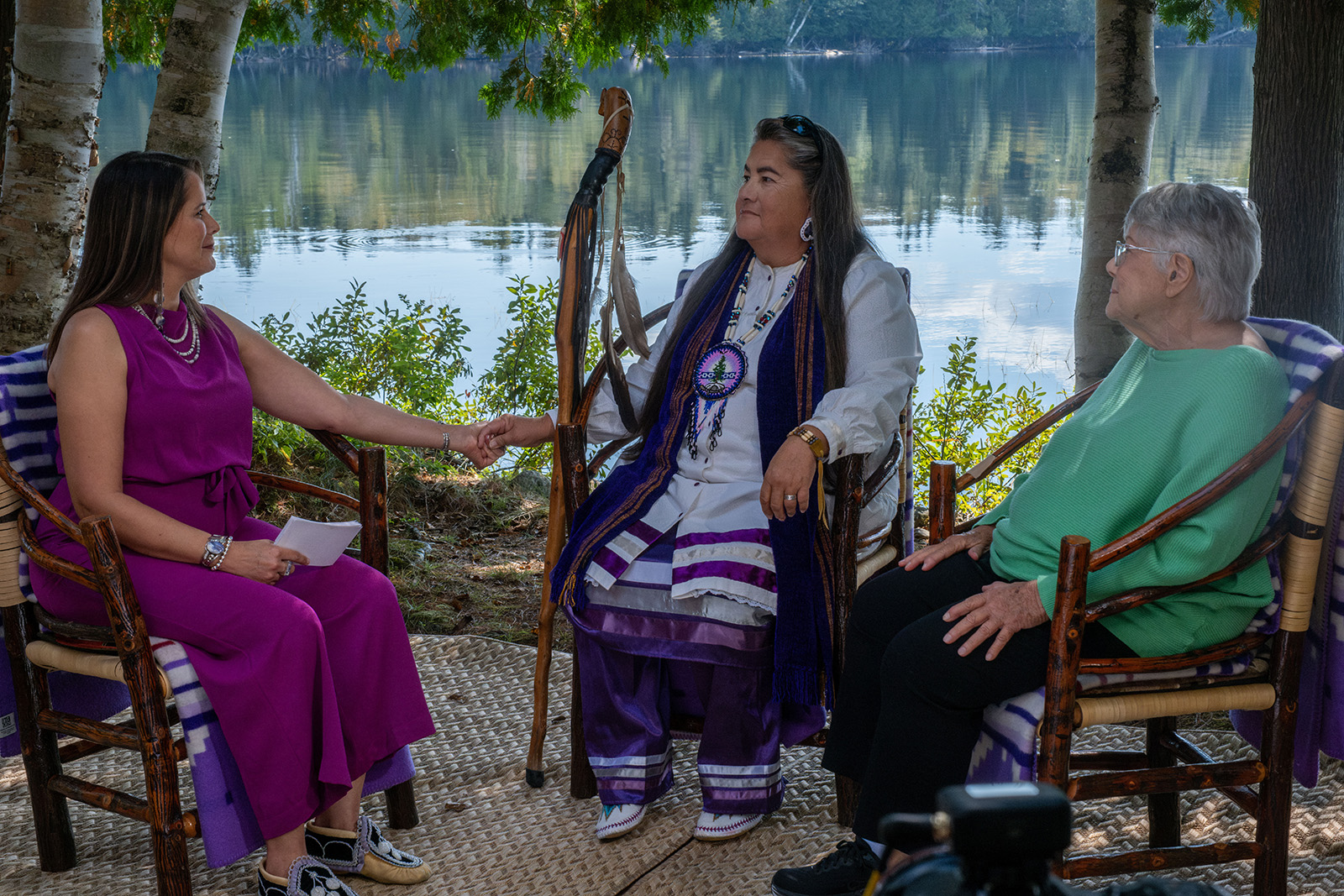
The production brought almost 50 people to Minnowbrook for an intensive filming schedule. The five episodes explore interconnected themes: the Doctrine of Discovery, Indigenous relationships with the living world, Haudenosaunee governance and its influence on American democracy, Indigenous women’s authority and its impact on suffragists, and matrilineal men who stand empowered alongside women leaders.
“The goal is to be able to bring a perspective to viewers and listeners that maybe they haven’t heard before—but one that is relevant, and closely tied to their own experience as citizens in this country,” Schenandoah says.
From Campus Collaboration to National Distribution
Based in the University area, Rematriation regularly works with Syracuse student interns through Newhouse and serves as a client for University courses. Support from Chancellor Kent Syverud’s office made Minnowbrook available for the production.
Since its premiere, “Rematriated Voices” has been picked up by PBS stations in Syracuse, Rochester and Watertown, as well as two national Indigenous radio shows including Native Voice One. The podcast is available on Spotify, Apple Podcasts and YouTube. The series can also be viewed on the Libraries website.
For students like Walker, credits on PBS and other distribution networks provide valuable professional credentials. But perhaps more importantly, the experience expanded their understanding of the Indigenous history and contemporary realities.
“I just think it really opened my eyes,” Walker says. “Now I feel like after that, I’ve gained a lot more insight on the Haudenosaunee people.”