Telling the Stories of War, Sebastian Junger Speaks With Newhouse’s Military Visual Journalism Students
Among some of the most prolific writers of the last century, a handful experienced the hardship of telling the stories of war. John Steinbeck, Martha Gellhorn, Jack London and Ernest Hemingway; all covered the harrowing and dangerous world that exists on the front lines of combat. Award-winning documentary filmmaker, journalist and author Sebastian Junger covered the dangerous frontier environment of Afghanistan’s civil war before the arrival of U.S. forces in late 2001 and embedded with U.S. forces in some of the most remote locations in the war-torn nation afterward.
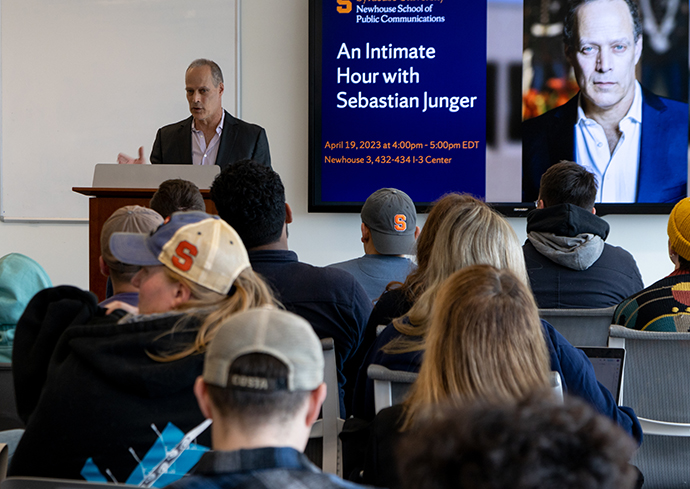
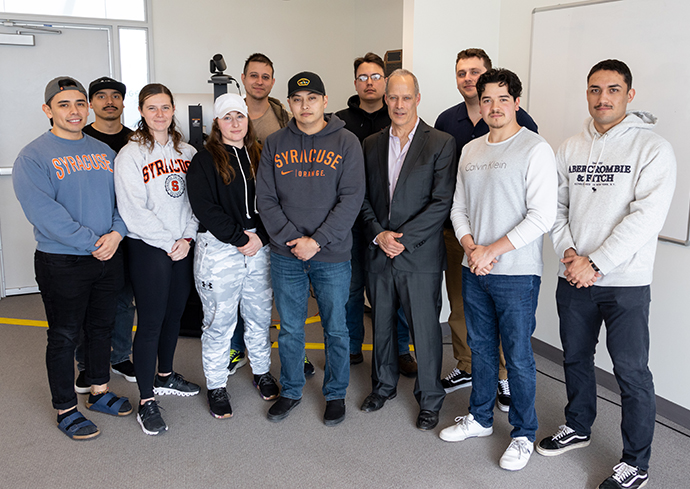
Junger was recently on campus to serve as the guest speaker for the opening reception of “The All-Volunteer Force at 50: Higher Education and America’s Volunteer Military” summit at the National Veterans Resource Center. Prior to the speaking engagement that evening, Junger spent time with the military-connected community on campus during a private event at the S.I. Newhouse School of Public Communications.
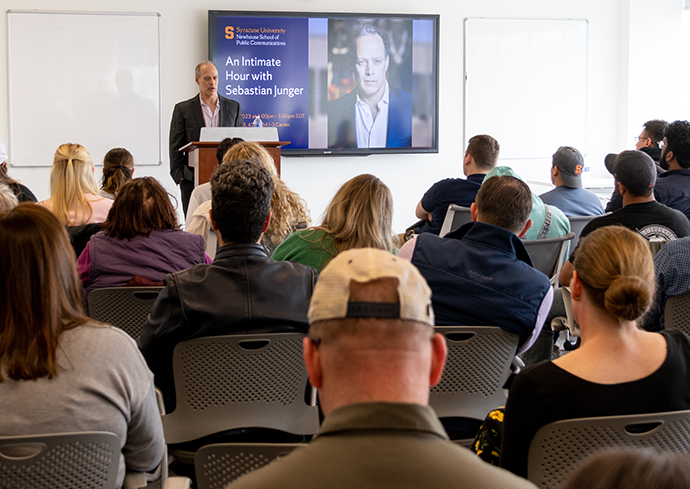
One of the key groups within the audience was students from Newhouse’s Military Visual Journalism (MVJ) program. The 10-month course is restricted to Department of Defense (DoD) mid-career communications professionals who, typically, are among the top performers among their peers. The program’s application is considered highly competitive due to the program’s prestigious history of producing award-winning storytellers within the Department of Defense, and it is not uncommon for the MVJ class to have a few students who, like Junger, have experienced telling the stories from the frontlines of conflict zones.
“The MVJ program takes some of the Department of Defense’s best and brightest communicators and puts them through two intense semesters that build upon their storytelling abilities and hones them into highly effective communicators. When they leave here, they are turning around and using those skills and lessons in a real-world environment that most of us will never experience,” said Nancy Austin, the deputy director of the Military Visual Journalism Program at Newhouse. “They typically receive instruction from professors who have amassed extraordinary experience in the civilian world, so it’s not often they get to learn from those who have done the job from a war zone while they are here.”
Junger reflected on how he hadn’t initially set out to become a war correspondent, his intent had been to simply write about dangerous jobs and the people who did them. His first book, “The Perfect Storm,” was about the tragic loss of a fishing crew from New England, which was later turned into a Hollywood movie with the same name. He would later make his way to Afghanistan to report on the Civil War that ravaged the nation after the 1989 Soviet Union withdrawal. After the terrorist attacks on September 11, 2001, Junger began to shift his focus to the arrival of U.S. forces in Afghanistan.
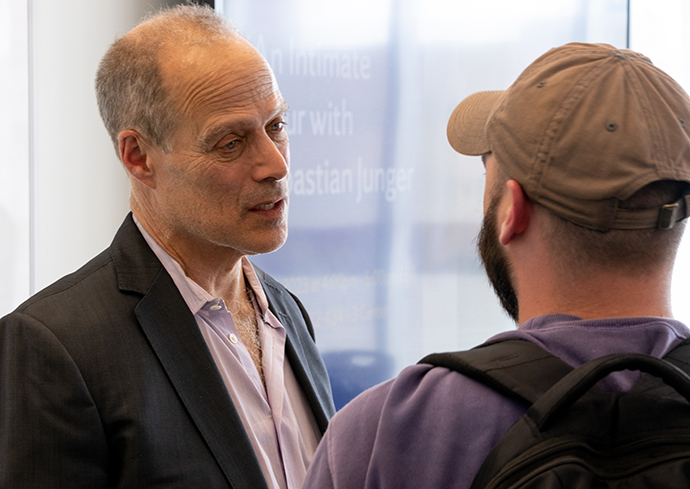
“A lot of militaries in the world, they don’t want journalists near anything they’re doing, they’re completely suppressive with their information. The fact that the U.S. military is mandated to have journalists with them, both military and civilian, is one of the things that makes this democratic country extraordinary,” says Junger.
With some members of the audience having previously experienced combat, Junger touched on some of the hardships that come with reporting on traumatic events in war-torn environments. While the memories of explosions and shootouts fade over the years, according to Junger, the memories of those negatively impacted by the atrocities never lose their grasp.
“What I’ve found is this: I’ve been in danger many times, and those experiences were temporarily upsetting. My reaction to them dissipated over time, but what never dissipated was the trauma of seeing the harm done to others,” Junger says. “There’s something about the human capacity for compassion and empathy, it’s devastating. That stuff has to be covered, but the people who are doing that important work will be traumatized for the rest of their lives.”
Being a war correspondent has obvious risks, the DoD has lost more than 130 communications professionals since World War I. In fact, the first woman Marine Corps officer to be killed in action in Iraq was a public affairs officer, Major Megan McClung, in 2006. The military’s combat correspondents, public affairs officers, photojournalists and combat photographers embed with front-line units to inform combat commanders, as well as the American public, with first-hand accounts of the military’s operations.

Civilian correspondents and journalists on the front lines are not immune from the harm and danger, either. Aside from Junger’s own personal experiences, he spoke briefly about losing fellow photojournalist, and friend, Tim Hetherington. Hetherington co-directed the award-winning documentary “Restrepo,” with Junger, and was later killed in 2011 while covering the Libyan civil war. In 2013, Junger directed the memorial documentary “Which Way is the Front Line From Here? The Life and Death of Tim Hetherington,” to tell the story of a man who lost his life telling stories of, and for, other people.
Newhouse has trained the military’s top communications professionals for almost six decades now. The U.S. Navy, recognizing the need for additional training for their storytellers, established the program in 1963 and the other branches of the military were quick to take advantage of the educational opportunity. Over the years the program has evolved to include specializations in different communications disciplines. A motion media track was added in 1993. Adapting to the changing technology and capabilities with communication today, the school offers a track in graphic design as well as the photojournalism and broadcast journalism track.
For more information on the Military Visual Journalism program, and Syracuse University’s historic commitment to service members, veterans, and their families, please visit the Office of Veteran and Military Affairs.