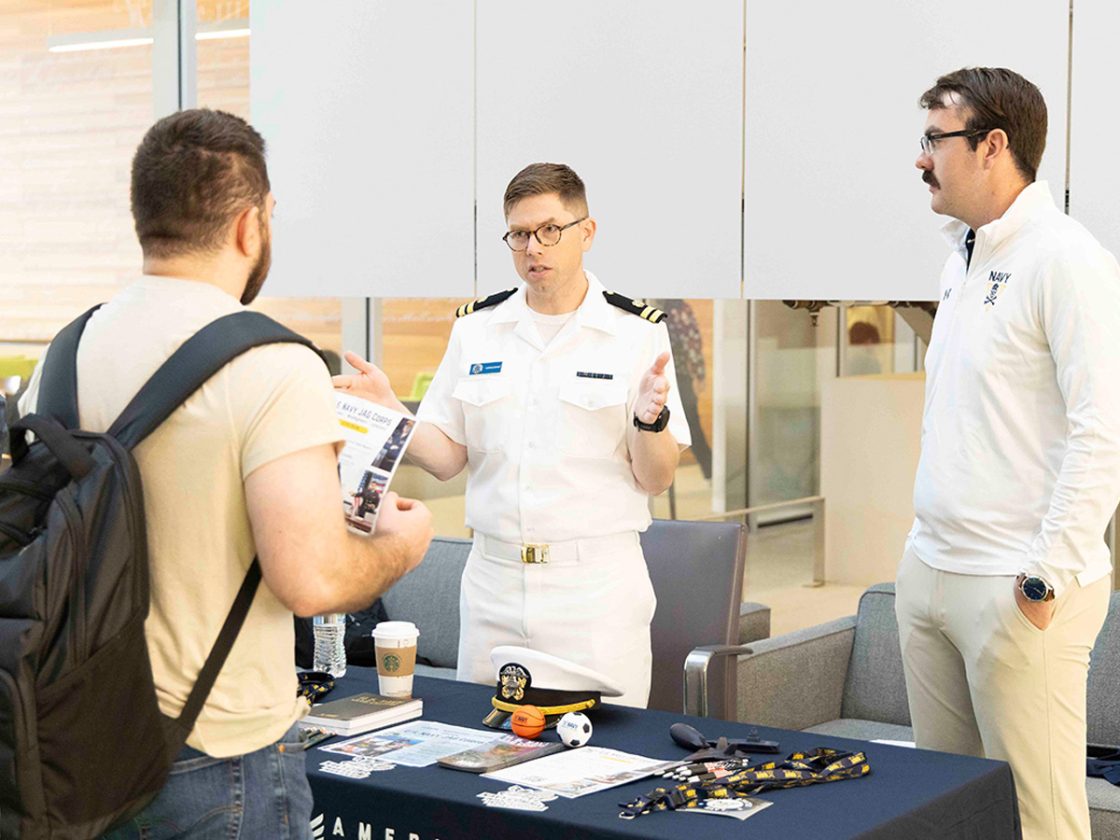
College of Law alumnus Lt. Aaron Ernst speaks with an interested student at the U.S. Navy booth at Multi-Service JAG Day. (Photo by Amelia Beamish)
Multi-Service JAG Day Offers Insight Into Legal Career Options With the Military
Many students at the College of Law picture their legal careers beginning in a courtroom, at a law firm, or with a government agency. But for some, a legal career begins in uniform as a military officer.
For those who pursue a career as judge advocates—military attorneys serving in one of the branches of the U.S. Armed Forces—the practice of law might include advising commanders on complex legal issues, representing service members in need of legal assistance, litigating cases in military courts, or navigating issues at the intersection of law and military operations.
This fall, Syracuse Law coordinated a Multi-Service JAG Day in Dineen Hall, giving students an opportunity to speak first-hand with military legal professionals and recruiters about what it means to serve their country while practicing law.
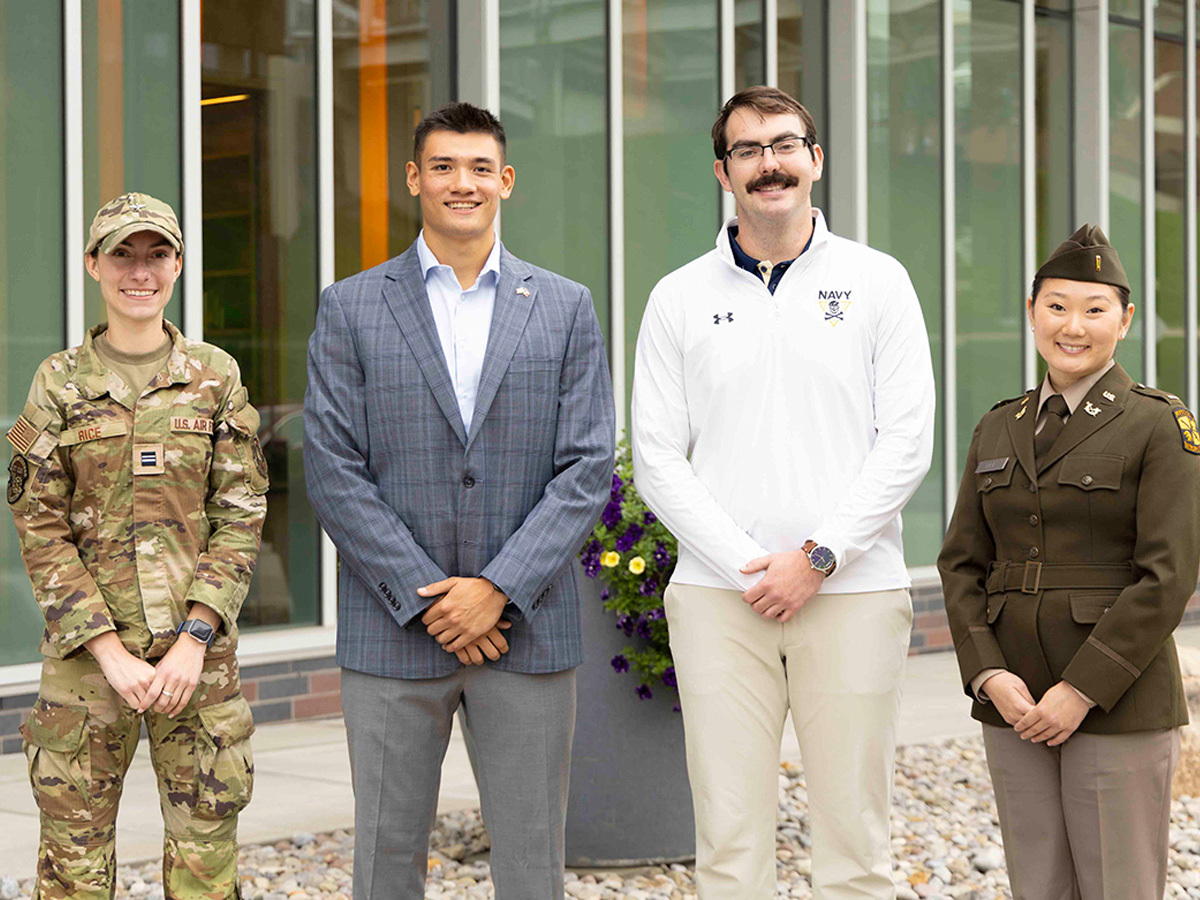
The event also included current students who are future judge advocates headed to the U.S. Army, U.S. Navy, U.S. Air Force and U.S. Marine Corps, a mix that gave the event a wide perspective for those exploring the JAG Corps but unsure which branch to pursue.
“Every year, Syracuse Law has a number of students who are drawn to careers centered on advocacy and pursue those interests through military service as judge advocates,” says Teaching Professor Elizabeth Kubala, a retired U.S. Army lieutenant colonel and military judge who serves as director of Veteran and Military Affairs for the College of Law and director of the Betty and Michael D. Wohl Veterans Legal Clinic. Before entering academia, Kubala served a career in the U.S. Army JAG Corps in a variety of legal and leadership roles.
In response to growing interest, Kubala established Multi-Service JAG Day in 2022 as a more efficient way to bring together recruiters from four of five branches of the military at one time and place. This year’s event was held in partnership with the College’s Office of Career Services with assistance from Marine Veteran Anthony J. Ruscitto L’27, president of the Military and Veterans Law Society. It allowed interested law students, most of whom are 1Ls, to compare the distinctive requirements, commitment and structure that each military branch offers by networking with recruiters, many of whom are Syracuse Law alumni.
“I want to thank Syracuse University College of Law for hosting the Multi-JAG Day. The students who attended had a genuine interest in the JAG Corps and the opportunities it offers,” says Lt. Aaron Ernst* L’24, who is a staff judge advocate in the U.S. Navy.
Students learned about what it means to serve their country while practicing law.
Military Officers First, Lawyers Second
Becoming a judge advocate is competitive, according to Kubala, but students who establish that path while in law school gain a key advantage: a position as a judge advocate is guaranteed once they graduate and pass the bar exam. While some Syracuse Law students who opt for this path are active military, many are inactive reservists or were in the ROTC while undergraduates. Others have no previous military experience at all.
Judge advocates carry the distinction of being military officers first and lawyers second, meaning, after passing the bar, they are given military officer training before judge advocate training. To become a commissioned judge advocate officer, an individual must meet all of the military’s medical and physical fitness requirements, complete basic field and weapons training, and understand military structure, law, leadership and customs.
Judge advocates often work in military or government offices handling court martials, criminal prosecution and defense, military justice, legal assistance for service members and investigations, as well as issues surrounding administrative and employment law, international and operations law, and contracting and government procurement. However, they can be deployed and reassigned, just like any other member of the military. While trained for combat, judge advocates do not typically participate in military missions but are often assigned as legal advisors to unit commanders in the field.
Some newly-commissioned judge advocates begin on active duty, while others opt to serve as reservists or in the National Guard while holding down civilian jobs and part-time judge advocate responsibilities. Length and type of service and other requirements differ between military branches.
Supporting Military Members Through Opportunity
“This year’s Multi-Service JAG Day was especially exciting because we welcomed both students who already know they want to become judge advocates and those who are simply beginning to explore where a career in advocacy and public service might take them,” Kubala says. “For some, that exploration may lead them to discover that military service is exactly the right fit.”
*The opinions and views expressed here belong solely to the individuals quoted, and do not necessarily reflect those of the DoW or its components. Any mention of Syracuse University or Syracuse University College of Law does not imply DoW endorsement.
Story by Caroline Reff