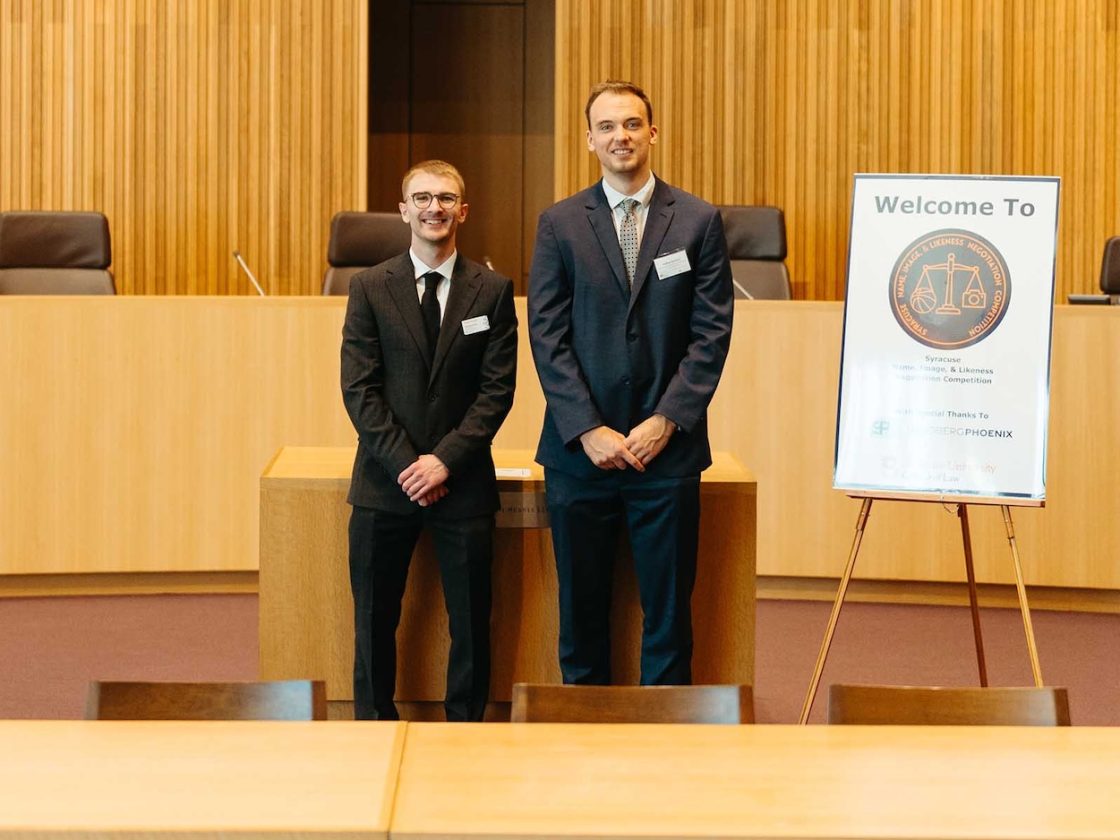
Students Cody Pearson (left) and Will Baldwin (right) organized the inaugural Syracuse Name, Image and Likeness Negotiation Competition (SNILC) and NIL Symposium.
College of Law Hosts New Competition Focusing on NIL
After competing in an intercollegiate competition on professional sports negotiations earlier this year, Cody Pearson L’27 and Will Baldwin L’27 started brainstorming about creating a unique competition at the University’s College of Law that would combine developing advocacy skills and the growing interest in sports law among the student body.
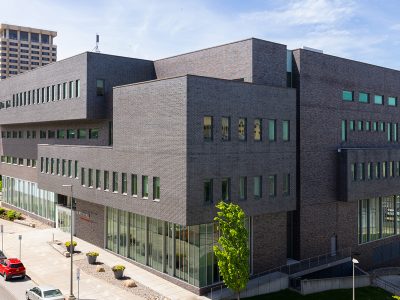
In September, Pearson and Baldwin’s idea came to fruition when law students, alumni and other sports-related professionals gathered in Dineen Hall for the Travis H.D. Lewin Advocacy Honor Society’s inaugural Syracuse Name, Image and Likeness Negotiation Competition (SNILC) and NIL Symposium. Sixteen teams from around the country participated in the competition to hone their contract negotiation, oral advocacy and deal-making skills in the continually evolving area of NIL.
Putting Together a Winning Team
Leading up to the competition, Pearson and Baldwin quickly built a network of faculty, staff and alumni to help them jump start the idea, including Michael Mariani, executive director of Syracuse Law’s Advocacy Program, who helped them craft a formal proposal.
One of their first connections came from a brief meeting the students had two years prior when they met alumnus Daniel Greene L’16 at a tailgate. Fast forward to early 2026, and Pearson and Baldwin passed their idea by Greene, a Syracuse-area attorney and a prominent voice in the NIL space who devotes much of his practice to collegiate and professional sports.
In addition, the two students approached Professor of Practice David Meluni of the University’s Falk College of Sport, who established the first NIL course in sports management in the country; and Professor of Law John Wolohan G’18, a sports lawyer, consultant and author affiliated with both the Law School and Falk.
All three were very supportive of bringing the competition to Syracuse Law.
“We were able to pitch our idea knowing that we already had three exceptionally knowledgeable people willing to help get this competition established,” says Baldwin of the 30-page proposal submitted to Todd Berger, Bond, Schoeneck and King Distinguished Professor of Law and faculty director of Syracuse Law’s Advocacy Programs.
“The students’ energy and enthusiasm were contagious, and I was immediately excited about the idea of a competition that connects important legal advocacy skills with an emerging and dynamic area of the law that is generating increasing interests among our students,” Berger says.
Once Baldwin and Pearson got the green light, they quickly began reaching out to practicing NIL attorneys and professionals to come to Syracuse to judge the competition. Their first major connection was Ben Chase of Sandberg Phoenix, who leads the firm’s NIL, sports and entertainment practice, and was eager to be a judge. In addition, Sandberg Phoenix agreed to sponsor the competition.
Using LinkedIn and firm websites, Baldwin and Pearson were able to identify other potential candidates. There was a lot of interest in the competition, and many said yes, including Ken Knight L’21, a former Division I athlete and founder and CEO of W3 Sports Group; and Sydney Weiskopf of the Lyda Law Firm, who represents athletes, entertainers and businesses in sports and entertainment law, focusing on NIL, NCAA eligibility, IP and general business law.
Ultimately, Chase, Knight, and Weiskopf went on to judge the championship round of the NIL competition.
As each judge was secured, Baldwin and Pearson posted the names on LinkedIn, which resulted in emails and calls from others eager to participate. Ultimately, 17 individuals with ties to sports and the law signed on to judge the competition.
“We thought it might take two or three years to gather the kind of interest and support we got almost immediately,” says Pearson of the enthusiastic response.
Huddling Together to Negotiate a Deal
When the weekend of the competition arrived, 16 two-person teams from 12 law schools across the country, including two teams from Syracuse Law, competed in the SNILC.
“We were pleased with the turnout,” says Pearson. “Most law schools don’t have an attachment to a big athletic program, so the Syracuse brand and its long-standing Division I sports programs held a lot of weight.”
The competition consisted of three parts: preliminary rounds followed by an NIL symposium on Friday and the final rounds on Saturday.
The first day saw student teams negotiating using fact patterns around an athlete and a company looking to close an NIL deal.
“We wrote closed universe fact patterns, so the teams didn’t have to do a lot of outside research but were given as much information as they needed,” says Baldwin, who, along with Pearson and Mariani, wrote all fact patterns for the competition. “It was much more a test of negotiations skills rather than how much you watched ESPN.”
“I was sitting on the edge of my seat hoping my fact patterns were effective, and I was really pleased the competition went as well as it did,” says Pearson.
Judges observed and took notes, never interrupting the interactions and scored each team according to a pre-established rubric on team work, creativity, professionalism, negotiation skills and more. At the end of the first day, the judges chose eight teams to move forward.