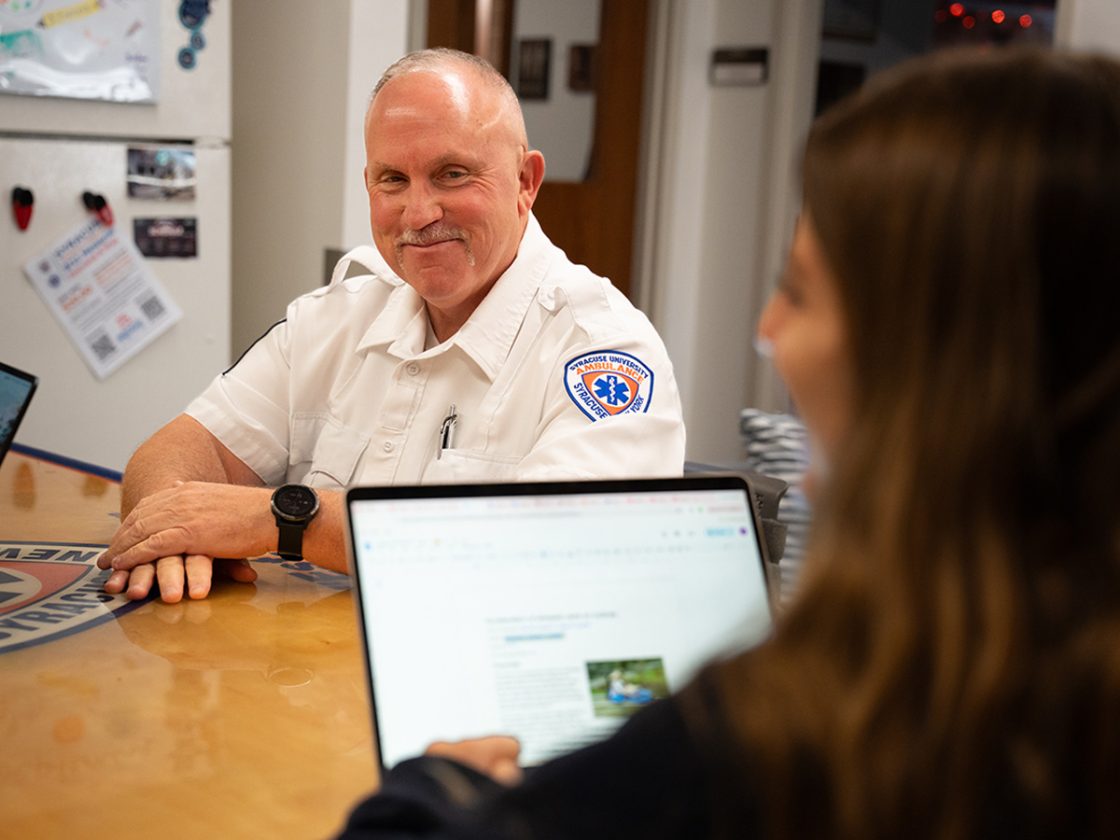
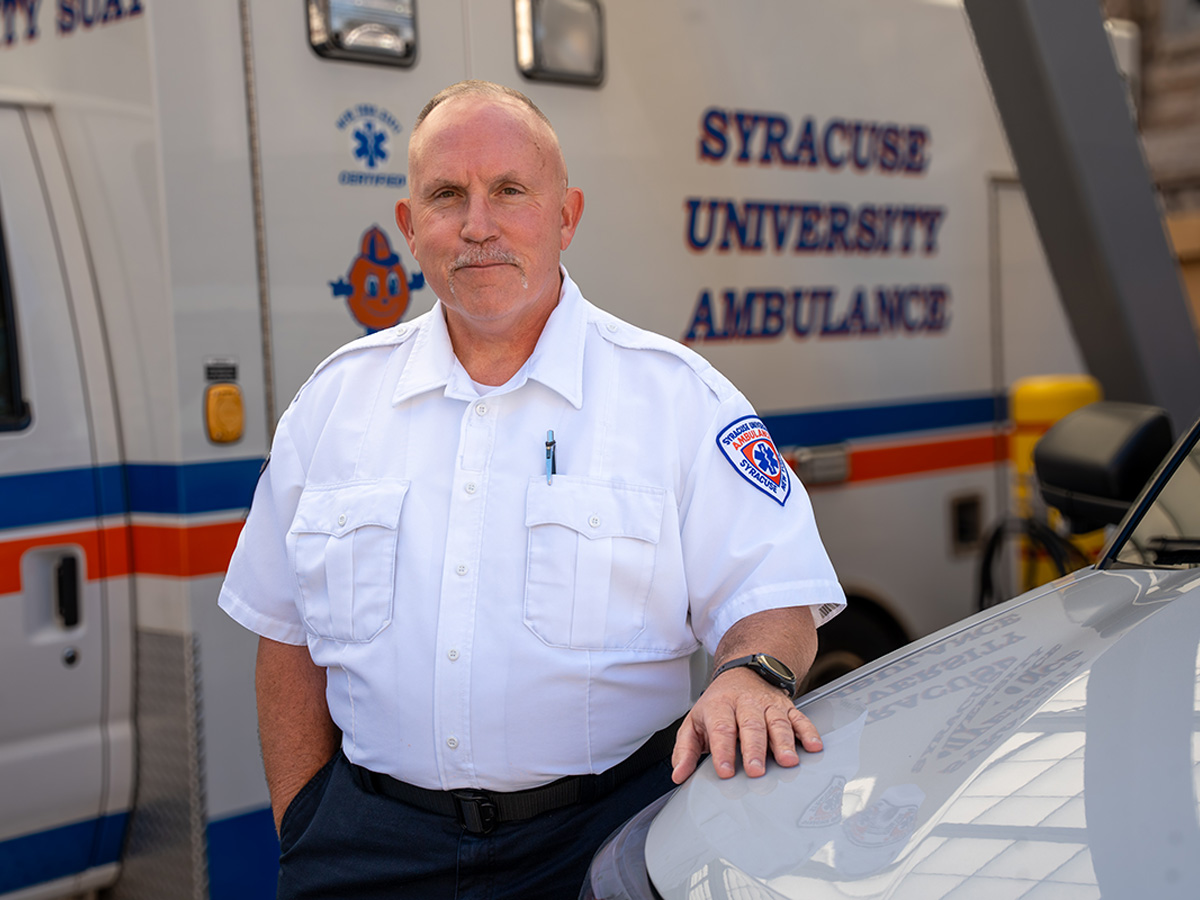
Paul Smyth, the University's manager of emergency services, chats with an SUA member. (Photo by Amy Manley)
A Paramedic Rewrites How Student EMTs Handle Trauma
Paul Smyth has dedicated nearly three decades to answering the call. As a paramedic and manager of emergency medical services for Syracuse University Ambulance (SUA), he has walked into more crises than most people encounter in a lifetime.
Now, Smyth is turning his attention to what happens to first responders after the call ends, and he’s building a program for the student first responders he manages in SUA.
Smyth was recently selected for the New York State Department of Health Division of State Emergency Medical Services Mental Health Fellowship, a yearlong program run in partnership with the Mental Health Association in New York State. He is one of 20 fellows chosen statewide from a pool of 50 to 60 applicants.
Developing Resilience
The fellowship’s central focus is resilience—giving first responders and their leaders the tools to process trauma in healthier ways than simply pushing through it. That mission resonates deeply with Smyth, who has spent 15 years at SUA after a long career with community emergency services agencies. He has learned to compartmentalize difficult calls, he says, but he knows that not everyone can or should have to.
“That complacency will get you,” Smyth says of the pressure first responders face after tragic calls.
His question, increasingly, is what he can do to better support SUA’s student members, both in the moment and long after the sirens fade.
That question carries extra weight on a college campus, where student Emergency Medical Technicians (EMTs) juggle calls alongside classes—and where the calls aren’t always minor. Smyth has responded to cardiac arrests and other traumatic emergencies on campus with students who had never faced anything like it before.
One number from the fellowship’s training has stuck with him: the average person experiences three to four critical incidents in a lifetime, while first responders can face hundreds.
“I’ve seen firsthand how much resilience training matters, both in this line of work and in my military career,” says Joseph Hernon, associate vice president for emergency and environmental risk services. “Paul’s work through this fellowship is exactly the kind of investment we need to be making in our people, giving students tools to process what they see isn’t optional; it’s how we make sure they can sustain this work, in EMS or wherever their careers take them.”
Through the fellowship, Smyth has completed a three-day resiliency officer training modeled on a program developed by the armed forces and later adopted by the Federal Bureau of Investigation. He is now serving as SUA’s resiliency point person, developing a critical incident stress debriefing presentation for weekly training and preparing to administer an anonymous, confidential survey to SUA’s more than 90 members to gauge how well the agency is currently supporting their mental health.
Fostering Coping Strategies
Smyth also draws on the University’s Barnes Center at The Arch, connecting students with counseling services when a call hits especially hard. It’s a resource, he notes, that many community agencies don’t have.
For Smyth, the payoff is measured in the years ahead, not just for the students who stay in EMS, but for those who move into other health care fields after graduation. Giving them coping tools now, he believes, will serve them long after they leave Syracuse.
“The resiliency and tools our students build here don’t stay in the classroom or our EMS agency—they go on to shape how our students handle setbacks, solve problems and adapt long after they’ve crossed the graduation stage,” says Smyth.
Smyth and his counterpart from the Harpers Ferry Ambulance in New York’s Southern Tier, which serves Binghamton University, are the first two collegiate EMS professionals to take part in the program since it launched two years ago.
Other fellowship recipients include first responders from across the state, spanning both EMS and fire services.
The fellowship runs through next June, with additional in-person training, monthly virtual sessions and a statewide survey still ahead.