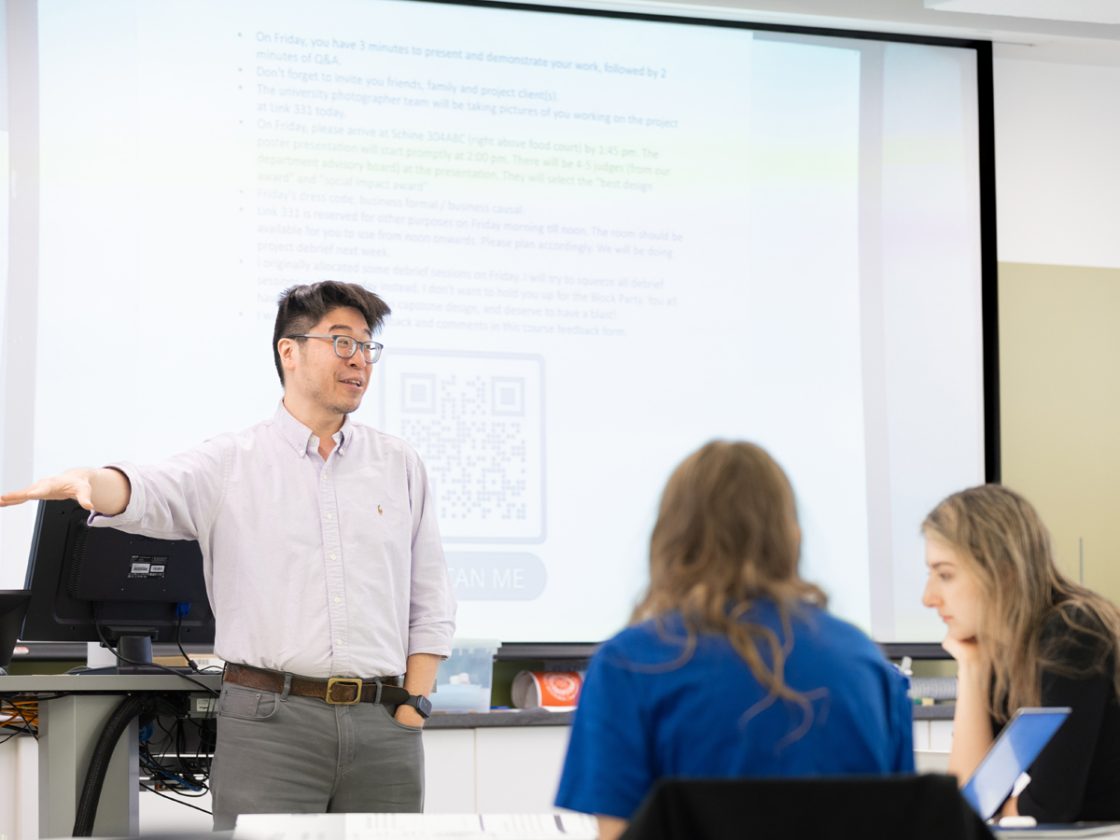
Meredith Professor Faculty Fellow Douglas Yung wants to help faculty and students think more intentionally about when AI supports learning and when it gets in the way.
Teaching and Learning Intentionally in the Age of AI
Pun To (Douglas) Yung, one of three inaugural Meredith Professor Faculty Fellows, spent the 2025-26 academic year developing and testing approaches for thoughtfully incorporating artificial intelligence into teaching, learning and assessment at Syracuse University.
A teaching professor in the College of Engineering and Computer Science, Yung says he was drawn to the topic through a curiosity about emerging technologies, “especially when they are changing quickly and we do not yet fully understand their implications.”
His fellowship combined faculty development, classroom experimentation and scholarship focused on assessment, professional judgment and responsible AI use. We sat down with Yung to learn more about the fellowship and his approach to AI.
I wanted to help faculty and students think more intentionally about when AI supports learning, when it gets in the way, what kinds of reasoning and judgment students still need to develop and what responsibilities they need to retain.
The work centered on three interconnected areas: faculty development, classroom experimentation and longer-term institutional capacity. In my own courses, I redesigned activities and assessments so that students had to verify claims, explain their reasoning, reflect on their use of AI and remain accountable for the final decision.
We need to design assessments that reveal the learning underneath the product. Are students making sound judgments? Can they explain their assumptions, evaluate evidence, compare alternatives and defend a decision?
The biggest pitfall is focusing too heavily on detection. If our main strategy is trying to catch students using AI, we are always reacting to the technology. We may also create mistrust without necessarily improving learning. A stronger approach is to redesign the assessment so that students remain responsible for contextual interpretation, verification, judgment, reflection and a defensible decision.
So, for me, responsible assessment is not about making every assignment “AI-proof,” nor is it about incorporating AI everywhere. It is about protecting the purpose of learning and making deliberate choices about where AI belongs. The goal is for AI to support the work without becoming a shortcut around experimentation, interpretation or professional judgment.
Honestly, no one has all the answers right now. AI is changing too quickly for any one person, or any one discipline, to keep up alone.
That is why faculty-to-faculty learning matters so much. Professors in music, engineering and English may teach very different courses, but they are often wrestling with the same questions: What does real learning look like now? How should we assess it? Where should AI fit?
The most useful conversations are not always about the newest tool. They are about what people are trying, what they are learning from it and what others might adapt to their own teaching.
I acknowledge that the anxiety is real. Faculty are worried about academic integrity, whether their expertise still matters and how they are supposed to keep up with tools that seem to change every week.
I have found that it helps to lower the pressure. Faculty do not need to become AI experts, nor do they need to assume that AI belongs in every course or assignment. What matters is having enough understanding to make intentional choices about where it supports learning and where it does not.
I usually encourage people to start with one real teaching challenge. Take one assignment that no longer feels quite right. Try one activity. Have one honest conversation with students about AI.
If anything, AI makes some aspects of the faculty role even more important. Students may be able to generate an answer quickly, but they still need someone to help them recognize weak evidence, question assumptions, understand context and make responsible decisions.
I hope we develop a culture in which AI is used intentionally where it strengthens education and limits where it distracts from or undermines the learning we are trying to achieve. My goal is for every instructor to feel confident making informed choices about when AI supports learning, when it does not and what students still need to do for themselves.
More broadly, I hope this work helps Syracuse build a culture of reflection, experimentation and shared responsibility. AI will keep changing, but the central questions will remain: Are students thinking critically? Are they acting ethically? Do they know when to question AI, when to challenge it, when to use it and when to rely on their own expertise instead?