Gridwerk is an innovative modular furniture system that can be taken apart and rebuilt as rooms and routines change, so pieces get reused instead of thrown out.
Build Modular Furniture That Grows With Your Space
As homes increasingly double as offices, studios and gathering spaces, furniture must do more than sit still.
Ralf Schneider has been designing for that reality for years. Recognizing the growing need for flexible, customizable spaces, he blended his knowledge of industrial design while improving how spaces function.
The result is Gridwerk, an innovative modular furniture system that can be taken apart and rebuilt as rooms and routines change, so pieces get reused instead of thrown out.
“Most furniture is designed as a fixed, finished object and rarely adapts as our lives and spaces change,” says Schneider, an associate professor of industrial and interaction design in the College of Visual and Performing Arts’ School of Design. “I wanted to design a system rather than a single piece, built on a consistent grid of interchangeable components that people can reconfigure as their needs evolve.”
Schneider has designed a collection of components that owners can reorganize into entirely different furniture configurations to meet their changing needs.

“My vision for Gridwerk was adaptable, long-lasting furniture that respects both the user and the material,” Schneider says. “Gridwerk mattered to me because it brings together what I care about most as a designer and educator: systems thinking, craftsmanship and designing for change rather than disposability.”
Schneider’s sustainable and modular furniture system was recently featured at the emerging talent (Wanted: Launch Pad) portion of the International Contemporary Furniture Fair in New York City.
Schneider sat down with Syracuse University Today to explain the benefits of a modular furniture system and how the principles behind Gridwerk carry over to his industrial and interaction design classes.
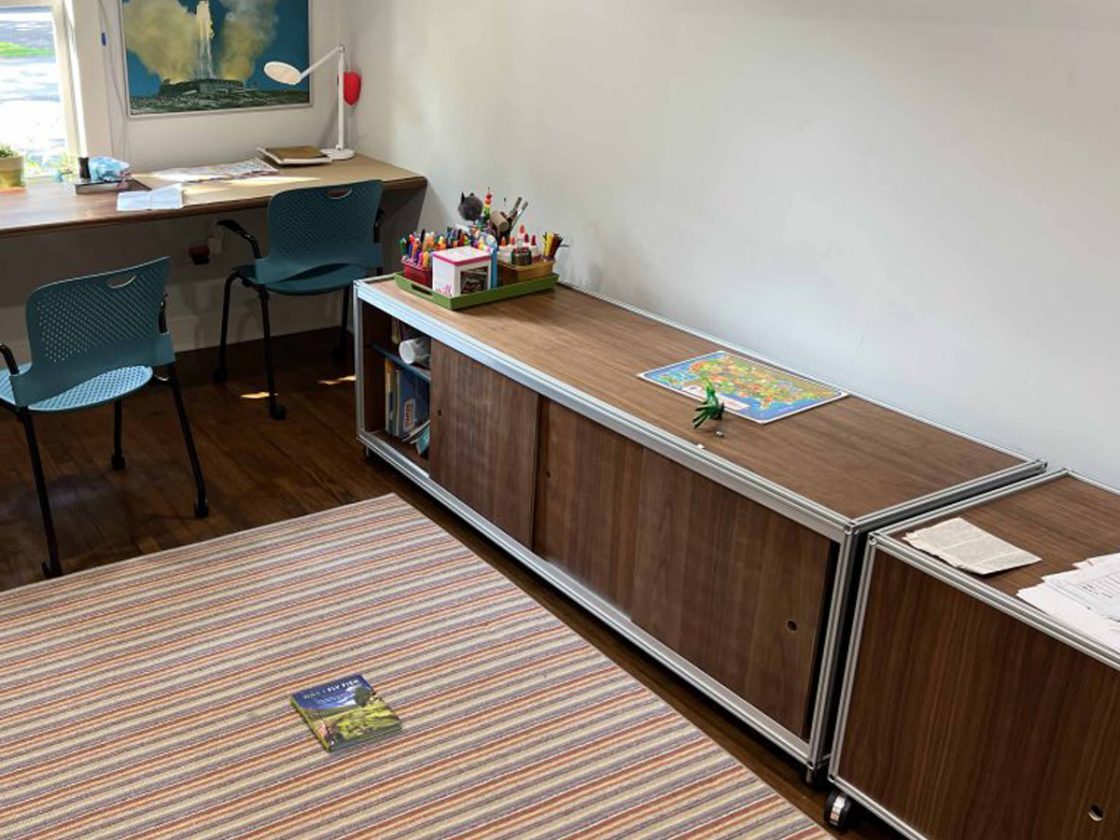
A modular system means the whole is designed before the parts, so every component is dimensioned to work with every other component. What makes Gridwerk distinct is that the grid is not just an assembly trick; it is the design language itself, so the system stays coherent no matter how you scale or rearrange it. All parts are connected with fasteners and form-fitting shapes using no adhesives.

A sideboard with sliding doors
Gridwerk is a family of clean, geometric pieces built from a shared set of standardized parts. Think of it as construction logic you can see: shelving, seating and storage that all speak the same visual and structural language. They can be combined, expanded or reconfigured over time. The frame is made of extruded aluminum profiles, and the surfaces of the cubes are filled with walnut-veneered plywood. Premium hardware adds a satisfying opening and closing experience. The sideboard design utilizes custom 3D-printed hardware for the sliding doors.
People move more often and live in smaller, changing spaces. Interchangeable components let them take furniture with them, adapt it to a new room and add to it over time instead of replacing it. It is flexibility, value and a bit of creative ownership all at once.
Sustainability is built into the logic of the system. Because pieces are modular and repairable, they can be reconfigured or expanded instead of discarded, which extends their life and reduces waste. Thoughtful material choices and efficient, low-waste fabrication reinforce that from the start.

A wall-mounted shelf
The biggest transferable principles are problem solving within systems thinking, designing with constraints and iteration. I also share how I created the Computer-Aided Design file. In the studio, I ask students to consider systems and relationships—not just designing objects—and to treat a shared constraint like the grid as a source of creativity rather than a limitation.
Gridwerk is a live example of that mindset. To expand on the notion of industrial and interaction design, I vibe coded [built quickly using AI tools] an interactive website that allows the user to enter custom Gridwerk dimensions that are then rendered as an interactive object in real time. I connected the idea to my teachings to show how emerging tools, including AI, can support rather than replace disciplined design thinking.