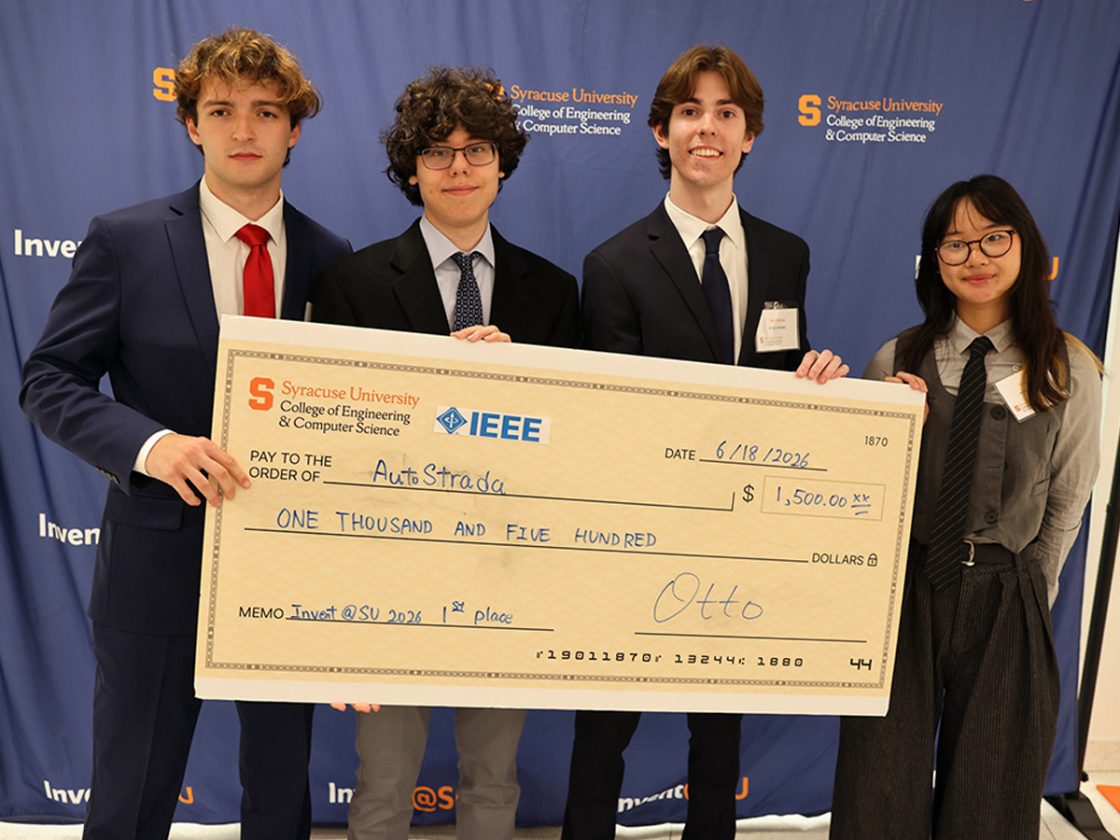
AutoStrada won the $1,500 first prize at Invent@SU for their autonomous traffic control system for one-lane construction zones. (Photo by Alex Dunbar)
Student Inventors Turn Everyday Problems Into Award-Winning Solutions
Bleron Balidemaj ’27, Jack Barna ’27, Heidi Ly ’28 and Josh Malvino ’28 were walking across campus when they saw flaggers at a campus construction project guiding traffic through a construction zone.
Watching the flaggers inspired AutoStrada, an autonomous traffic control system for one-lane construction zones that won the $1,500 first prize at Invent@SU, a program challenging College of Engineering and Computer Science students to solve real-world problems.
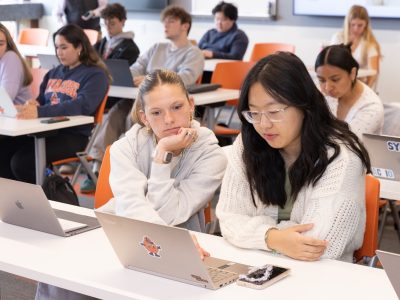
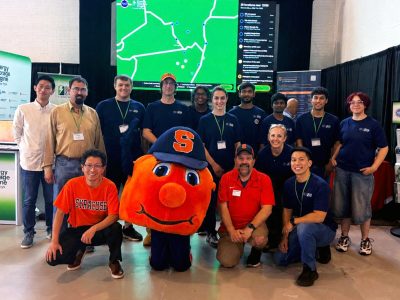
During the six-week program, 31 undergraduate ECS students and one undergraduate from the Martin J. Whitman School of Management refined their prototypes with feedback from guest evaluators before pitching to a panel of entrepreneurs.
A Focus on Safety in Construction Zones
For the inventors of AutoStrada, they say the system will improve safety and traffic flow by using vehicle detection and synchronized STOP/SLOW signs while also reducing the need for human flaggers.
“This technology improves safety, improves infrastructure and reduces costs associated with construction projects,” says Balidemaj, a computer science major.
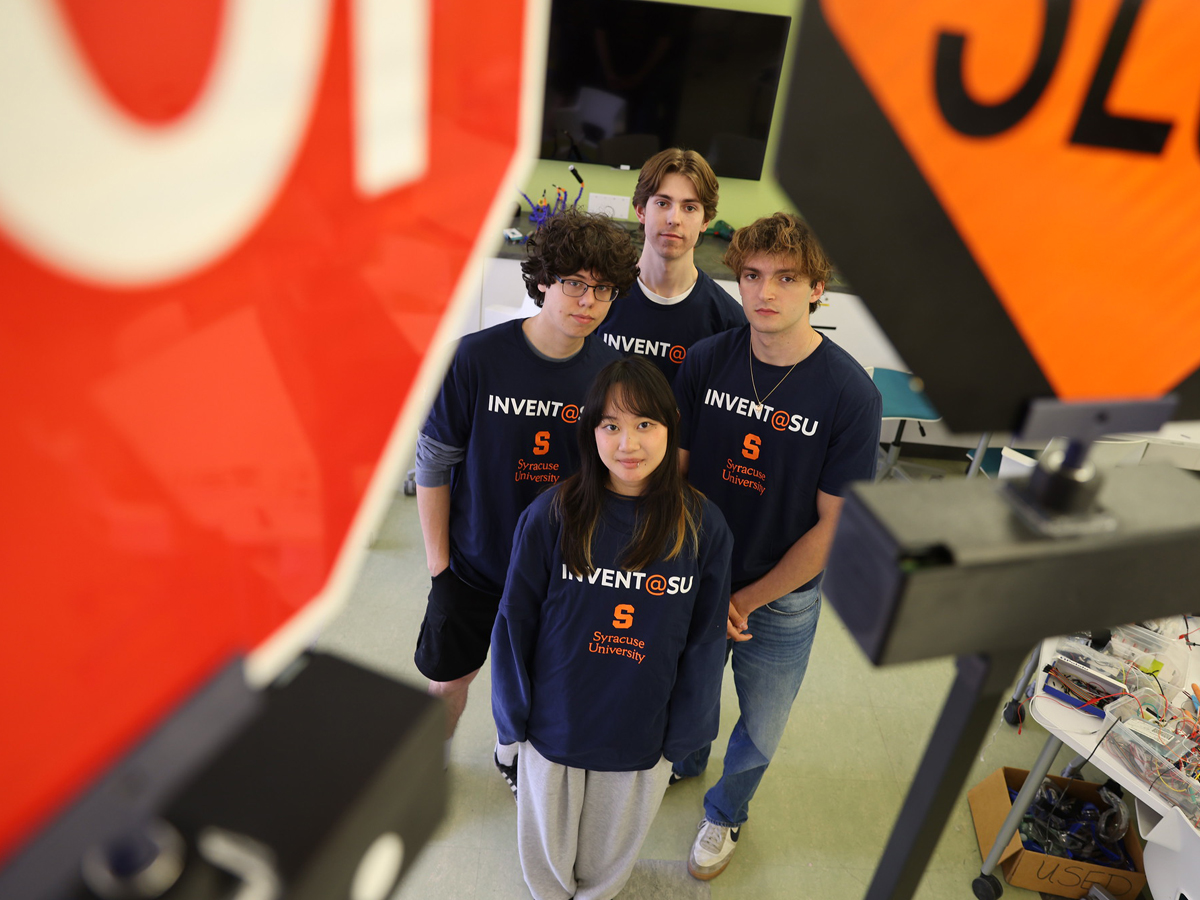
The AutoStrada team spoke with American Flagging, a traffic control company, and the Onondaga County Traffic Safety Advisory Board to gauge how viable their idea would be.
“We received positive feedback. The Onondaga County Traffic Safety Advisory Board is looking to utilize devices like this, and when we learned how big of a problem this issue was in the flagging industry, we knew we were onto something,” says Barna, a mechanical engineering major.
The group tested prototypes on campus roads, and the prototypes can now distinguish an approaching car from a pedestrian or cyclist.
The system works like this: two eight-foot, two-sided signs are set up on either end of a construction zone, each with a computer vision model that detects approaching traffic. As a driver enters the zone, they’re greeted with a SLOW sign. At the other end, a STOP sign holds oncoming cars until traffic has cleared.
“There is a real need for our product. With further development, this has the potential to cover large construction areas,” says Malvino, a computer engineering major.
Personal Frustrations Inspire Blood-Drawing Innovation
Another Invent@SU team found their inspiration from an experience that affected one of their team members, Manueska Fortunato ’28, and 32 million Americans: difficulty with invisible veins while having blood drawn.
Fortunato, Reid Hanson ’29 and Marissa Valencia ’29 devised VeinWarm, a medical warming device that improves vein visibility before blood draws and IV placements. Utilizing a hands-free heating patch, VeinWarm helps reduce needle insertion attempts, making the process faster and less painful for patients.
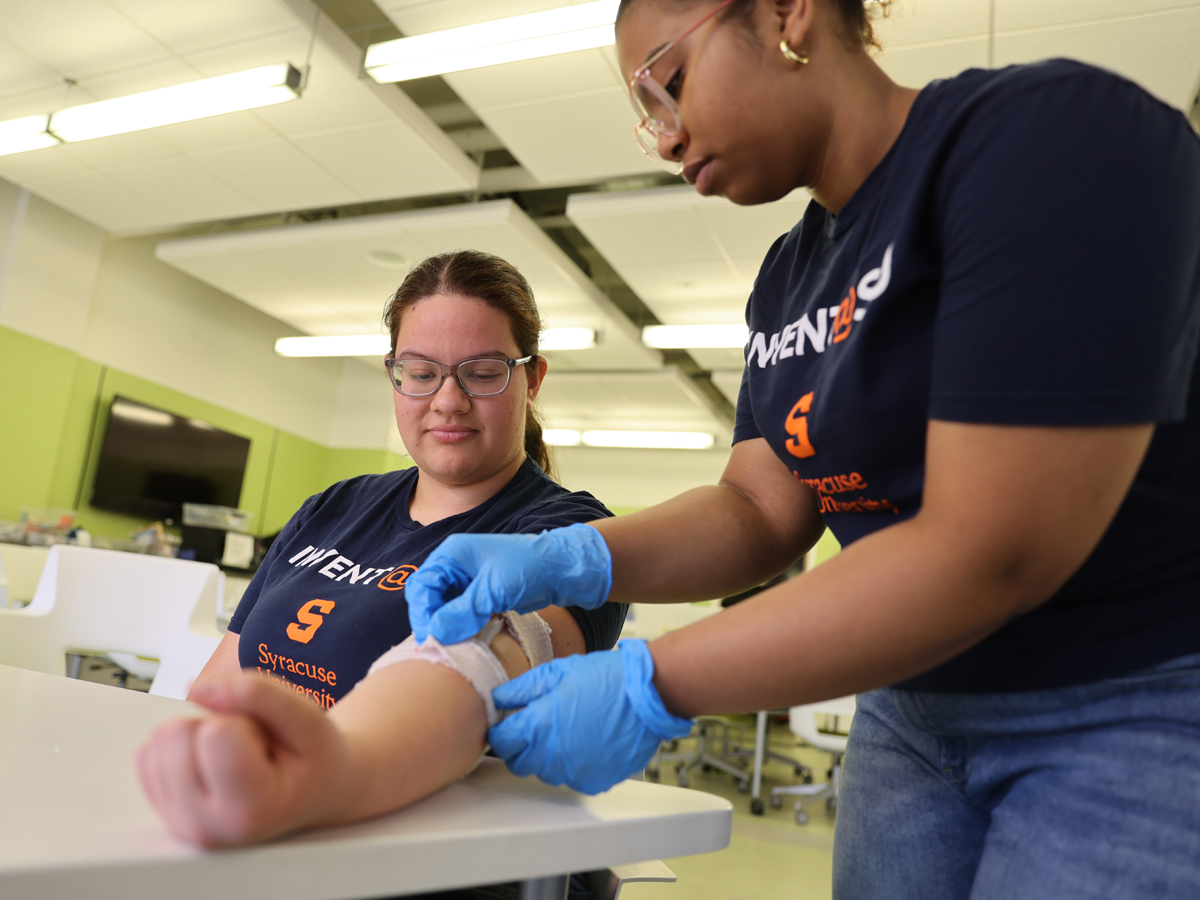
After speaking with nurses, the group learned that 13% of people with visible veins require multiple attempts before blood can be drawn, while 44% of people with invisible veins need multiple attempts.
“We knew from day one that we wanted to create something that benefitted society,” says Fortunato, a chemical engineering major. “Our idea correlated with our interests and focused on something that most of the population can relate to. Nobody wants to be pricked multiple times while having blood drawn.”
The students designed a medical-grade silicone patch with a heat source that increases the blood flow, improving vein visibility, and a center window for drawing blood after the veins appear.
The heating technology is inspired by disposable hand and foot warmers, activated by snapping a metallic disc. But instead of tossing VeinWarm after one use like traditional handwarmers, this invention is reusable, which Valencia says separates it from its primary competition in the marketplace.
“Every second counts for nurses who are trying to get blood drawn as quickly and efficiently as possible and often have a lot of patients they need to see,” says Valencia, a biomedical engineering major.
Hanson says that unlike existing vein-warming patches, which don’t have a buffer layer between the patch and the patient’s skin, VeinWarm heats up faster (an average of 15 to 30 seconds), stays warm longer and makes the veins more visible, giving nurses a better alternative.
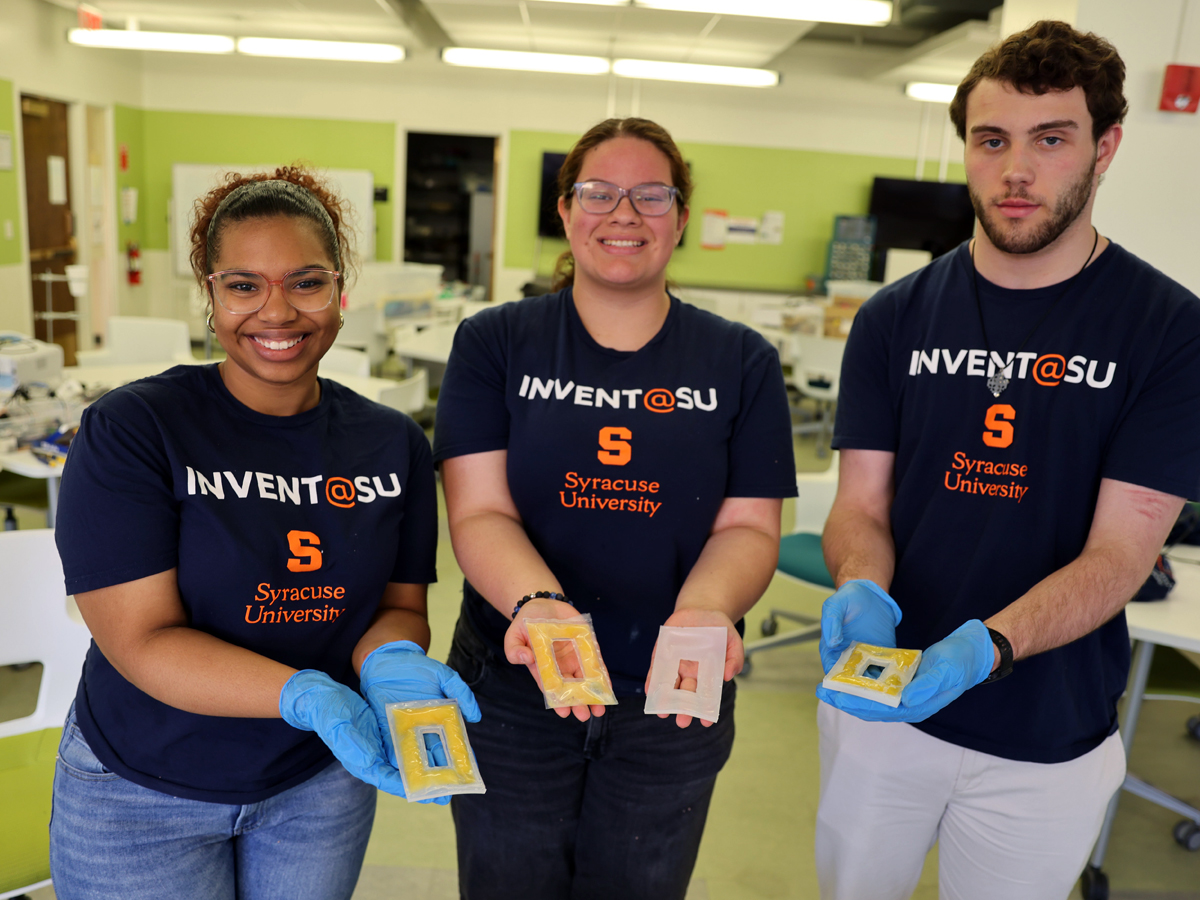
“We ended up creating a product that makes this blood-drawing process easier on nurses while making patients feel more comfortable, which was our ultimate goal,” says Hanson, a mechanical engineering major.
“Being able to develop that first prototype and getting it to work was really rewarding, and it’s surreal to know we can make a difference,” adds Ly, an electrical engineering major.
With Onondaga County officials already expressing interest in AutoStrada, and VeinWarm offering an edge over existing products, both teams plan to keep developing their inventions toward eventually bringing them to market.
Invent@SU returns next summer.